A Spot of Green

The rain falls gently on the parched ground in my yard, plastering the fallen leaves to the driveway. I am like the brittle grass, reaching up to collect each precious drop. Oh, how my yard needed this respite from the drought! Oh, how I did!

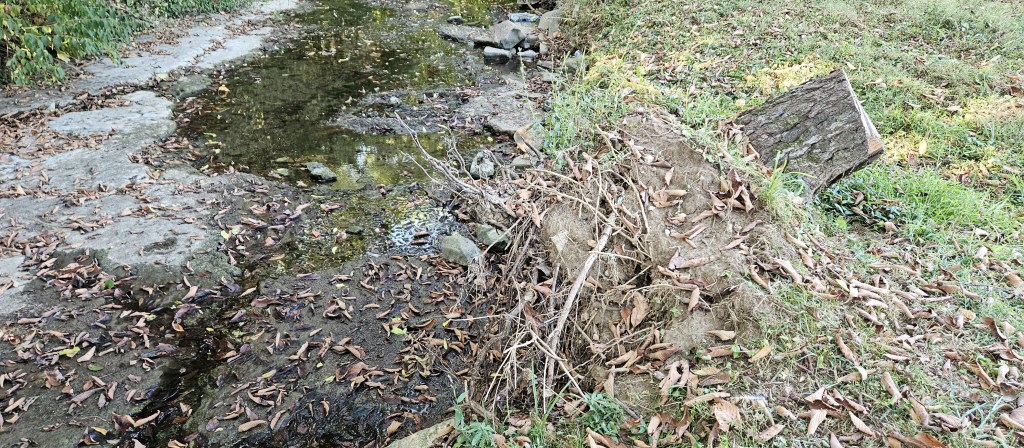
The muck in the creek rinses clear and the dormant eggs lying there burst into life. Little minnows dart around my grandson’s feet as we wade together through two inches of water. Already the grass along the banks is turning green despite the October chill in the air. Amazing how even a little rain can revitalize the world and restore life.

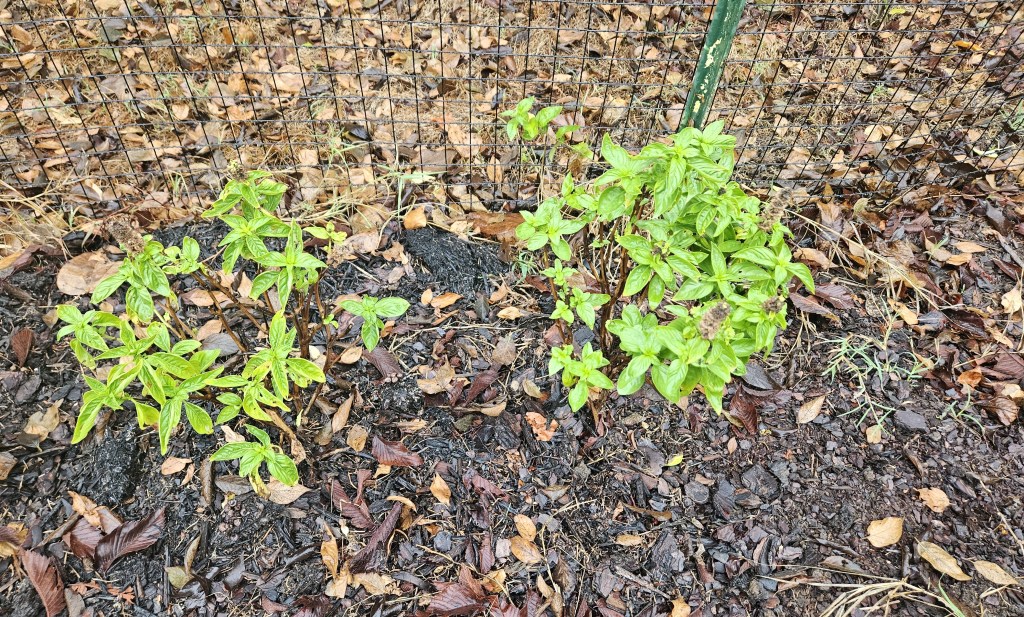
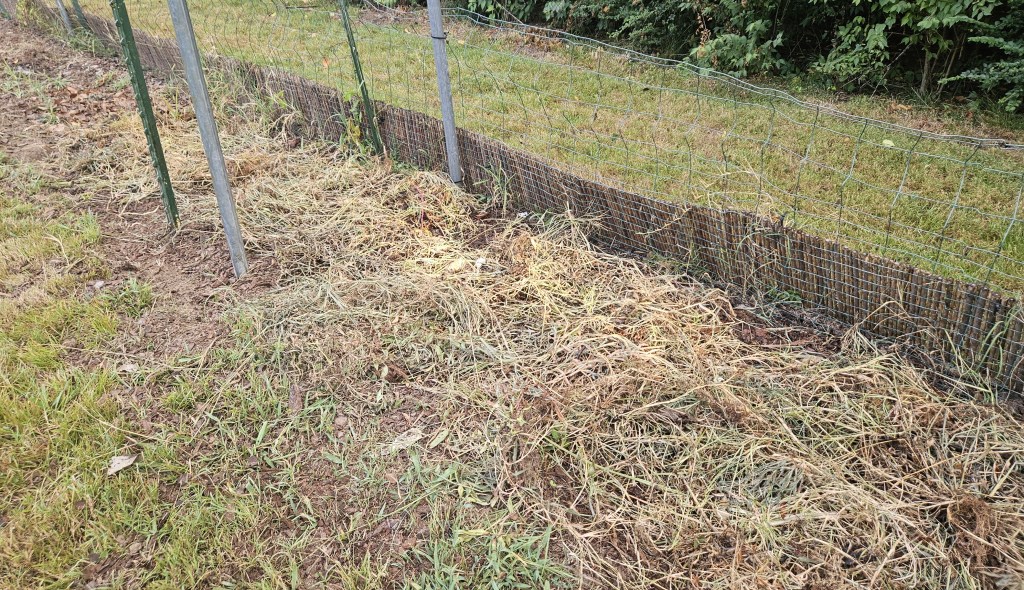
I had put my garden to rest until spring. Pulled down the old fence to begin work on the new one. Pulled up most of my plants. What wasn’t killed by blight was scorched by heat and drained of life by drought. The garden was over for the year. Only laziness had left the basil plants in the ground, brown and leafless.

Or maybe it was a nudge from God that had me leave the basil plants there. Because He is using them to restore my hope and bring my dormant seeds of faith to life.

The basil plants are covered in new green leaves. Bright and fragrant, they stand in contrast to the brown of my garden and my yard. See what God’s life-giving rain can do! See what God’s live-giving love can do.

I have been parched, feeling drained by demands and decisions and lacking the Spirit’s rejuvenating inspiration. This has been a time of soldiering on, preserving in the small tasks, taking tiny bites in faith that one day the elephant will be gone. (How do you eat an elephant? One bite at a time.) My quiet times have been just that – quiet. The grass had withered under the relentless sun and parched air.

As a deep longs for flowing streams, so my soul longs for you, O God. My soul thirsts for God, for the living God. Psalm 42:1-2

I train myself to give thanks for these times, times when my faith is put into action, when my roots can grow deep, when I can prove my perseverance. But what joy and relief when the rain comes!

Life revitalized, dormant ideas brought to life, dreams considered dead showing new signs of life. Each drop of the Spirit’s presence is an answered prayer, a call to life, invigorating, and restorative.

Perhaps we will have colors other than brown before fall morphs into winter. Perhaps I will get to make pesto once more this season. Hope – renewed by a little rain.

Perhaps you too have been feeling the drain of too much heat and too little water. Don’t hide yourself inside when the rain comes. Be like the brittle grass and reach out to catch each drop. Be like the dormant eggs that burst into life. Be like the basil plants bearing new leaves no matter how late in the season it is.

These expressions of life are made even more brilliant by the drab and dying environment around them. This may be your opportunity to show the world what water, the Spirit’s living water, can do.

Always be ready to make your defense to anyone who demands from you an accounting for the hope that it is you. 1 Peter 3:15b.

See what love the Father has given us, that we should be called children of God; and that is what we are. The reason the world does not know us is that it did not know him. 1 John 3:1.

Perhaps this is your opportunity to be the green plant in the brown field.

Love in Christ, Betsy

Sun Rise

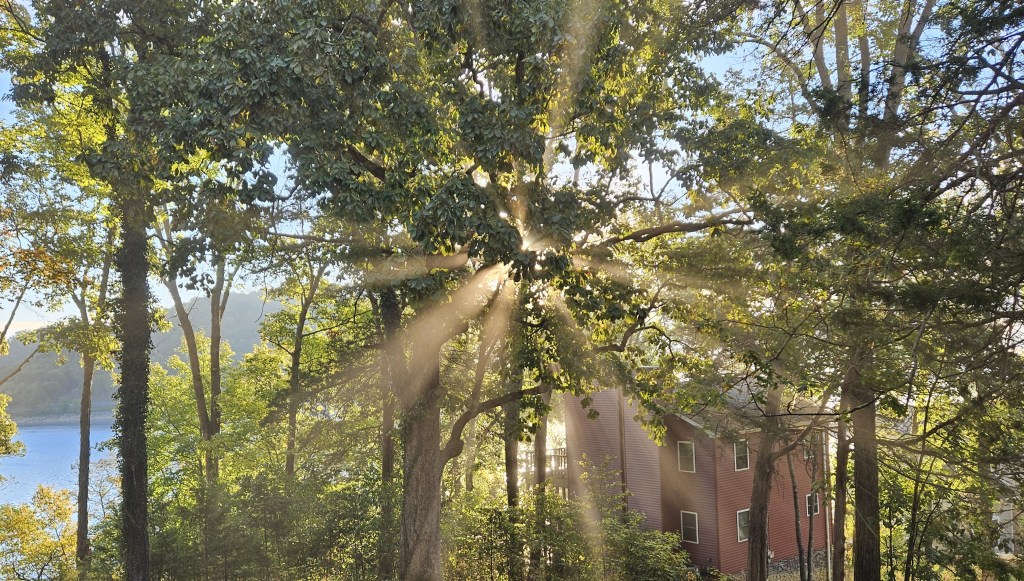
The sun rises through the trees and fills the day with light. The mist on the ground evaporates and the sky brightens to a glorious shade of blue. The sun has risen. Risen indeed!

What a joy to watch the darkness disperse. What a blessing to see leaves that looked gray in the dark slowly become a radiant shade of orange in the sunlight. Look what God is showing us He can do.

The leaves on the tree cannot block the light forever and soon even those will fall. The clouds in the sky cannot dim the sun forever. Soon the light will break forth from behind the clouds and stretch across the sky.

There is no stopping the light of God. There is no hiding the love of Christ.

Again, Jesus spoke to them, saying, “I am the light of the world. Whoever follows me will never walk in darkness but will have the light of life.” John 8:12.

His beauty and His love are everywhere, surrounding us as completely as the light of the sun surrounds us during the day. Often His love is hidden by anger and hate or dulled by clouds of gloom and despair. But He knows us too well and loves us too much to stay hidden forever. And when His presence breaks forth in our lives, what a glorious thing! This is cause for rejoicing!

I have had my moments of darkness, my nights of sorrow and despair and anger. I have nursed the fear that they would continue forever. But God (the two words that change everything), God breaks through with light and hope, with love and joy, just as the sun breaks through the clouds and shines through the leaves that would hide it. He relieves me of the burden of my sinfulness; He dispels the gloom of a fallen world; He shows me a better way.

I have experienced it myself and seen it in the lives of others. Deep in darkness, the light bursts through. We see where we have been wrong, where we have hurt others and ourselves, where we have not acted in love. God burns it all away in his light and shows us a path of love instead. And when we turn to follow Him, I think all heaven rejoices just as I rejoice.

And when he comes home, he calls together his friends and neighbors, saying to them, “Rejoice with me for I have found my sheep that was lost.” Just so, I tell you, there will be more joy in heaven over one sinner who repents than over ninety-nine righteous persons who need no repentance. Luke 15:6-7.

I face the rising sun and let it warm my skin as it dispels the darkness. It’s a new day, the day the Lord has made. No matter how cold and dark the night was, I will rejoice in this day and be glad in it. The sun has risen and a glorious day awaits.

Christ is risen; He is risen indeed!

Now is the Time

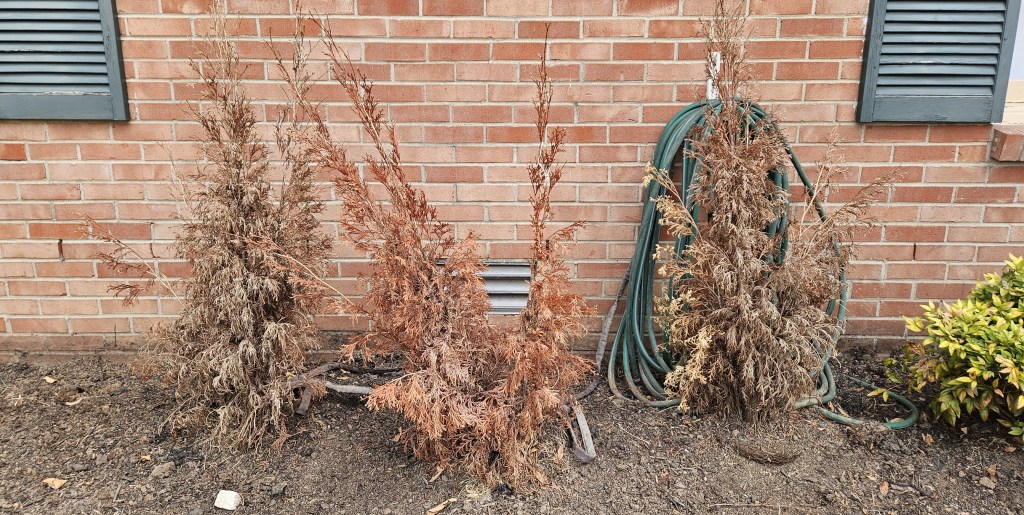
The January ice storm had killed my previous arborvitae, which had grown too tall for my front garden anyway. These were planted in late spring, which seemed like a good time to plant new ones, and there was an abundance of them at the garden store. Apparently, though, late spring is not the best time to plant arborvitae; early fall is.

Like planting garlic in the late fall, the idea of planting trees in the fall feels a little unwise. Aren’t we headed into winter when things die? According to experts, though, it is the shock of warmer temperatures which threaten the plant. In duress, early spring is okay, but my poor new plants had faced drought and extreme temperatures and had not survived.

Now is the time to replace my dead arborvitae with new ones. The preferred window for planting is short and almost over. The time to plant is now.

It’s got me thinking about other things that seem to have time constraints on them. I remember the Israelites who missed their first opportunity to enter the promised land. I remember Esther who waited for the second dinner to make her request, not even knowing how God was preparing the king’s heart and mind. These stories remind me that timing matters, and we need to follow God’s timing, not our own.

Trust in the Lord with all your heart, and do not rely on your own insight. In all your ways acknowledge him, and he will make straight your paths. Proverbs 3:5-6.

I had an old family piano in need of repair that I decided to get rid of. For some reason, I couldn’t pull the trigger; I couldn’t let go. For a year, I looked at that piano and felt, ‘not today.’ Then one morning, it was time. I put an ad online and got an immediate response. A small church had voted the night before to allocate exactly the amount it would take to get my piano in working order. God’s timing. They came and picked it up that afternoon.

Sometimes we need to act at once. Sometimes we need to wait. God knows when the time is right and if we stay in connection with Him, He will let us know as well. It’s scary. I don’t want to miss an opportunity; I don’t want to mess it up by acting too quickly. My own knowledge is so limited.

Fortunately, God has sent us the Holy Spirit to guide our steps, a good shepherd to lead His sheep. Often, He gives us second chances, and sometimes third and fourth chances! I can replant my arborvitae. It took forty years, but the Israelites did enter the promised land.

I can imagine few things worse than spending eternity realizing I had missed my opportunity to get to know God. We have so much to be thankful for on this earth, so much beauty, so many relationships. God wants to connect with us and gives us many opportunities to get to know Him. I don’t want to miss a one. I don’t want to have any regrets that I acted too quickly or too slowly. That’s probably an unreasonable expectation, but I will not miss the opportunity to follow Him today.

For he says, “At an acceptable time I have listened to you, and on a day of salvation I have helped you.” See, now is the acceptable time, see now is the day of salvation! 2 Corinthians 6:2.

My landscapers are here with my new arborvitae. Now is the time.

Love in Christ, Betsy

Armchair Quarterback

It’s football time!

Beyond watching the game, many of us also coach the players from our dens. Throw the ball! Run! Go for it! As if we know more about the situation then those athletes and coaches who have played and studied the game for years. As if we were physically or mentally capable of doing what they are doing. As if we were willing to dedicate that much of our life to this game. Because let’s face it, I am not. I do not have the skill set or raw talent they have. I have not spent hours on training and physical conditioning. I have not learned the nuances of my teammates or my opponents. I don’t know all the different options available and what determines which plays are carried out when. I have not immersed myself in strategy and analytics. So, what qualifies me to criticize these players and coaches who have?

And if that is true in football, it has become a national obsession with politics. I am completely unqualified and incapable of running for President, being elected President, or governing as President. My guess is that that is true for you as well. And yet, without being to understand the complexities of the job, we routinely criticize whoever holds that position. As if we could do a better job. As if meeting my expectations of leadership were the President’s objective, as if he should value my opinions at all. What hubris!

I fear we do this with God as well sometimes. We question His motives, His presence, His sovereignty. We think He doesn’t love us when we don’t get our way. We stomp our feet like an indignant three-year-old and scream. And when we have finished with our fit, God answers.

Where were you when I laid the foundations of the earth? Tell me, if you have understanding. Who determined its measurements – surely you know! Or who stretched the line upon it? On what were its bases sunk, or who laid its cornerstone when the morning stars sang together and all the heavenly beings shouted for joy? Job 38:4-7.

That is not to say that we should stop asking questions, stop trying to learn more. If we care about football, we should learn the rules, the strategies, and the physical demands of the game. If nothing else, it helps us realize how difficult their job really is. Asking questions and learning the answer may help us understand why the players we were yelling at from our couches did not throw or run or go for it.

And we certainly should care about how our leaders govern us. If there are issues that are important to us, we should be all means get involved in advocating for those issues, whatever they may be. But for the past fifty years, we have made a pastime of hating our President. No matter what our President is doing, we criticize his decisions and how they are made. As if we could do better.

And we should certainly bring our questions to God. We should study and read and learn and pray and worship and stomp our feet occasionally. From Abraham to Nicodemus, God welcomes our questions, our arguments, our wrestling. He wants us to ask because He wants us to get to know Him better.

And this is eternal life, that they may know you, the only true God, and Jesus Christ whom you have sent. John 17:3.

Sometimes a question is criticism and sometimes it is a pathway to deeper understanding. Let’s stop asking questions like we already know the right answer. Let’s admit that we are not trained athletes or successful politicians. Let’s admit that we are not God and resist the urge to criticize Him. Instead, let us bring all things to Him in prayer.

Love in Christ, Betsy

Roots

A few years ago, a best-selling Christian author told a story about a tree that had fallen in her yard.

She had installed an underground irrigation system to keep her grass and trees alive. It worked, but the system had encouraged the tree to send its roots out laterally through out the yard just under the water source. While the tree’s shallow roots brought ample water, when the storm came, the tree was unable to stay standing. Its roots were too shallow. To stay upright, the tree needed to develop deeper roots.

The speaker left the story there. We need to develop deeper roots to withstand the storms that life will certainly bring.

The story has stayed with me. What I keep returning to is what caused the tree to have shallow roots. The tree was doomed because it had never been forced to develop deep roots. It did not have to work for the water. There were no dry spells to encourage the roots to dig deep into the ground for hidden aquafers.

The woman meant well watering her yard. We all mean well when we make life easier for others. We care about our plants, our pets, our family, our friends, and even the wildlife around us.

But there is growing research that what we think is helpful may be harmful. Feeding wildlife can hinder their ability to forage naturally (Don’t feed the wildlife!). There is growing evidence that protecting our young children from failure and heartache limits their ability to manage those situations as adults (Let your children fail). And making water too easily accessible for our trees may prevent them from growing deeper roots.

Could this be true in our faith as well?

A woman once told me that she had been skipping going to her big screen church because she just didn’t feel happy enough to sing all that praise music and lift her hands. I wanted to ask her what being happy had to do with worshiping God, but instead I encouraged her to read the psalms.

I am weary with my moaning; every night I flood my bed with tears; I drench my couch with my weeping. Psalm 6:6.

Just maybe it is precisely the times of pain and thirst that encourage us to develop deeper roots of faith.

Can we believe in a God who lets thousands die in flooding? Who lets a child be abused? Can we worship a God who shatters our happy life? How will we know if our life is always easy and successful and well-watered?

When the storms of life come, and they do come, I want my roots to reach deep to find the hidden joys of a relationship with God. There is everlasting water there. It may not be easy water. It probably won’t be easy water. It may not contain the laughter of the water park, but it will bring peace and strength and faith.

Jesus said to her, “Everyone who drinks of this water will be thirsty again, but those who drink of the water that I will give them will never be thirsty. The water that I will give will become in them a spring of water gushing up to eternal life.” John 4:13-14.

Today, I will praise God for those days when He has led me develop deeper roots of faith. I thank Him for those days of drought and heat, of tears and sadness, of doubts and fears that have led me to dig deep and find His eternal water.

Would it be wrong to wish the same for you?

Love in Christ, Betsy

Change

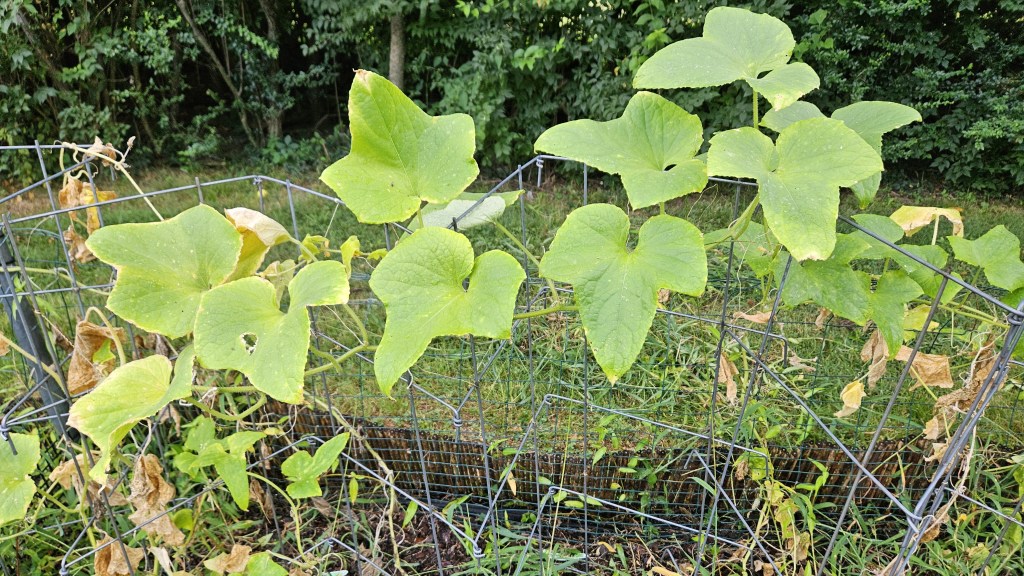
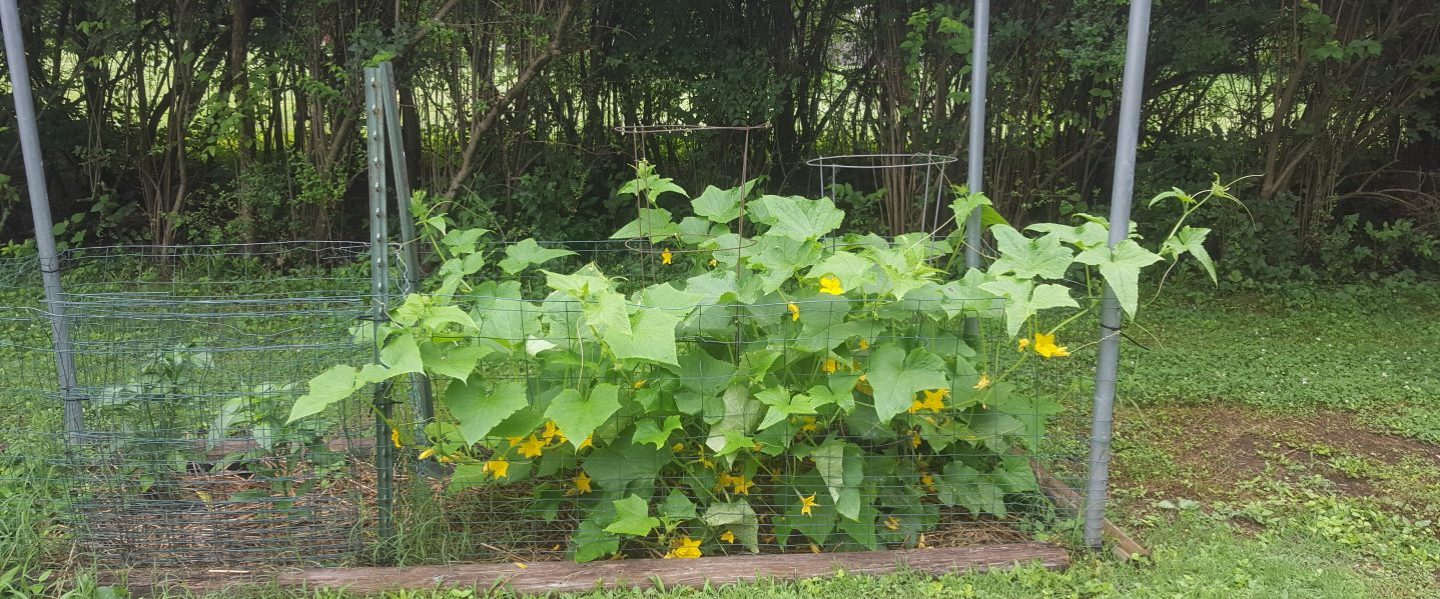
The cucumber plants have died. The pepper plants are dying. It’s time to call the summer garden done and begin preparations for fall.

Change is never easy. The end of something you loved, successful or not, is a loss. The days are over when I can fix or improve this year’s harvest. It was what it was and now I must move on.

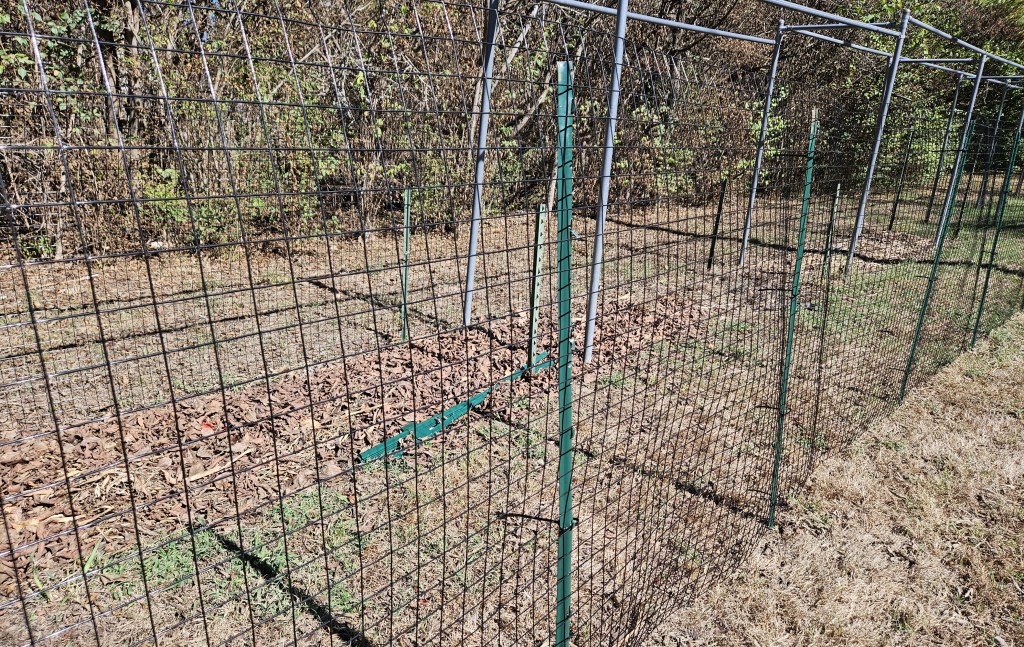
This year, that moving on involves work. My fence is broken down and torn apart in places. My soil is diseased and in need of restoration. My body tells me to stop bending over the fence to harvest and develop a means of easier access. So, I have called in my garden helpers, and we will slowly reconfigure the garden. It is too much to do in a day. And I have at best one morning a week to give to my garden. And I have some time before I need to plant again, so I am in no hurry.

This seems to be the way most change happens, slowly, over time, a little bit at a time. Not all change is good, but not all change is bad either. This tearing down of my garden feels destructive. I’m ripping up dead plants, pulling out supporting cages, and tearing down protective fences. This can’t be good, right?

Now I will tell you what I will do to my vineyard. I will remove its hedge, and it shall be devoured. I will break down its wall, and it shall be trampled down. Isaiah 5:5.

But the garden is such a glimpse of a larger reality. I know that all this destruction will enable my garden to produce more and better fruit in the future. I know that this destruction is not permanent. Like re-breaking a bone before you can set it properly, sometimes things have to get worse before they can get better.

We know it’s true, but it’s hard to see when our lives are being ripped up, our support pulled away, and our defenses destroyed. It just feels like destructive change. It feels like judgment.

Perhaps it is judgement, in the sense that I know my garden can produce better fruit than it did this past year. This year’s harvest was fine. I loved the few tomatoes I got, the random cucumbers, the scanty basil leaves, but I know the space has produced better in the past. If I want it to produce better in the future, some destruction needs to happen.

Perhaps God knows that you are capable of oh-so-much more than you are producing right now. Not that what you are giving to the world right now is bad or unappreciated, just that God wants your life to be abundant and your garden to be fruitful.

I am the vine, and my Father is the vinegrower. He removes every branch in me that bears no fruit. Every branch that bears fruit, he prunes to make it bear more fruit. John 15:1-2.

The problem, of course, is that the promised benefit is in the future. Right now, all we sense is destruction and judgment.

If, however, our desired goal is a closer relationship with God and if difficulties, change, and disruptions deepen and strengthen that relationship, then we can see them as pruning, as ensuring an abundant future. If our desire goal is a comfortable, easy life, we will not see the beauty in overturning the garden.

The transformation of my garden will take a while. I hope you will continue to join me by reading along. I can’t promise it will be pretty, but I am confident that God will bring something good out of all of it.

Love in Christ, Betsy

Just Enough

I am new to growing figs, but I was encouraged to grow them by the baskets full of figs that friends have shared in the past. Too much to eat, too much to process, too much to share. For some reason, that has not been my experience.

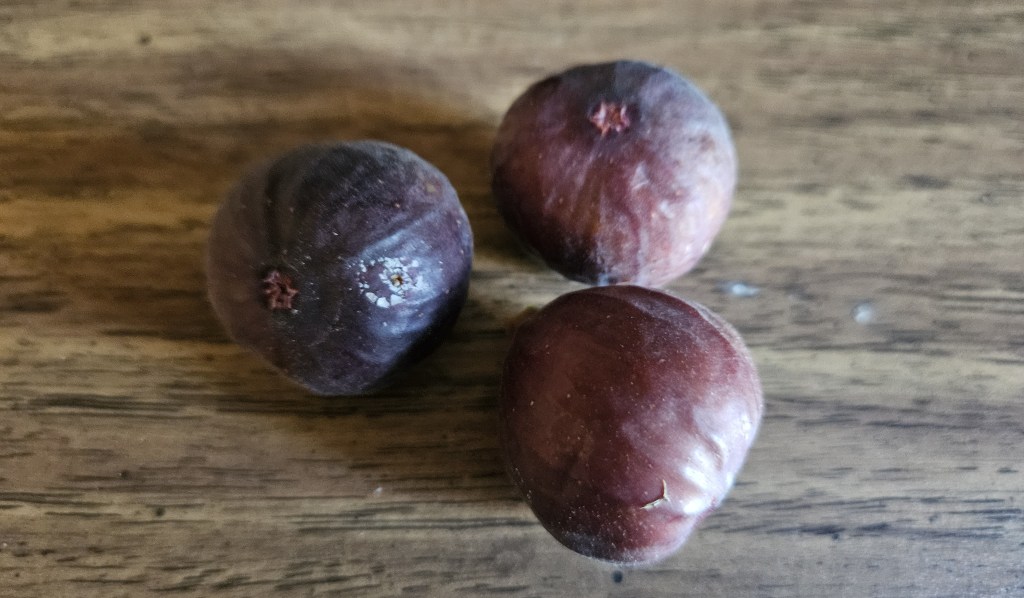
My tree is producing figs and they are delicious! Sweet and pithy, they dissolve in my mouth, and I love having them available. But they ripen one at a time every few days. So, if I share a ripe fig with you, it is the one and only ripe fig I have that day. Tomorrow I may have another one, but if I don’t eat it soon, it will become overripe.

As grateful as I am for each and every fig, I also feel a little, well, disappointed. I don’t want to share the few I have and yet I would like to have enough to share them with others, let others share my joy, perhaps brag a little. And there’s the rub. I want a big harvest partially so you will be impressed by my big harvest.

See how God has blessed me! Oh, yes. God definitely gets the credit. I can not make a single fig appear, or a tomato or a cucumber or even a basil leaf. But there is still pride in showing off how much God has blessed my gardening efforts, and some embarrassment when those blessings seem a little scarce and far apart.

Am I now seeking human approval or God’s approval? Or am I trying to please people? If I were still pleasing people, I would not be a servant of Christ. Galatians 1:10.

Sometimes, God seems to give to us abundantly and sometimes only just what we need for today. And it is tempting to think that this has something to do with us, with our efforts and attitudes, with our righteous living or poor decision making. But it could have more to do with God than with us.

Perhaps he gives us abundance so that we can share, just enough so that we can trust in His providence, and not quite enough so that others can be generous. Perhaps a limited supply is the blessing.

So, God has blessed me with a few ripe figs, and I am grateful for them. I don’t have enough to make fig preserves or take a basket to my friends, but I have one for today and one for tomorrow and what more, really, does anyone need?

Give us this day our daily bread. Matthew 6:11.

In this culture where more is better, we may confuse abundance with blessing. It may be tempting to think that riches signify God’s approval. God may give us riches for His purposes, but He may also call us to sell all that we own (Mark 10:21). He may tell us to take nothing with us (Luke 9:3). He may even turn our idea of blessing on its head.

Blessed are you when people revile you and persecute you and utter all kinds of evil against you falsely on my account. Rejoice and be glad, for your reward is great in heaven, for in the same way they persecuted the prophets who were before you. Matthew 5:11-12.

These ripening figs are a gift. An underserved gracious gift from a loving God. I will be grateful and not complain that there is not more. I do not need more. He has provided what I need, my daily fig.

Love in Christ, Betsy

Hidden by Weeds

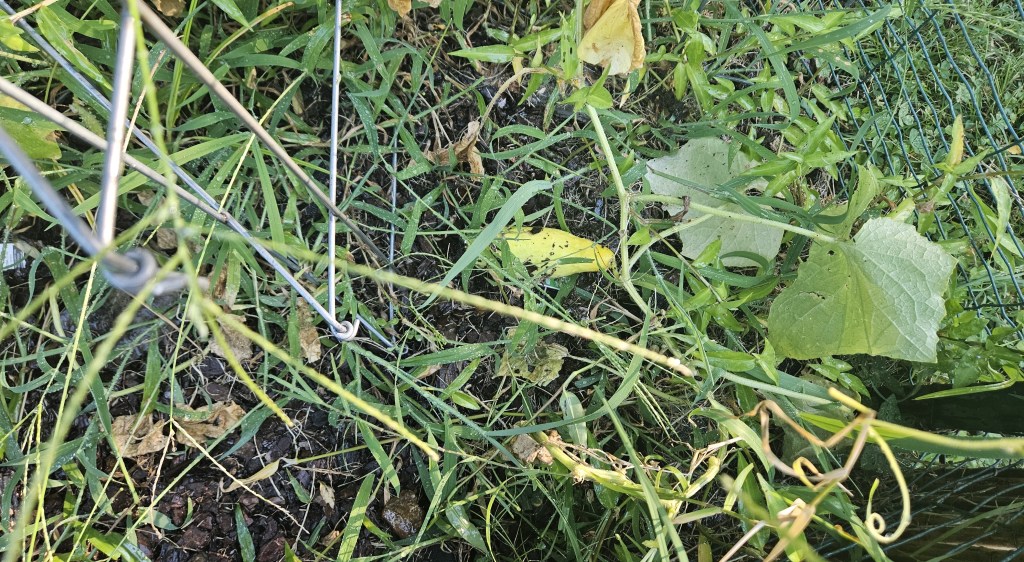
I did a little long-overdue weeding of my cucumber patch and look what I found – a cucumber hidden by the weeds, over ripe and rotting on the ground.

My first thought was anger at myself for having missed it when it was green. If I had kept the weeds at bay, if I had been more diligent in training the cucumbers to the climbing cage, if, if, if. We’ve all done that, or, at least, I hope I’m not the only one who does that. But who knows why I missed it. It doesn’t change the fact that I did. Coulda, woulda, shoulda, didn’t.

It’s got me thinking about other kinds of fruit that could be hidden under other kinds of weeds.

I’m in the middle of a rather large purchase of lake front property right now, and it has me anxious. I know, do not be anxious about tomorrow, but I really want this to happen and am missing my husband. I am riddled with concern that I am messing it up or forgetting something vitally important or making a huge mistake or biting off more than I can possibly chew. I am letting the weeds grow up.

As for what fell among the thorns, these are the ones who hear; but as they go along their way, they are choked by the cares and riches and pleasures of life, and their fruit does not mature. Luke 8:14.

Or it rots unseen.

When I am anxious, I tend to be short with people, easily agitated, impatient. Love and gentleness may be present in my life, but it is hidden when I am anxious. And if I don’t tend to these weeds now and let that fruit be seen, the opportunity to do so may be lost.

Because that cucumber when ripe would have been a blessing. I love cucumber sandwiches. I love to munch on crispy slices, plain or with a little basil. Cucumbers are a wonderful addition to corn salad or tossed salad. But the moment for that cucumber to be a blessing has passed. It was lost because I let it be hidden under the weeds.

Now and for the next few months I will be dealing with a host of new people, attorneys and landscapers, builders, surveyors, and the corps of engineers to make this lake property a reality. I will have many opportunities to bear the Spirit’s fruit and further the kingdom, or hide that fruit under the weeds of anxiety, the cares and pleasure of life. And if that fruit is hidden now, it may never have the opportunity to bless the person for whom God is growing it.

Perhaps this rotting cucumber is calling me to weed now and avoid the coulda, woulda, shoulda of missed opportunity.

Do not worry about anything, but in everything by prayer and supplication with thanksgiving, let your requests be known to God. And the peace of God, which surpasses all understanding, will guard your hearts and your minds in Christ Jesus. Philippians 4:6-7.

I pick the rotting cucumber and add it and the pulled weeds to the compost pile. God can turn even our failures into blessing. And I head inside to spend some time weeding my soul as I have weeded the garden.

Love in Christ, Betsy

Not Dead Yet!

The vegetable plants are dying; even the weeds are wilting. As the temperature nears one hundred again, most of my plants have called it quits for the year. Enough already, it’s too hot.

I can relate. The afternoons have found me huddling in my house, air conditioner churning away, book in hand. Even the lake is little respite as the water is warm and the breeze even warmer. What did people do before ac?

I go to the garden while the sun is still low in the morning sky. Already the dew has evaporated in the heat. I water my dying plants and look for signs of life. My basil, oregano, and peppers still survive. The raspberry and fig seem undeterred. My poor cucumbers are almost gone. Almost.

Above the browning leaves and dying stalks, amidst the weeds that grow no matter what, a lone cucumber plant is holding forth. Like a character in a British comedy, I hear him cry. “I’m not dead yet!” Okay, mostly dead, or that is, alive.

What a reminder this little plant is to not jump to the ending too soon.

Yes, it is mid-August, and the cucumbers will die off soon, but that is no reason to call them dead before they are. Unlike my tomato plants which have been dead from blight for a month now, these cucumbers still have life in them. Who knows, with cooler temperatures and ample water, they may still produce.

Having faith can feel naïve sometimes, like foolishness even (maybe especially) to ourselves. Any sane person would know that the cucumbers are on their last leg and there is no point in nursing along the dying plant in a fanciful wish that they will produce at this late stage. Any sane person would know that a dead man doesn’t just rise from the grave and walk again, not after he was true and fully dead.

For the message about the cross is foolishness to those who are perishing, but to us who are being saved it is the power of God. 1 Corinthians 1:18.

Because with God, nothing is impossible. Let that sink in a minute. Let that shake your cynicism, your world-wise skepticism. It’s not normal for a sea to part, a virgin to give birth, or the sun to move backward on the sundial, but can you say with assurance that God didn’t make it possible? Are you so sure that your constraints can be applied to an eternal, omniscient, all-powerful God?

I don’t know that God will cause cucumbers to grow on this hardy plant, but I believe He can. And in that faith, I will water and tend this little plant for as long as it is green. I will move forward with plans that may not come to fruition. I will work to be kind to those who hurt my feelings and gentle toward those who anger me.

And in those relationships that have been damaged by broken trust, unkind actions, differing agendas, I will hear the faint whisper of “I’m not dead yet.” Who knows, with cooler temperatures and ample water, they may still live.

Love bears all things, believes all things, hopes all things, endures all things. 1 Corinthians 12:7.

What are you facing today that makes you want to throw up your hands and walk away? What hope do you harbor that wisdom would say is foolish? What are you bearing that is just too much, what plant are you watering in hopes that it will survive? Keep bearing, keep believing, keep hoping, keep enduring.

God is not dead, not even mostly dead. He is alive and well and active in the world. And with God, nothing is impossible.

Love in Christ, Betsy

Figs

School has started and summer draws to a close. My garden is winding down as well. The leaves on the cucumber plants have begun to wither and there are no more blossoms on the peppers. Soon it will be time to harvest the basil and freeze pesto for the winter. But my figs – they are telling a different story.

I have eaten ripe figs in early August, so I know that these figs may be ripening late, but what a gift! This is year three for my fig tree, the year they are due to bear fruit, and my little tree is loaded with green buds. As I slowly dismantle my garden, I know these buds will grow larger and turn purple, soft, and delicious.

The promise of fruit, the waiting as the plant grows, the excitement as the fruit appears, this anticipation is one of the great joys of gardening.

So often, our food needs are met immediately. We go to the store, get what we want, and eat it. Is it winter? That is no problem. Someone has shipped fruit and vegetables from a warmer clime or grown them in a hothouse. You can get almost any produce even on the coldest days. No waiting, no anticipation.

A garden reminds us that God did not create a world where our wants were met immediately. He created a world of seasons, of fluctuations in temperature and rainfall, of planting and waiting.

Be patient, therefore, beloved, until the coming of the Lord. The farmer waits for the precious crop from the earth, being patient with it until it receives the early and the late rains. James 5:7.

It’s hard to be patient. It’s difficult to wait. How long, O Lord?

As children, we must wait to grow up, until we are large enough, smart enough, old enough, until we are mentally and physically capable. As adults we must wait (hopefully) for the right spouse, the right job, the right place to live. We wait to have children and then wait for them to mature. We wait for wrong doers to be brought to justice and good people to get a reprieve from their troubles. We wait for God to change the people around us and, if we are honest, to change us as well. We wait for figs to ripen.

While waiting, we continue in our daily tasks of tending. We water and weed the garden. We struggle at the challenges of the day. We help those around us. We aid those who are hurting and love our neighbors. We pray and meditate on scripture. We listen for God’s call to us and follow Him.

He has told you, O mortal, what is good; and what does the Lord require of you but to do justice, and to love kindness, and to walk humbly with your God? Micah 6:8.

And as we go about our tasks, the fig ripens. The child grows up, we find a soulmate, we find purpose in a vocation, wrongs are righted, and prayers are answered. We may even realize that we have been changed by the presence of the Holy Spirit in our lives.

The day will come when these figs are ready to harvest. The day will come when we are ready to face the Lord. The day will come when God puts all his enemies under his foot. Until that time, persevere in your daily tasks, pray without ceasing, savor the joy of anticipation, learn the peace of patience, wait for the fig to ripen.

Because those figs would not taste good today, but in the future, they will be delicious!

Love in Christ, Betsy