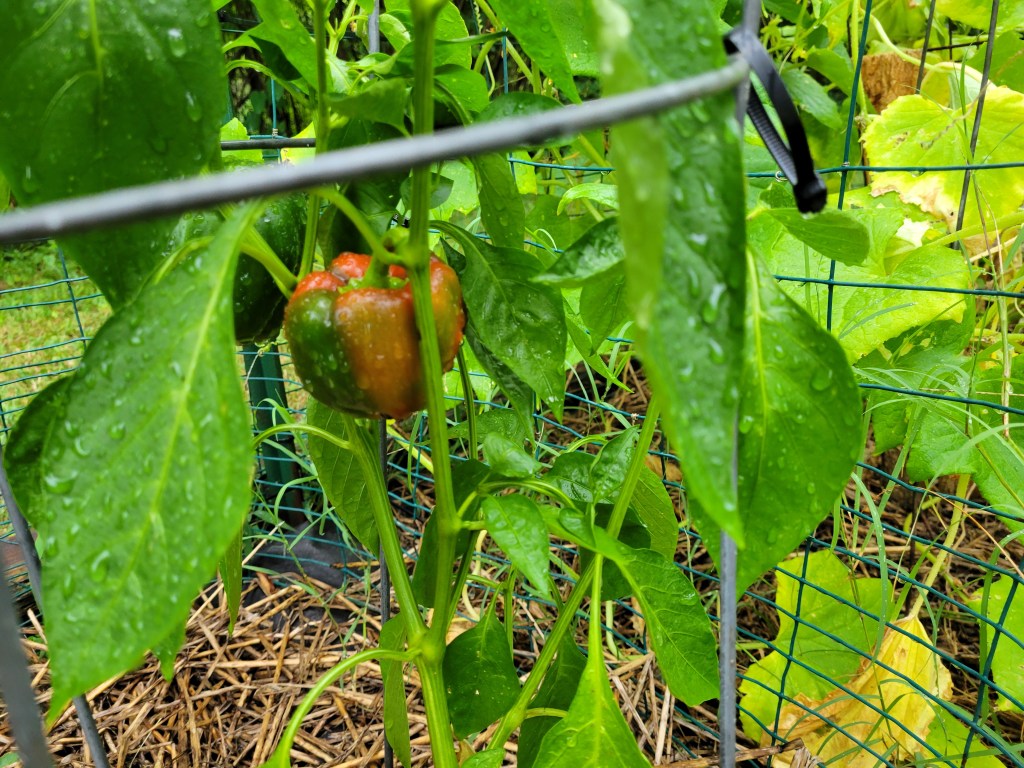
When you buy starter plants, they are in trays, which are labeled at the end. The suppliers mark each plant are individually, but I don’t always look at the individual labels. A recipe for disaster.
One year, we planted small sweet peppers. We had found a recipe for stuffing them with cheese and were eager to make a bunch. We bought two plants. But as they grew, one looked a little off; slightly different shaped leaves, a darker hue, thinner peppers. Nick reasoned that he should try one before we stuffed them.
I still don’t know what they were – ghost peppers, perhaps? Mouth on fire, tears streaming down his red face, stuffing bread into his mouth, Nick washed his face and hands and arms, repeatedly.
With gloves, we packed all the harvested peppers in a ziplock bag, dug up the plant and gave it all to a friend who liked hot peppers.
Beware of false prophets, who come to you in sheep’s clothing, but inwardly are ravenous wolves. You will know them by their fruits. Are grapes gathered from thorns, or figs from thistles? … Every tree that does not bear good fruit is cut down and thrown into the fire. Thus you will know them by their fruit. Matthew 7:15-20
Our inattention had led us to plant something we didn’t want in our garden. It needed to go – immediately and totally. Since this was a matter of taste, we could give it to a friend. If they had been poisonous, we would have thrown them all away.
Sometimes, our inattention allows bad fruit to grow in our lives. Sometimes, it’s difficult to tell the false prophets from the real ones. Often the plants can look very similar, but the fruit is very different.
While Jesus commands us to “judge not,” to be loving and forgiving, to understand that all sin is equal and your sin is no worse than mine, to know that all have sinned and God is willing to forgive all sin, Jesus also calls us to be discerning about who we listen to, who we follow and what we plant in our spiritual gardens. It’s not always clear. Sometimes our inattention leads us astray; sometimes there is deception at work.
So, once the “bad fruit” becomes obvious, dig up that plant, cut down that tree, and get it out of your garden.
And sometimes, this issue is not “bad fruit,” but no fruit at all.
We tried to grow blueberries for three years without success. We researched varieties and growing recommendations. We enhanced the soil and protected the plants. 6 blueberries in 3 years. Finally, it was time to dedicate that garden space to something else.
Like the man in Jesus’s parable of the barren fig tree (Luke 13:6-9), “For three years I have come looking for fruit on this tree, and still I find none. Cut it down! Why should it waste the soil?” We cut our blueberry bushes down. In the parable, the gardener (presumably Jesus) is more patient and kind and convinces the man to give the fig tree more time, promising additional love and care.
What a gift, what a blessing, what a warning.
The Lord is not slow about His promise, as some think of slowness, but is patient with you, not wanting any to perish, but all to come to repentance. But the day of the Lord will come like a thief. 2 Peter 3:9-10
Right now, my Victory Garden is growing well. The plants are producing, and the fruit is good. But it is not a time to rest. Every day I must water; every day I must encourage growth, every day I must harvest what is ripe. I need to be vigilant for the appearance of bad fruit and concerned when no good fruit appears.
How is your garden growing?
Thank you for sharing your time with me and sharing these thoughts with others. I hope that I have involved you in this story, and would love to hear your thoughts.
Betsy
Do whatever He tells you. John 2:5
Discover more from The Victory Garden
Subscribe to get the latest posts sent to your email.
 The Victory Garden