Give Thanks

I am grateful to live in a country that intentionally sets aside a day to give thanks. As humans, we often let the day devolve into a day of political arguments, old scores, and overdoing it. I. like the biblical Martha, tend to focus on logistics and preparation and miss the important thing.

God gives us this day, this food, our breath, what little strength we have. (Deut. 8:11-18) God gives us the opportunity to live in communion with Himself, the giver of all good things, the creator of the universe, and the Lord of heaven’s armies.

This is the true gift for which I want to give thanks:

The word became flesh and dwelt among us, and we have seen his glory, the glory of the father’s only son, full of grace and truth. John 1:14

who, though he was in the form of God, did not regard equality with God as something to be exploited, but emptied himself. Philippians 2:8

He calls us to “abide with him.” (John 15)

Jesus came to them and said, “All authority in heaven and on earth has been given to me…remember, I am with you always, to the end of the age. Matthew 28:16,20.

So,

If we have died with him, we will also live with him;

if we endure, we will also reign with him;

if we deny him, he will also deny us;

 if we are faithless, he remains faithful – for he cannot deny himself. 2 Timothy 2:11-13.

Thanks be to God! His faithful love endures forever!

Love in Christ, Betsy

Plans

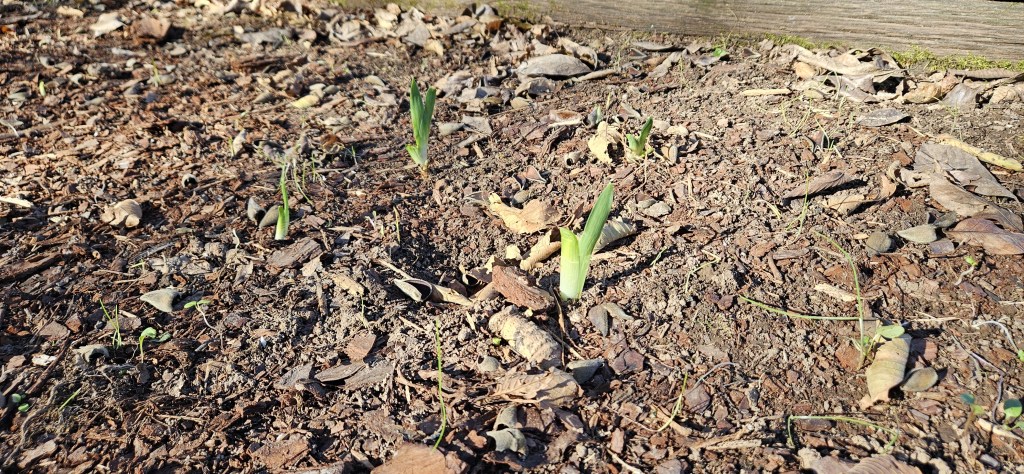
I planned to plant my garlic this weekend, after the first hard frost. But a warm spell has made my iris come up, so I think I will wait. I fear if I plant them now, they will expend all their energy sending up scapes instead of developing bulbs.

Best laid plans. Man plans and God laughs. (Not an actual quote of Proverbs 16:9).

It’s got me thinking about planning. I do a lot of it this time of year. Planning for Thanksgiving, for holiday activities, for family gatherings, for next year. And planning for the garden. What to plant, where, and when. What needs to be done before I plant. Lots of planning and scheduling.

Where is God in all this planning? He must be front and center. He controls the weather, so I need to be flexible for when He brings warmth and frost, rains and droughts. All my plans may be sidetracked tomorrow by a sudden illness or accident.

I spent one December homebound with two sick children. Pre-internet or amazon, so gifts were sparse. Not what I had planned.

This fall, a group of women and I are discussing “respectable sins,” you know, those ones we often laugh about – irritation, frustration, cynicism, vanity, pride, fear, worry. At root is often a lack of faith in God, His love for us and His knowledge of what we need. Sometimes, we fail to cede our will to His and instead tell Him what to do and get upset when he doesn’t do it. We stomp our feet and hold our breath, figuratively if not literally.

My Father, if it is possible, let this cup pass from me; yet not what I want, but what you want. Matthew 26:39.

Can you imagine? And I think a delay in planting my garlic bulbs is inconvenient?

What would happen if I didn’t plant them until December? Until February? Never? What if I didn’t have cranberries at Thanksgiving or never decorated my mailbox for Christmas? Are any of these things worthy of irritation or anxiety?

I still plan to plant my garlic, serve cranberries, and decorate my mailbox. But if none of that happens, that is okay, too. (At least, I plan to be okay with it!!) Because none of those things are important in the big picture of my relationship with God, Jesus, and the Holy Spirit. What is important is that I deepen my relationship with Him.

Jesus tells us to “Seek first the kingdom of God” (Matthew 6:33). I think of this as seeking first His presence. Not just first thing in our day, but also first in priority. More important than gardens, or menus, or decorations. More important than my plans. Easier said than done when I am caught up in the hustle and bustle of my desires.

Perhaps I will take a moment to wonder at the beauty of iris pushing through the ground and reaching for the sun in November. Maybe I will revel at the beauty of the leaves that still cling to the trees and feel the sun on my face. Perhaps none of my plans are as important as praising God for His goodness right now in this moment.

After all, who am I to questions God’s plans or think mine may be more important?

As God reminds Job:

Where were you when I laid the foundations of the earth? Tell me, if you have understanding. Job 38:4.

I’m inviting God into my planning this season. I’m asking Him what His plans are. I pray that I will conform my plans to His. Will you join me?

Love in Christ, Betsy

Tarps

For as long as I have had a garden, I have had weeds in my garden. My husband and I designed our garden space around the dimensions of weed barrier cloth, but that only keeps the weeds suppressed under the cloth. They soon resurface. I have spent hot hours pulling weeds. I have paid others to pull them. I have even considered elevated beds so grass from my yard wouldn’t invade my garden space. Of course, I would have to fill the raised beds with weed-free dirt, which probably doesn’t exist.

My efforts may have kept weeds at bay or out of sight for a while, but they always come back. I know people who love to weed, love to see the pristine results of their daily diligence. But daily diligence is not my strong suit. I reserve what little talent I have for that to devotional time and brushing my teeth. Nothing else receives daily attention.

So, there have always been weeds in my garden.

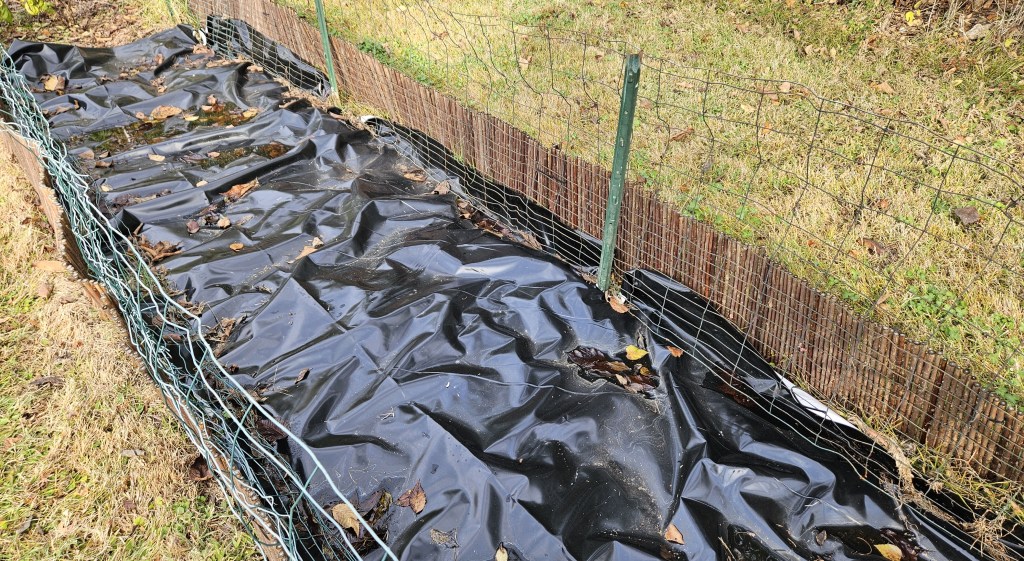
I am trying something new (to me) this year – occultation taps. These heavy-duty tarps block sunlight, UV rays, and water. The white underbelly of the tarp heats the soil, so the weed seeds germinate, and then kills them, leaving you with a weed-free garden to plant. Fingers crossed.

I put the tarps over my garlic beds about a month ago while it was still warm. I plan to plant garlic within the week, so we shall see. I also covered the sugar snap beds. Although occultation is only supposed to take a few weeks, I will leave my sugar snap beds covered until I plant them in late February or early March. Hopefully, we will have enough warm days over the winter for the tarps to work.

These tarps aren’t cheap or particularly easy to manipulate. It makes me wonder about the lengths I will go to get what I want, without submitting to the proven method of daily weeding. Is this stubborn orneriness? And if so, where else does it raise its head?

If you have read my musings for long, you know that I often talk about weeds. Perhaps I should spend more time talking about the wonders and joys of having a garden. Just before I took the above photo, I picked five ripe raspberries and one ripe fig from my garden. A November gift. Sweet and juicy, they were a divine reminder of why I have a garden. The fruit is worthy of any and all aggravation.

When we talk about the Christian life, what do we talk about? Do we only talk about the joyous fruit of communion with God, the times when we sense His presence, feel His love, hear His voice? Or do we talk more about the struggle of not conforming to the world, of keeping the weeds of self-interest, pride, and irritation at bay?

Neither one tells the whole story. Because, like my garden, the Christian life contains both glorious fruit and troublesome weeds. Green pastures and valleys of shadows, wondrous feasts and the presence of enemies. (Psalm 23)

I fear we tend to emphasis one over the other. I know a woman who couldn’t go to her big screen church after her husband died because she didn’t feel joyous enough to worship God. I know a man who attends a church where discussion is discouraged and congregants are spoon-fed “correct” answers to complicated issues. And I know that I am prone to dive into the struggles and difficulties and fail to share the absolute joy I find in communing with God.

I look forward to a weed-free garden. Until then,

By this everyone will know that you are my disciples, if you have love for one another. John 13:35.

Love in Christ, Betsy

Salt

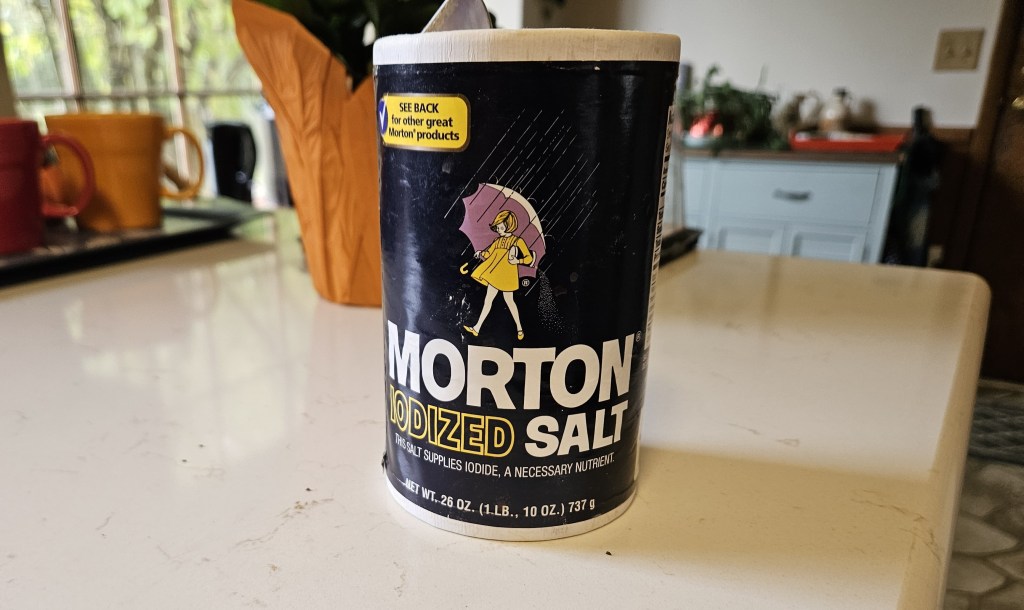
I’ve been thinking a lot about salt recently. A friend of mine has a dozen different colors and flavors of salt. I have Morton’s. We both use salt on a regular basis. I bet you do too. Salt is in everything, as those of who have had to limit its intake can attest.

Salt makes food taste better. It’s just a rock, a crystallized mineral. It takes no action on its own. It didn’t rise out the ground eight thousand years ago and tell the ancient Balkans, Bulgarians, and Chinese that it could change their lives. They found this mineral in springs and rocks. They experimented with it, tasted it, and rubbed it on the most recent animal kill. They let it dissolve in water and soaked their aging vegetables in it.

What an amazing and life changing gift from the earth, from God. And it is just there for our use. Sometimes just sitting in rocks beside streams for animals to lick on their way past. Sure, we humans have mined it, processed it, commercialized it, and fought over it. But that is because salt is vital and necessary to our survival.

Salt not only makes things taste better. It is an essential element, a necessary electrolyte to keep us healthy and functioning. Salt is used in brining and pickling and smoking and canning, allowing for the safe preservation of our food. We gargle salt to heal our mouth sores and soak in it to heal our wounds. Salt is also used in chemical processes, water treatment, land stabilization, and de-icing.

You are the salt of the earth. Matthew 5:13.

Can our mere presence make this much of a difference to the world around us? Can we, by simply being available, add flavor to other’s lives, preserve their dignity, enhance their lives, and cure their ailments? Are we an essential element in each other’s lives?

Salt can also corrode, destroy, and kill. It has long been used to eradicate weeds. Conquering armies would salt grain fields to prevent growth. I’ve heard it’s deadly to slugs. The salty breeze from the ocean destroys a/c units, corrodes paint, and rusts the chairs. Road salt eats away your car’s paint and makes the metal rust. Too much salt in your diet causes hypertension and can be fatal. Ingesting salt water can lead to hallucinations and death.

So, is salt a preserver or a killer? Does it enhance life or corrode it? As eager as we are to classify things as ‘good’ or ‘bad,’ salt is just salt. It is not making any moral choices or grappling with complexities. We slap those attributes on it based on what it feels like to us in the moment.

Some people struggle to say that God is good. How could such a loving God do such and so? He gives us life. He flavors it and enhances it and preserves it. At times He seems to destroy it. I can’t see the world as He sees it. I don’t think I even want to. God is God. I will not slap my moral judgement on His actions.

Jesus tells we are the salt of the earth and urges us not to lose our saltiness. The thing is that salt never loses its saltiness. It’s what it is. We sense it as “unsalty” when it has been diluted. With too much water, too much starch, salt can be absorbed by its environment. But it is still salt.

We are here to flavor and enhance and cure. We may be called upon to destroy – false gods, heretical beliefs, sin in our lives. We, His children, are salt. He sends us out into the world to be – salt.

You shall not omit from your grain offering the salt of the covenant with your God; with all your offerings you shall offer salt. Leviticus 2:13.

You are the salt, my friend. Not because you have made yourself salt, but because God made you salt.

Love in Christ, Betsy