Food

Photo by Wesual Click on Unsplash

Thanksgiving is tomorrow! If you do not live in the United States, you are missing a wonderful celebration of God’s abundant provisions. Thanksgiving is the only holiday that is celebrated in no other way but by the gathering of family and friends to eat, and eat abundantly. It is a celebration of our thankfulness for food. And what is a garden, really, except a means of producing food?

From the beginning, God knew we needed food and provided it; perhaps even creating this need in us.

God said, “See, I have given you every plant yielding seed that is upon the face of the earth, and every tree with seed in its fruit, you shall have them for food.” Genesis 1:29

When His people were wandering around the wilderness, God provided manna for them to eat and, on at least one occasion, quail.

At twilight you shall eat meat, and in the morning you shall have your fill of bread, then you shall know that I am the Lord your God. Exodus 16:7

Food was a necessary part of hospitality, and feasting was a national requirement for the Israelites. There were many reasons to sacrifice animals to the Lord; most involved a subsequent feast.

And the flesh of your thanksgiving sacrifice of well-being shall be eaten on the day it is offered; you shall not leave any of it until morning. Leviticus 7:15

Food plays a critical role in Jesus’ ministry – from meals with sinners and pharisees, to the feeding of thousands. Jesus compared the kingdom of heaven to a feast (Matt. 22; Luke 14), and used yeast to describe both bad teaching (Mark 8) and the kingdom of God (Luke 13).

Jesus establishes the most enduring remembrance of His life, death, and return as a meal. The Last Supper, the Lord’s Supper, Holy Communion, Eucharist.

Then He took a loaf of bread, and when He had given thanks, He broke it and gave it to them, saying, “This is my body, which is given for you. Do this in remembrance of me. ” Luke 22:19

Food. We have to have it. We have made an art form of it. Just the varieties of bread across cultures and within cultures are mind-boggling. A friend of mine makes egg rolls for Thanksgiving to honor her Vietnamese heritage. Naan is a wonderful addition to crescent rolls. How about leftover turkey tacos or pitas along with our hot browns? How many varieties of dressing does your family serve?

Jesus said to them, “I am the bread of life. Whoever comes to me will never be hungry, and whoever believes in me will never be thirsty.” John 6:35

Because as wonderful and filling as our Thanksgiving feast may be tomorrow, by Friday, we will need more food. But once we know Jesus, crucified and risen, we may need to eat, but we will not need to know anything else. We have abundance.

I came that they may have life, and have it abundantly. John 10:10

We have so much to be thankful for, so many gifts, so much grace.

Happy Thanksgiving!

Betsy

Victory

Victory. It’s a deceptive word.

On the one hand, victory is success; triumph over difficulties.

No, in all these things we are more than conquerors through Him who loved us. Romans 8:37

On the other hand, victory implies that there is war, struggle, hardship. Just look at the verse preceding verse 37:

Who will separate us from the love of Christ? Will hardship, or distress, or persecution, or famine, or nakedness, or peril, or sword? As it is written, “for your sake we are being killed all day long; we are accounted as sheep to be slaughtered.” Romans 8:36

Cheery! While there are Christians who face these types of hardships in the world today, my guess is that few (if any) of you reading this have ever faced these levels of distress. As a Christian living in the Bible belt of the United States, the few difficulties I have are not a result of my faith.

I must admit that I named this blog ” The Victory Garden,” because I love the confidence, the faith, the hope, that in the end God wins. God has promised us victory over evil (1 John 4; 4), over Satan (Heb 2:14), over temptation (1 John 3:8), over our own sinful nature (Col. 2:14), over our past (2 Cor. 5:17).

But victory implies battle. and God has promised us that as well. We will face hatred (Matt 10:22), persecution (John 15:20), the forces of darkness (Eph. 6:12), trials (1 Peter 4:12), and refinement by fire (1 Peter 1:7).

Perhaps this is how God’s people felt when they thought about the Promised Land. There were already people living there. This ragtag bunch of nomads would have to fight against established strongholds and peoples, some of whom were giants. Just like us, God had promised victory, had promised them this land, but there were battles ahead.

God’s people, then and now, are in a battle for possession of the land, our souls, humanity’s soul. God has promised us victory, but we do not win every battle. We need to “put on the full armor of God” (Eph. 6:10) and listen to God’s instructions (Judges 7). Tactics will vary based on the enemy we face, the established sin in our lives, but the battle is real.

And there’s an uncomfortable truth hidden in the story of God’s people entering the Promised Land.

These were the nations the Lord permitted to remain so He could use them to test Israel. Judges 4:1

Therefore, so I would not become arrogant, a thorn in the flesh was given to me, a messenger of Satan to trouble me. 2 Corinthians 12:7

There are Canaanites living in the promise land; there are weeds in my garden, there are thorns in my flesh, there is evil in our midst.

When I started this blog, this adventure, I wrote the following:

A garden is an act of faith, just like the Christian life. You must battle internal demons that tell you, “you can’t do it;” “it’s too hard;” “you aren’t capable enough;” “the effort is not worth it;” “you will fail.” You must battle predators that devour your growth and steal your fruit. You must battle invaders that strangle your growth and divert your resources. You must endure weather that thwarts and threatens and damages what you can produce. But God has granted you a vision of ripe fruit where only barren ground now exists. God will give you the motivation, the ability, and the strength to be victorious in battle; victorious against inner demons, predators, invaders and inclement weather.

Welcome to the Victory Garden.

So don’t be discouraged by the Canaanites in the land, the sin that seems to never leave your side, the thorn in your flesh, the failings that keep you humble and dependant on God.

The Lord said to Gideon, “The troops are too many… Israel would only take the credit away from me saying, ‘my own hand has delivered me.'” Judges 7:2

My grace is sufficient for you, for power is made perfect in weakness. 2 Corinthians 12:9

Keep fighting my friend. God will bring victory in His time.

Betsy

Work in the garden

It’s annoying to me that gardening takes so much work. It’s annoying to me that Christianity takes work. Maybe I’m just lazy, but shouldn’t life and faith be, well, easier?

The earliest followers of God struggled with this same question. God gave us the answer over 4000 years ago: Nestled in the real life experiences of growing food to eat, God explains that we struggle because we are not in perfect communion with Him.

Our story, as told in the Bible, begins with a garden and fruit-bearing plants.  

And the Lord God planted a garden in Eden, … Out of the ground the Lord God made to grow every tree that is pleasant to the sight and good for food. Genesis 2:8-9

Easy. God walked in the garden and talked to Adam and Eve, and they had all they needed.

But that wasn’t good enough for them. They wanted to know more than God have permitted them to know. They wanted to satisfy their desires. They wanted to make their own rules. The result? Crops would no longer grow without effort;; man would have to work at his relationship with the ground and with God. 

And to the man He said, … cursed is the ground because of you; in toil you shall eat of it all the days of your life. Genesis 3:17

Fortunately, this is the beginning of our story, not the end. We have been promised, through Ezekiel and John, that this bountiful, toil-free garden will return when Jesus returns and man is once more in perfect communion with God.

Fruit trees of all kinds will grow on both banks of the river. Their leaves will not wither, nor will their fruit fail. Every month they will bear fruit, because the water from the sanctuary flows to them. Their fruit will serve for food and their leaves for healing. Ezekiel. 41:12

But we are not there yet.

While in this life, we have to toil in the garden. God is providing the food like He always has, but it requires some effort on our part. We must want the produce badly enough to work for it; we must want the relationship badly enough to work for it.

Because in this life, our relationship with God is broken. He presents Himself to us at every turn, but God does not force Himself on us. Until we are with Him in His kingdom, we must continue to “toil.”

And so we pray, “Thy Kingdom come.” We look forward to a time when life is not a struggle. We look forward to a future where we are in perfect communion with God. Most likely, we will “die in faith without having received the promises” like millions before us, still “desiring a better country, that is, a heavenly one. ” (Hebrews 11:16 ) And here’s the promise, the hope:

Therefore, God is not ashamed to be called their (or our) God; indeed, he has prepared a city for them. Hebrews 11:18

A city with a river running through it. Where we do not need to toil for food. Where we do not need to struggle to be in communion with God.

Then the angel showed me the river of the water of life, bright as crystal, flowing from the throne of God and of the Lamb through the middle of the city. On either side of the river is the tree of life with its twelve kinds of fruit, producing its fruit each month. Revelation 22:1-2

Hang in there, my friends. Do the work, keep the faith.

Let us hold fast to the confession of our hope without wavering, for He who has promised is faithful. Hebrews 10:23

Thanks for sharing your time with me.

Betsy

The Tithe

Tithing, like gleaning, was a harvest law established when the people of God entered the promised land.

Set apart a tithe of all the yield of your seed that is brought in yearly from the field. Deuteronomy 14:22

The annual tithe, interestingly, was to be consumed by the giver, in the presence of the Lord, at the place that God chose, “so that you may learn to fear the Lord your God always.” v.23.

Every third year you shall bring out the full tithe of your produce for that year, and store it within your towns; the Levites, because they have no allotment (of land) or inheritance with you, as well as the resident aliens, the orphans and the widows in your towns, may come and eat their fill so that the Lord your God may bless you in all the work that you undertake. Deuteronomy 14:28-29

This is the tithe that most churchgoers know. Ten percent of our earnings go to the church for support of the staff and facility, and for charitable gifts to the community and the world.

The Levites, like the foreigners, widows, and orphans, did not have land allotted to them by Joshua. Therefore, they had no means of providing food for themselves. The Levites, instead, were to dedicate themselves to the service of God, the care of the temple, and the offering of sacrifices.

To the Levites, I (God) have given every tithe in Israel for a possession in return for the service that they perform, the service in the tent of meeting. Number 18:21

How the Levites handled this influx of grain and wine, who got how much and why, is not known, but Moses instructs them to “set apart an offering from it to the Lord, a tithe of the tithe. v.26

God, through Moses, set up tithing as an obligation, not as a charitable act. More like the taxes which support our first responders, teachers and civil servants. Unlike countries with state religions, our taxes do not support our religious institutions, but we, as the people of God, are still called to support them.

Bring the full tithe into the storehouse, so that there may be food in my house, and thus put me to the test, says the Lord of hosts; see if I will not open the windows of heaven for you and pour down for you an overflowing blessing. Malachi 3:10

We live in a time of financial disclosure, salary negotiations, and 501(c)s. Churches cannot rely on income anymore than businesses can. We review how non profits and business use the money they receive; we demand tax returns from our candidates for office. Do we monitor how we spend our own resources as closely as we monitor how others spend theirs? Are we bringing the full tithe into the warehouse? Are we supporting those who are maintaining our temples and offering their service to God? Are we presenting our tithe to the Lord, at the place of His choosing, so that we remember to fear the Lord?

I also found that the portions of the Levites had not been given to them; so the Levites and the singers who had conducted the service, had gone back to their fields. So I remonstrated with the officials and said, “Why is the house of God forsaken?” Nehemiah 12:10

It was not the Levites and singers that Nehemiah considered forsaken; it was God and His house.

I am often tempted to consider my wants and needs before I consider the needs of God’s house. God reminds us to not forget the source of our wealth, the source of our resources, but to remember and honor Him with a small portion, a tithe, of all we have received.

Take care that you do not forget the Lord your God. When you have eaten your fill and have built fine houses and live in them, … and all you have is multiplied, then do not exalt yourself … Remember the Lord your God, for it is He who gives you power to get wealth. Deuteronomy 8:12,18

Who am I honoring with my gifts, my wealth, my treasure?

For where your treasure is, there your heart will be also. Matthew 6:21

Betsy

Gleaning

One of the more intriguing practices mandated by Mosaic law was gleaning.

When you reap the harvest of your land, you shall not reap to the very edges of your field, or gather the gleanings of your harvest. You shall not strip your vineyards bear, or gather the fallen grapes of your vineyard; you shall leave them for the poor and the alien. I am the Lord your God. Leviticus 19:9-10

When God’s people entered the promised land, Joshua allotted land to 11 of the twelve Israelite clans by sacred lots, based not on wealth or position or merit, but on God’s manipulation of chance. Joshua did not allot land for the foreigners, the non-Hebrews, who traveled and lived with the Israelites. And with few exceptions, women and children had no land. But without land to harvest, how would these people eat? Where would their food come from? God’s law made it very clear that these peoples were not to be allowed to go hungry just because they had no land; gleaning was God’s provision for the stranger living among the Israelites.

God’s law entitled any foreigner or landless individual to glean in anyone’s field; every land owner was to leave some of the harvest for them to glean. 

When you reap your harvest in your field and forget a sheaf in the field, you shall not go back to get it; it shall be left for the alien, the orphan and the widow, so that the Lord your God may bless you in all your undertakings. Deuteronomy 24:19

This was not charity by the landowner. The land was only “his” because God had allotted it to him; part of the responsibility of owning the land was following the gleaning laws. And the gleaners still had to work to harvest the portion set aside for them.

Sometimes, when I am figuring out tips or budgeting to the penny, these verses come to me. We are told to be good stewards, but also be generous with the gifts God has given us; leave a little wiggle room for those needier than me. Perhaps I should be willing to hire someone to do something I could do simply because they need the work more than I need the money?. After all, the landowner could easily harvest his land to the edges. Perhaps I just need to loosen my hold on “my possessions,” recognizing that they are all gifts from God.

And there’s no telling what may come from our willingness to follow God’s laws about sharing His gifts to us with others. Boaz was a landowner following God’s laws concerning gleaning, when he noticed Ruth, probably the most famous gleaner in the Bible.

She is the Moabite who came back with Naomi from the country of Moab. She said, “please let me glean and gather behind the reapers.” So she has came, and she has been on her feet from early this morning until now, without resting for even a moment. Ruth 2:6-7

Ruth, the foreign woman working in the field, grandmother to King David.

Gleaning may take many forms in today’s economy. Some non-profit organizations still glean the fields of commercial farms to add to food banks. Many grocery stores and restaurants donate unused food stuffs to homeless shelters. Some business intentionally hire disabled workers and ex-convicts, giving them dignity and a living wage. Many companies donate goods, services, and profits to help others.

Do I really need everything my field produces? Could there be someone who needs at least a little of it more than I do? Has God granted me land, not based on merit, but on His grace, requiring that I share the land’s produce with others? The Israelites did not consider gleaning charity. It was an obligation to God. I believe it still is.

Whoever has two coats must share with anyone who has none; and whoever has food must do likewise. Luke 3:11

Must. What must I share today?

Betsy

More than Enough

I have pulled up my garden for the year, but there seems to be more to talk about! Although I didn’t have much of a harvest this year, there have been years when the harvest was overwhelming. While harvesting the fruit may feel like the last step, it is far from it. That fruit can rot on the kitchen counter every bit as easily as it can rot on the vine. My first choice is to eat it, usually raw. My second choice is to give it away. Over the years, I have frozen a lot of homegrown veggies; my freezer is still full of sliced bell peppers in vacuum sealed bags. My children may inherit them! In the past, I have made tomato sauce, jarred cooked tomatoes and filled mason jars with pickles. If I lived in a time of scarcity or poverty or no refrigeration, preserving these products would be a vital part of gardening. As it is, I rarely used these foods and ended up throwing most of them out. Better to just give them away.

Giving the fruit away still entails some work. I need to pick out the best looking fruit and take them to people while they are fresh. I need to have a basket for carrying my produce to folks and bags for them to carry the fruit home. Not a hard task, but still a task. Do I feel so tasked with sharing other gifts God has given me? Am I being generous with my time and money? Am I using my skill set to honor Him? Am I making the effort or letting the fruit rot on the counter?

Like good stewards of the manifold grace of God, serve one another with whatever gift each of you has received. 1 Peter 4:10

I have a friend who makes bread and butter pickles every year from her harvest. She and her mom used to do that every fall, and the process connects her to her heritage. Family and friends expect this gift from her, and the pickles are a welcome addition to any gathering. Like all things homemade, they represent a gift of time and effort, more valuable than most things from Amazon.

These gifts are no small thing. God has gifted us with food and money and time and grace and faith and love. God has gifted some of us with business acumen or artistic skills. Some of us are gifted researchers or organizers or encouragers. When we share these gifts with each other, we strengthen the body of Christ, the community of believers.

Now there are a variety of gifts, but the same Spirit. To each is given the manifestation of the Spirit for the common good. I Corinthians 12:4,7

God has given you a gift. It may seem as small as a mustard seed, but what wonders God can perform with it! (Matthew 13:31) Two fish and five loaves, that’s all the boy had to contribute, but what God did with it! (John 6:9). Am I contributing what God has given me, no matter how small? Are you?

Thank you for continuing to read my thoughts on the garden and the Christian life. I hope to continue these posts for a while, although some will have little to do with gardening. I appreciate the gift of your time, and I hope God has made my words somehow meaningful to you.

For we are what He has made us, created in Christ Jesus for good works, which God prepared beforehand to be our way of life. Ephesians 2:10

Betsy

A Time for Everything

It is time to dig up my garden; time to call it done. It is time to let the ground rest. The plants have died; there will be no more fruit this year.

The garden was a bust this year – the snow peas failed, and the squirrels ate all my green tomatoes. I harvested some cucumbers and peppers, but not very many. Sometimes life is like that. We put in the effort, but seem to reap little or no reward.

I have faith that God is in even these times, maybe especially in these times. Maybe the reward of this year’s garden was the survival of a wild animal. Maybe the seeds from that stolen fruit will produce volunteer tomatoes in the woods beyond my creeks, nourishing animals for years to come. Perhaps the fruit it produced was these musings, these lessons.

But the summer and this garden have come to its end.

For everything there is a season, and a time for every matter under heaven: a time to be born, and a time to die; a time to plant and a time to pluck up what is planted. Ecclesiastes 3:1-2

There is a sadness to ending the garden for the year: no more fresh growth; no new blossoms; no need for me to walk the garden daily. Where did the summer go? But there is a relief as well: no more weeding; no frustration with failure; no constant demands for attention. Are you ready for some football? There’s an excitement for what Autumn promises: Bible studies are getting back together; my daughter’s expecting twins; I need to prepare for family gatherings and holidays. Such excitement on the horizon!

A time for everything.

Now is the time to let the ground rest, lie fallow. Rest is a vital part of the growing season, allowing the soil to rejuvenate. The ground, like you and me, needs rest, sleep, vacation, Sabbath.

Remember the Sabbath day and keep it holy. Six days you shall labor and do all your work. But the seventh day is a Sabbath to the Lord your God; you shall not do any work. Exodus 20:8-10

Perhaps this blog needs to take a rest as well, but not quite yet. I have a few more thoughts I would like to share over the next weeks, not all of which are garden related. If you have subscribed to this blog or are a follower, WordPress will notify you of my posts. If you are getting these posts through an email from me, please let me know if you would like to continue receiving it, because I will no longer send out unsolicited emails.

As for future gardens and plans, I am trying to stay open to the Spirit’s guidance. God willing, I will have a garden next year; God willing, there will be something to harvest. But for now, I am pulling up the dead plants, taking down the fence, and letting the grass grow.

This season is over. I look forward to what God holds in store for me during the next one.

Betsy

All things came into being through Him, and without Him not one thing came into being. What has come into being in Him was life, and the life was the light of all people. John 1:3-4

Giving Thanks

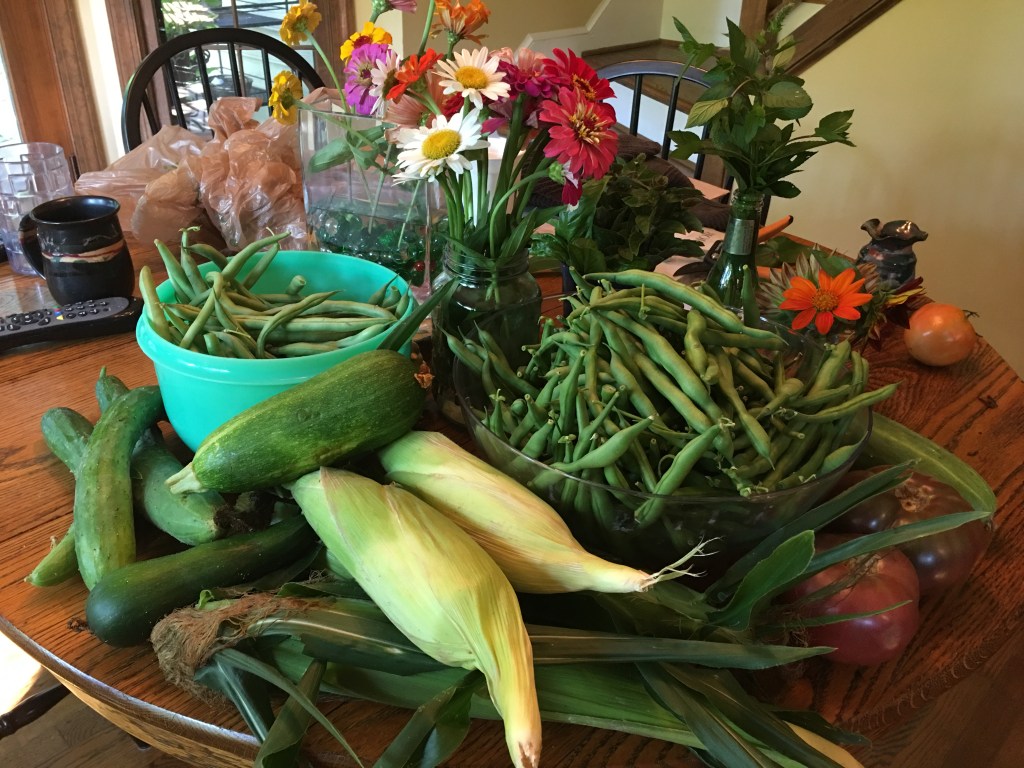
I can remember our dining room table covered with tomatoes. Nick said it made him feel wealthy. We were so grateful for God’s abundance.

This year, my garden has blessed some squirrels with a wealth of tomatoes.

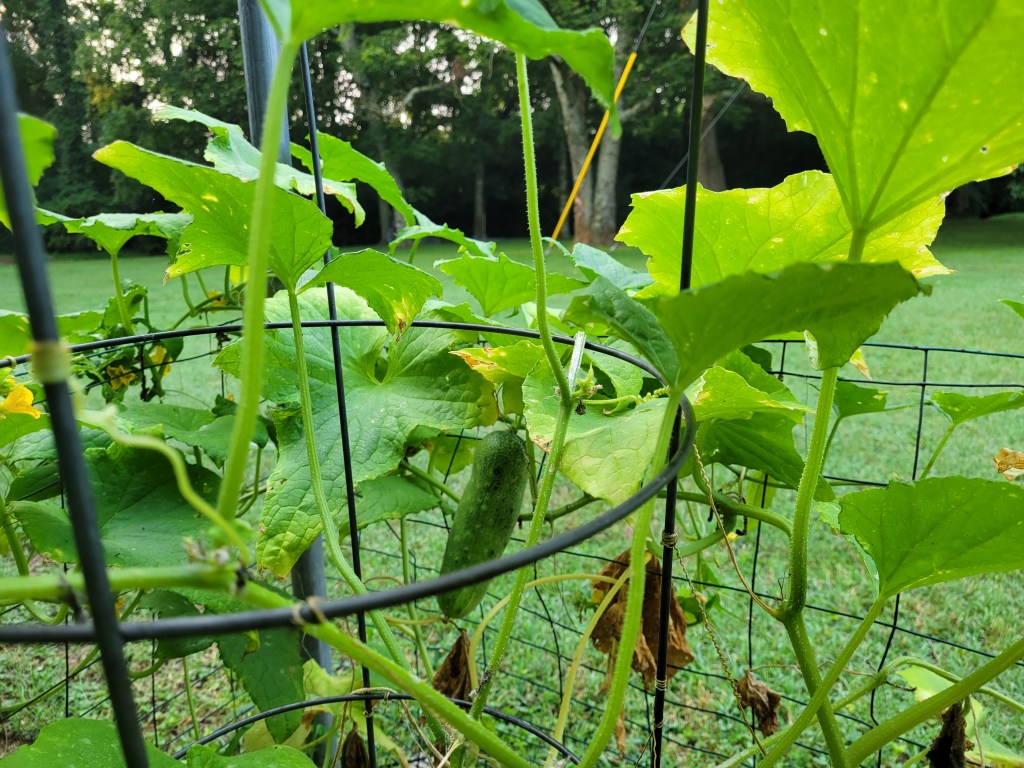
The heat has been too much for my exuberant cucumbers, and the vines are dying.

I have not given up hope. I still water and tend; there are still blossoms. I have reinforced the fence and netting. There’s still a chance.

Any harvest fills me with gratitude. What an amazing gift – food from the earth. We are so accustomed to it that the wonder has dulled. God gives us what we need to survive. He always has. Not the government, not business ventures – the earth. God’s creation feeds God’s creatures.

God said, “See, I have given you every plant yielding seed that is upon the face of the earth, and every tree with seed in its fruit; you shall have them for food. Genesis 1:29

This year, in a time of drought and heat, God has been feeding His wild animals through my garden. That is OK. They cannot go to the grocery store or the farmer’s market to purchase what they need. I am grateful that I can.

I am grateful that I have a yard. I am grateful that there are wild animals living among us, although sometimes the bunnies and squirrels behave more like pets. I am grateful for water to quench my thirst, trees to provide shade, and a home with air conditioning to keep me cool.  

There is so much to be thankful for! So many of God’s gifts to us have become “given” that we fail to stop and give thanks for them. The sun, the warmth, the rain, the cool breeze, water. Trees, flowers, grass, seed bearing fruit.

You cause the grass to grow for the cattle, and plants for people to use, to bring forth food from the earth. Psalm 104:14

Too often I focus so much on what I want to do, and my failure to complete it, that I miss what God is accomplishing. I miss the opportunity to give God thanks for what He has provided, what He is doing in my life.

The Jesus asked, “Were not ten made clean? But the other nine, where are they? Was none of them found to return and give praise to God except this foreigner?” Luke 17:17-18

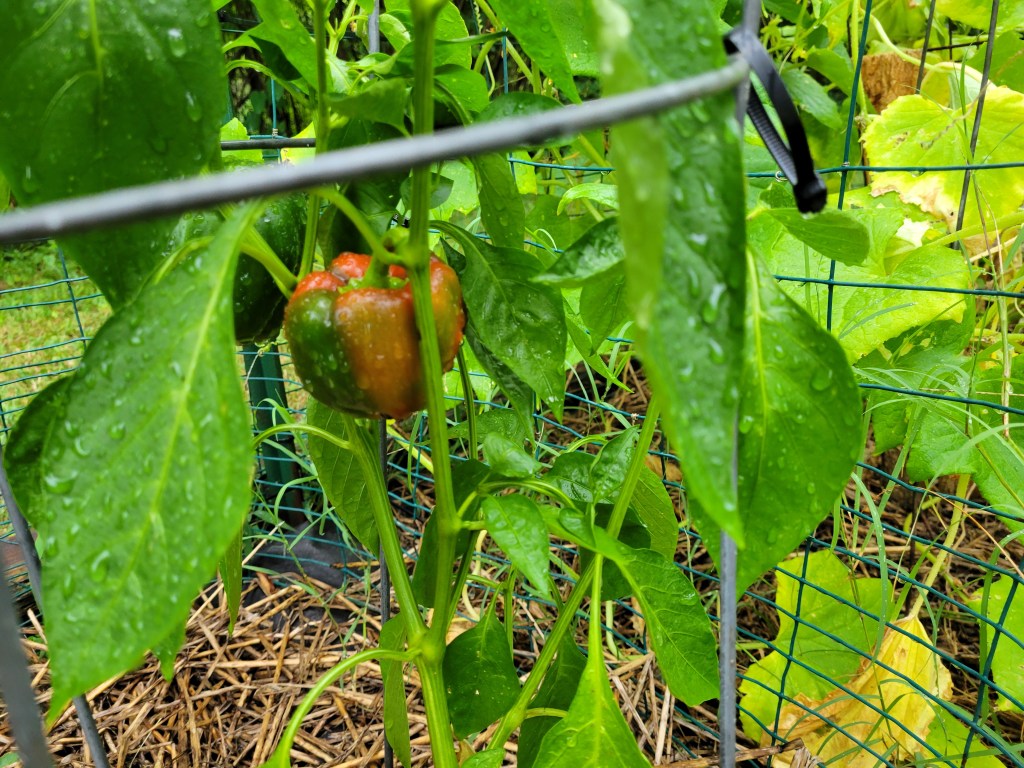
So today, I am giving thanks for my peppers. I am choosing not to dwell on my lack of ripe tomatoes. I am grateful for the cucumbers I harvested last month. I have decided to be grateful that my ripening tomatoes may have helped some desperate animal. I have plenty, and I have the ability to get more. I may still be able to harvest some tomatoes this year. But even if I don’t harvest anything more, I still choose to be grateful. Grateful to God for all that He has provided me. Grateful to God that He cares for me and the squirrels.

Give thanks in all circumstances, for this is the will of God in Jesus Christ for you.  I Thessalonians 5:18

A friend of mine has a sign in her kitchen which reads: What if you woke up tomorrow with only those things for which you were grateful today? Would we not spend the entire day listing all the things for which we are grateful? Will I spend at least part of my day today thanking God, being grateful for His gifts? Will you?

Don’t you think He would like at least one of us to “return and give praise to God?”

Thank You, Lord, for these peppers. Thank You for teaching me through the garden. Thank You for letting me have a garden. Thank You for gardens everywhere – your constant provision for us. You are a good and gracious God.

And thank you, friends, for reading this. Thank you for your encouragement.

Betsy

I am the light of the world. Whoever follows me will never walk in darkness. John 8:12

Bad Fruit

When you buy starter plants, they are in trays, which are labeled at the end. The suppliers mark each plant are individually, but I don’t always look at the individual labels. A recipe for disaster.

One year, we planted small sweet peppers. We had found a recipe for stuffing them with cheese and were eager to make a bunch. We bought two plants. But as they grew, one looked a little off; slightly different shaped leaves, a darker hue, thinner peppers. Nick reasoned that he should try one before we stuffed them.

I still don’t know what they were – ghost peppers, perhaps? Mouth on fire, tears streaming down his red face, stuffing bread into his mouth, Nick washed his face and hands and arms, repeatedly.

With gloves, we packed all the harvested peppers in a ziplock bag, dug up the plant and gave it all to a friend who liked hot peppers.

Beware of false prophets, who come to you in sheep’s clothing, but inwardly are ravenous wolves. You will know them by their fruits. Are grapes gathered from thorns, or figs from thistles? … Every tree that does not bear good fruit is cut down and thrown into the fire. Thus you will know them by their fruit. Matthew 7:15-20

Our inattention had led us to plant something we didn’t want in our garden. It needed to go – immediately and totally. Since this was a matter of taste, we could give it to a friend. If they had been poisonous, we would have thrown them all away.

Sometimes, our inattention allows bad fruit to grow in our lives. Sometimes, it’s difficult to tell the false prophets from the real ones. Often the plants can look very similar, but the fruit is very different.

While Jesus commands us to “judge not,” to be loving and forgiving, to understand that all sin is equal and your sin is no worse than mine, to know that all have sinned and God is willing to forgive all sin, Jesus also calls us to be discerning about who we listen to, who we follow and what we plant in our spiritual gardens. It’s not always clear. Sometimes our inattention leads us astray; sometimes there is deception at work.

So, once the “bad fruit” becomes obvious, dig up that plant, cut down that tree, and get it out of your garden.

And sometimes, this issue is not “bad fruit,” but no fruit at all.

We tried to grow blueberries for three years without success. We researched varieties and growing recommendations. We enhanced the soil and protected the plants. 6 blueberries in 3 years. Finally, it was time to dedicate that garden space to something else.

Like the man in Jesus’s parable of the barren fig tree (Luke 13:6-9), “For three years I have come looking for fruit on this tree, and still I find none. Cut it down! Why should it waste the soil?”  We cut our blueberry bushes down. In the parable, the gardener (presumably Jesus) is more patient and kind and convinces the man to give the fig tree more time, promising additional love and care.

What a gift, what a blessing, what a warning.

The Lord is not slow about His promise, as some think of slowness, but is patient with you, not wanting any to perish, but all to come to repentance. But the day of the Lord will come like a thief.  2 Peter 3:9-10

Right now, my Victory Garden is growing well. The plants are producing, and the fruit is good. But it is not a time to rest. Every day I must water; every day I must encourage growth, every day I must harvest what is ripe. I need to be vigilant for the appearance of bad fruit and concerned when no good fruit appears.

How is your garden growing?

Thank you for sharing your time with me and sharing these thoughts with others. I hope that I have involved you in this story, and would love to hear your thoughts.

Betsy

Do whatever He tells you. John 2:5

Pick the Fruit

The cucumbers are ripe and the peppers have turned red.

I need to go out and pick, today.

Tomorrow, there will be more to pick. Because I planted indeterminate plants, this is happening over a period of weeks instead of all at the same time. As I pick, more ripen.

In fact, if I do not pick the ripe fruit, I delay the production of more fruit. Perhaps the plant only has so much energy to share, and it goes to the ripe fruit before it goes to the emerging fruit. In this sense, picking the fruit is a sort of pruning that allows for more resources to be sent to emerging fruit.

Pruning is the act of cutting back the unproductive parts of the plant so that the more productive parts can flourish. Much less important in backyard gardens than in a vineyard, pruning dead branches and “dead-heading” flowers can still improve any crop. Perhaps picking the fruit accomplishes the same goal.

Every branch that bears fruit He prunes to make it bear more fruit. John15:2

Nick liked to think that it made the plant happy to know that we desired its fruit; that us picking the fruit encouraged the plant to produce more. And I want happy, fruit-producing plants.

After all, everyone likes to feel appreciated. We all want at least one other person to appreciate what we are producing, what we are putting out into the world, what we are gifting to the cosmos. And when others seem to appreciate our efforts, we are more likely to continue them.

Therefore encourage one another and build up each other, as indeed you are doing. I Thessalonians 5:11

Another reason to pick the fruit is because the fruit I grow in my garden, like the fruit the Spirit grows in my life, has a purpose. And its purpose is not to just to sit and rot on the vine.

We may not know the purpose of what is growing in our lives. Like the tomato I give away, I may never know its end use.

But one thing I know. Every fruit has a purpose beyond its own existence.

Fruit propagates more plants and benefits every creature that partakes of it. That beautiful tomato does not exist to make the plant look pretty. And God does not give us joy and peace so that we can be joyful and peaceful in our home by ourselves.

God gives us His fruit to further His kingdom and benefit every creature on this earth. What a waste it would be to let it rot on the vine, to deny that fruit its larger purpose.

“I was afraid, and I went and hid your talent in the ground. Here, have what is yours.” But his master replied, “you wicked and lazy slave!” Matthew 25:25-26

So I am headed out to the garden to pick a cucumber or two, maybe even a pepper. Maybe I’ll have them on a salad or as a sandwich. They will provide me with vital nutrients to support me for another day. They will allow me to put off a grocery run for a while. I may even share them with you.

And I will thank God for growing them in my garden. I thank Him for my yard, the sun, the rain, the fruit itself, and the ability to pick it, eat it and share it.

I also thank Him for you, dear friends, who have encouraged me and continue to do so. I hope my experiences in the Victory Garden have encouraged you. You, too, have fruit to share.

Betsy

It is the Lord that goes before you. He will be with you; He will not fail you or forsake you. Do not fear or be dismayed. Deuteronomy 31:8