A Mouse in the House

I was watching tv the other night when a mouse ran across the hardwood floor in front of me. I froze. My blood pressure skyrocketed, and I felt my heart in my throat. Disgust gripped me over this two-inch mammal. It had to go.

For years I had cats. To be fair, I probably had mice then too, but the cats kept them at bay. When my last cat passed away at nineteen, I chose to replace my living room floors and furniture instead of replacing her. I finally have a fur and scratch free living room, but I also have a mouse.

I put out those friendly traps that supposedly poison the rodents, but this one seems immune. (At least I hope it is only one, although that sounds naïve.) I put out the ‘humane kill’ boxes and baited them to no avail. Every day I looked for signs of its presence and cleaned more of my kitchen, my closets, any potential hiding place.

And still, I would catch glimpses of it running down the hall, triggering my panic response. At night, my dreams would be nightmares of mice. (If only a nutcracker prince would kill them all!)

I finally laid down those sticky pads in multiple corners and around all the bait traps. It worked, but slowly. What a horrible way to die. Despite my aversion to rodents, I felt sorry that it had to die that way, stuck in place. But nothing else worked. And it had to go. For my sanity; for the cleanliness and sanctity of my home.

Do you think God looks at our sin that way?

There are six things that the Lord hates, seven that are an abomination to him: haughty eyes, a lying tongue, and hands that shed innocent blood, a heart that devises wicked plans, feet that run to evil, a lying witness who testifies falsely, and one who sows discord in a family. Proverbs 6:16-19.

Do you think He tries to rid His house of these things? Not just his church, but me, one of the houses where His Spirit lives? When I look at another with ‘haughty eyes,’ with disdain and contempt, does His pulse race and His stomach turn? When I ‘embellish the truth,’ does He set out traps to catch me in my lies? And when I ‘outsmart God’ in His attempts to humanely rid my life of sinful ways, is He left only painful and miserable ways to get rid of them?

I hope that I can be diligent in cleaning out my internal closets and cupboards. I pray that God will show me the evidence, the signs of sin’s presence in my life. And having seen my actions through God’s eyes, I pray God gives me the strength to keep my sin at bay.

My apologies if you are one of those people who decorate for Christmas with cute little stuffed mice dressed in holiday garb. I know at some level that mice are just doing what they do, that they enter my home for warmth and food and safety from hawks. But this is not the place for them. My home will not be a sanctuary for mice.

And my life will not be a sanctuary for sin and demons. I want my life to reflect God’s love for me, for you. I, like those football players, want to say. “First, all glory goes to God our savior.” I want to get rid of my sin for my sanity, for the cleanliness and sanctity of my home.

Search me, O God, and know my heart; test me and know my thoughts. See if there is any wicked way in me, and lead me in a way everlasting. Psalm 139:23-24.

I may get a cat in the spring. I could use help keeping the rodents out of my home. I thank God for the Holy Spirit to help me keep the sins out.

Love in Christ, Betsy

Salt

I’ve been thinking a lot about salt recently. A friend of mine has a dozen different colors and flavors of salt. I have Morton’s. We both use salt on a regular basis. I bet you do too. Salt is in everything, as those of who have had to limit its intake can attest.

Salt makes food taste better. It’s just a rock, a crystallized mineral. It takes no action on its own. It didn’t rise out the ground eight thousand years ago and tell the ancient Balkans, Bulgarians, and Chinese that it could change their lives. They found this mineral in springs and rocks. They experimented with it, tasted it, and rubbed it on the most recent animal kill. They let it dissolve in water and soaked their aging vegetables in it.

What an amazing and life changing gift from the earth, from God. And it is just there for our use. Sometimes just sitting in rocks beside streams for animals to lick on their way past. Sure, we humans have mined it, processed it, commercialized it, and fought over it. But that is because salt is vital and necessary to our survival.

Salt not only makes things taste better. It is an essential element, a necessary electrolyte to keep us healthy and functioning. Salt is used in brining and pickling and smoking and canning, allowing for the safe preservation of our food. We gargle salt to heal our mouth sores and soak in it to heal our wounds. Salt is also used in chemical processes, water treatment, land stabilization, and de-icing.

You are the salt of the earth. Matthew 5:13.

Can our mere presence make this much of a difference to the world around us? Can we, by simply being available, add flavor to other’s lives, preserve their dignity, enhance their lives, and cure their ailments? Are we an essential element in each other’s lives?

Salt can also corrode, destroy, and kill. It has long been used to eradicate weeds. Conquering armies would salt grain fields to prevent growth. I’ve heard it’s deadly to slugs. The salty breeze from the ocean destroys a/c units, corrodes paint, and rusts the chairs. Road salt eats away your car’s paint and makes the metal rust. Too much salt in your diet causes hypertension and can be fatal. Ingesting salt water can lead to hallucinations and death.

So, is salt a preserver or a killer? Does it enhance life or corrode it? As eager as we are to classify things as ‘good’ or ‘bad,’ salt is just salt. It is not making any moral choices or grappling with complexities. We slap those attributes on it based on what it feels like to us in the moment.

Some people struggle to say that God is good. How could such a loving God do such and so? He gives us life. He flavors it and enhances it and preserves it. At times He seems to destroy it. I can’t see the world as He sees it. I don’t think I even want to. God is God. I will not slap my moral judgement on His actions.

Jesus tells we are the salt of the earth and urges us not to lose our saltiness. The thing is that salt never loses its saltiness. It’s what it is. We sense it as “unsalty” when it has been diluted. With too much water, too much starch, salt can be absorbed by its environment. But it is still salt.

We are here to flavor and enhance and cure. We may be called upon to destroy – false gods, heretical beliefs, sin in our lives. We, His children, are salt. He sends us out into the world to be – salt.

You shall not omit from your grain offering the salt of the covenant with your God; with all your offerings you shall offer salt. Leviticus 2:13.

You are the salt, my friend. Not because you have made yourself salt, but because God made you salt.

Love in Christ, Betsy

Rain

Into every life a little rain must fall. Save for a rainy day. As if rain were a bad thing.

My brother-in-law and I planned to spend this weekend pressure washing and resealing the lake house deck. The pressure washing took place on a sunny, warm day, but the resealing was postponed – rain was in the forecast.

Rain often interferes with our plans. It snarls traffic and forces us to adapt to its presence. But as a gardener, I know that rain is essential. Water is essential – for life, for growth, for bearing fruit.

My creek has been dry for weeks, the grass has turned brown, and leaves drop brittle and cracked. We needed this rain.

When I was younger, major weather events were often referred to as “Acts of God.” Hurricanes, earthquakes, tornados, flooding – all “Acts of God.” Now we refer to them, and a host of other variations from the norm, as “extreme weather conditions.” As if God were not a factor, did not create the world, did not establish weather patterns and variations in it.

Our weather derives from an amazing and complex balance of factors, including solar flares from millions of miles away, the churning magma at the center of our planet, gravitational pulls, and variations in the atmospheres beyond our reach. These forces interact with a myriad of factors within our reach – water and trees and ecological diversity, as well as man-made factors – to lead our forecasters to predict rainy or sunny days.

Sometimes weather events happen that we don’t remember having happened before. They have. Our lives are short compared with the earth’s. In 1811 and 1812, major earthquakes along the Mississippi River caused it to flow backward and create Reelfoot lake. 1815 was dubbed “The year without a summer” after a volcanic eruption in Indonesia caused the coldest summer on record in Europe. If we had had a twenty-four-hour international news cycle at the time, this decade would have had us in a panic.

Then he said to them, “Nation will rise against nation, and kingdom against kingdom; there will be great earthquakes, and in various places famines and plagues, and there will ne dreadful portents and great signs from heaven.” Luke 21:10-11.

Are these ‘Acts of God?’ Somehow, these cataclysmic events have not destroyed the earth or its inhabitants. Perhaps they have worked to stabilize the planet and create an even better environment for those of us who live here. Perhaps from a distance, from God’s perspective, earthquakes and volcanos and rainfall and drought are threads in a weaving that yields beauty and strength and durability.

I stand beside my little creek and listen to the faint gurgle as the water flows over the rocks. The breeze cools my cheeks, and leaves flutter to the ground beside me. Such a simple little creek flowing through what once was farmland on its way to the Harpeth River, to the Mississippi, to the ocean. Alive now with the recent rain. Sunlight filters through the trees and bounces back to me in the water. I sense the hand of God in this place, in this moment. Because a little rain fell.

Yet he has not left himself without a witness in doing good – giving you rains from heaven and fruitful seasons, and filling you with food and your hearts with joy. Acts 14:17.

Perhaps even a gentle rainfall is an act of God. Perhaps it is a result of the complex system that only a wise and wonderful God could create.

We can see rain as a bad thing; we can see a lot of things as “bad” when they aren’t what we want in the moment. But my little creek is reminding me that rain can be a very good thing, a gift, a witness to God’s good and loving nature.

Let it pour.

Love in Christ, Betsy

Garden Shoes

I first posted this in 2023. Couldn’t get it off my mind, so I am starting October with a first-ever repeat!

They sit by the back door expectantly, waiting for me to slip them on. Worn out, worn in, scuffed and muddy and comfortable, these are my garden shoes.

I slip them on before I head to the garden. The yard, covered in dew, strewn with grass clippings, muddy from the recent rains, and riddled with thorny plants and industrious bees, can be a messy place. Inside my shoes, my feet are dry and clean and safe.

Without these shoes, dedicated to this less than glamorous role in life, either my feet would be in peril, or my fancier shoes would be.

Their appearance in no way diminishes their importance, quite the opposite. It is their worn out, worn in, scruffy, muddy, comfortable countenance that gives them value, makes them perfect for the role of garden shoe.

But God has so arranged the body, giving the greater honor to the inferior member, that there may be no dissension within the body, but the members may have the same care for one another. 2 Corinthians 12:24-25.

Has God assigned you a less than glamorous role in life? Are you worn out, scruffy, and covered in yard debris? Do you feel like an “inferior member?” Haven’t we all felt that way at some point?

Maybe your infant has just thrown up on your one clean shirt, or your mom has wandered down the street in her pajamas looking for the dog that died three years ago. Maybe the dishes have piled up in the sink and toilet backed up in the bathroom. Maybe your boss has trashed your work and told you to start again, again. Maybe your body has failed you, leaving only wishes with no option of action.

You have a very crucial role in the kingdom of God. You are every bit as much a part of God’s garden as the ministers and the missionaries.

In a large house, there are utensils not only of gold and silver, but also of wood and clay, some for special use, some for ordinary. 2 Timothy 2:20.

And all are valuable. Could you imagine using your silver goblet to measure flour? The silver goblet may be shiny and precious and placed where all can see, but the plastic measuring cup far more useful, more functional, more necessary, and more important to daily life.

I wouldn’t wear my garden shoes to a ladies’ luncheon, but I depend on them.

And Jesus tells us that God values the less glamorous servants highly.

Whoever wants to be first must be last of all and servant of all. Mark 9:35. (Also Matthew 20:26, Luke 22:26.)

Maybe in the tables-turned, topsy-turvy Kingdom of Heaven, God will give my garden shoes the place of honor.

Maybe in the tables-turned, topsy-turvy kingdom of Heaven, God will give the parent, the caregiver, the housekeeper, the worker, and the invalid seats of honor.

So the last will be first, and the first will be last. Matthew 20:16. (Also Matthew 19:30.)

So, if you are feeling like a worn-out pair of garden shoes today, take heart. If we are following Jesus, He will give us the work He needs us to do, glamorous or not. His Spirit within us will make us “dedicated and useful to the owner of the house, ready for every good work.” (2 Timothy 2:21.)

My garden shoes wait patiently for me to slip them on. Just a little walk out to the garden, around and through it, then back inside. Job done; they rest. How happy these shoes make me, doing their little job so well. I do not see their age, their misshapen body, their dirty exterior covered in yard debris; I see their faithful, useful, service.

Well done, good and faithful servant, You have been faithful over a little; I will set you over much. Enter into the joy of your master. Matthew 25:21.

 Love in Christ, Betsy

Seagulls

They stood like sentinels facing into the wind, aware of me but far enough away to maintain their ground.

I watched as one seagull plummeted repeatedly into the shallow waters offshore. Perhaps they were watching him as well.

At last, he lifted from the water with a small fish sideways in his beak. Squawking loudly through his clinched bill, he circled around to the birds on shore and landed among them. Most of the gulls hopped over to inspect his prize, or being seagulls, to steal it. I have watched them try to pry fish from a pelican’s beak.

The victorious gull rose into the air and circled out into the ocean again, screeching and squawking. He made a wide circle over the waters and returned to the herd of gulls on the shore. I wondered why he didn’t land somewhere away from the others to enjoy his meal.

Five birds hopped over to him again as he continued his loud boasting. Again, he lifted off and flew a wide circle over the waters and returned to the crowd. Only two birds responded to his constant screech as he landed, the small fish still gripped firmly in his beak. Perhaps he was more interested in showing off his success than eating his meal.

Been there; done that.

When he circled again with his uneaten fish, the other gulls ignored him when he landed and so did I. I closed my eyes to the sun and listened to the waves. I listened to the full-throated warble of a gull whose bill was not clamped tightly on a fish, and I heard the continued screeching of boastful fish catcher.

I don’t know if he ever ate the fish, I lost interest in his repetitive attempts to impress the crowd. I rather hope he dropped the fish and other gulls ate it, but that is, perhaps, unkind. He did make the effort to catch the fish. I have watched diving birds enough to know that it is not an easy thing to do. I wish for his sake that the fish would have been a reward enough for his efforts.

Beware of practicing your righteousness before other people in order to be seen by them, for then you will have no reward from your Father who is in heaven. Thus, when you give to the needy, sound no trumpet before you, as the hypocrites do in the synagogues and in the streets, that they may be praised by others. Truly, I say to you, they have received their reward. But when you give to the needy, do not let your left hand know what your right hand is doing, so that your giving may be in secret. And your Father who sees in secret will reward you. Matthew 6:1-4.

What fish am I holding in my beak and squawking about today? What act of generosity do I trumpet in the streets? What righteousness am I practicing just to be noticed by others?

The waves are calling. The wind sends them crashing on the shore and makes the heat bearable. There are seagulls standing on the shore, staring at the ocean, unaffected by their bragging neighbors. Perhaps their only focus is to appreciate the beauty of God’s creation and give thanks for His bountiful gifts.

I think I’ll join them.

Love in Christ, Betsy

Pretty

I’m trying to make my garden look pretty. I’m not sure why. My sisters are coming over, but it is much too late in life to try to impress them. Very few people see my garden. More to the point, I doubt they would care if it were pretty or not.

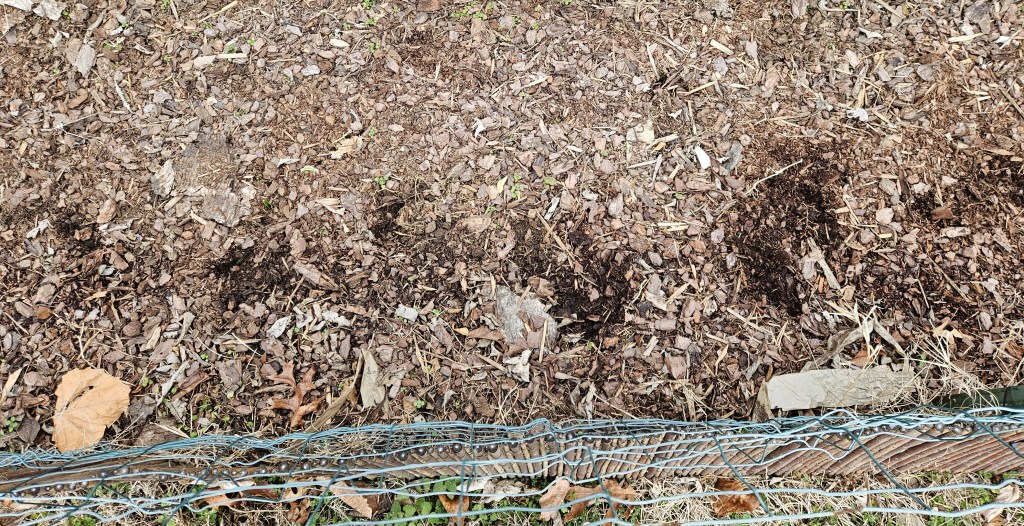
So why do I want the edging straight? To make it truly pretty, I would need to get a stronger fence, one that isn’t all bent and mushed from me leaning over it, but then I couldn’t lean over it to reach the ground. I could zip tie the edging more tightly to the raggedy fence, but that will make replacing the fencing more difficult if I choose to do so.

I am pleased that it hides the weeds growing on just the other side. I wouldn’t want anyone to know I had weeds in my garden! The weeds are still there, of course, doing their mischievous work. I have not made the effort to root them out or suppress their growth for the winter. But I would like others to think I have. I would like anyone who wanders into my back yard to think that I am industrious and organized and dedicated and marvelous. How ridiculous.

God is not fooled. He sees the garden as it truly is. I doubt anyone else is fooled either. The wavy fence line is visible from here. One small step closer and you’ll see over the edging and notice the weeds.

My attempts to make my garden pretty are not showing the world how marvelous I am. Instead, they are revealing my fear that you will see my imperfections and shun me for them.

My mind tells me that anyone who will shun me is not worthy of being my friend, but at times I am still that middle schooler entering the lunchroom. I want everyone to be impressed with me, to want me to sit at their table, to like my clothes, my hair, my abilities, my friendly and effervescent personality.

God is not fooled. He sees me as I truly am. I doubt anyone else is fooled either, at least not for long. If they look closely or step nearer, they will see my faults.

The odd thing is that I am rarely bothered by the weeds in other people’s gardens. Not everyone is a meticulous housekeeper. Not everyone is always kind and loving. Most people let vanity and pride, irritation and sarcasm grow in their gardens. We all have our weeds.

So, why do I want my garden to look pretty?

Am I now seeking human approval, or God’s approval? Or am I trying to please people? If I were still pleasing people, I would not be a servant of God. Galatians 1:10.

As with most things, my desire to have a pretty garden could be motivated by a desire to share God’s beauty with the world – an array of colorful flowers, the hues of ripe fruit, the luscious green of healthy plants. After all, God creates beauty every day in the shifting ombre shades of a sunrise or sunset, and my little garden can reflect a little of that.

But God sees my motivation as well as what I am showing to the world. He knows if I strive to honor Him or impress others. If I am reading Matthew 7:21-23 correctly, it is not pious actions, even those done in His name, that God seeks, but a relationship with Him.

But the Lord said to Samuel, “Do not look on his appearance or on the height of his stature, because I have rejected him; for the Lord does not see as mortals see; they look on the outward appearance, but the Lord looks on the heart.” 1 Samuel 16:7.

And no wobbly garden edging can hide my weeds from God. He sees them all. And He loves me anyway. He loves you anyway. Perhaps I need to let my weeds show and we can all stop pretending we are weed free, and love each other like He loves us, weeds and all.

Love in Christ, Betsy

Enthusiasm

I thought my cucumbers were enthusiastic plants, climbing their supports and stretching outside the fence, but they are mild in comparison to this raspberry plant!

In her second year, my raspberry plant has already birthed three new plants in the cracks in the cardboard covering. She is almost six feet tall. I sense I need to cut her back, hem her in, trim off the excess.

I have seen articles and studies on pruning, but I skim right past them. Tomato plants and cucumbers don’t require pruning. Although it’s possible they could be better if I did prune them…

Pruning is an important part of growing perennial plants, but I am new to perennials and have much to learn. Seeing this raspberry bush take over my garden and reach into the yard makes me want to learn. This can’t be best for the plant, best for the berry harvest, or best for me.

And yet, her growth is thrilling. Her enthusiasm for growth is contagious. I want to grow with enthusiasm and burst out all over the place!

My mother used to tamp down my enthusiasm on a regular basis, to the point where I felt like a wild pony trapped in a corral. But she understood. She had been a cheerleader in her youth; enthusiasm runs in my genes. Perhaps she was trying to prune me.

He removes every branch in me that bears no fruit. Every branch that bears fruit, he prunes to make it bear more fruit. John 15:2.

I am tempted to use this as my guide for how to prune. I am sure Jesus’ listeners at the time knew how to prune; they were grape and olive growers. They were being asked to apply their gardening knowledge to spiritual growth. Perhaps that is what the Holy Spirit would like me to do – learn how to prune this raspberry bush, when and how and to what extent, and apply that knowledge to my spiritual life.

Perhaps the goal should not be excessive growth that spreads out everywhere, but a contained healthy plant that produces much fruit. My smaller tomato plants are covered in green tomatoes, while this huge raspberry produces few berries.

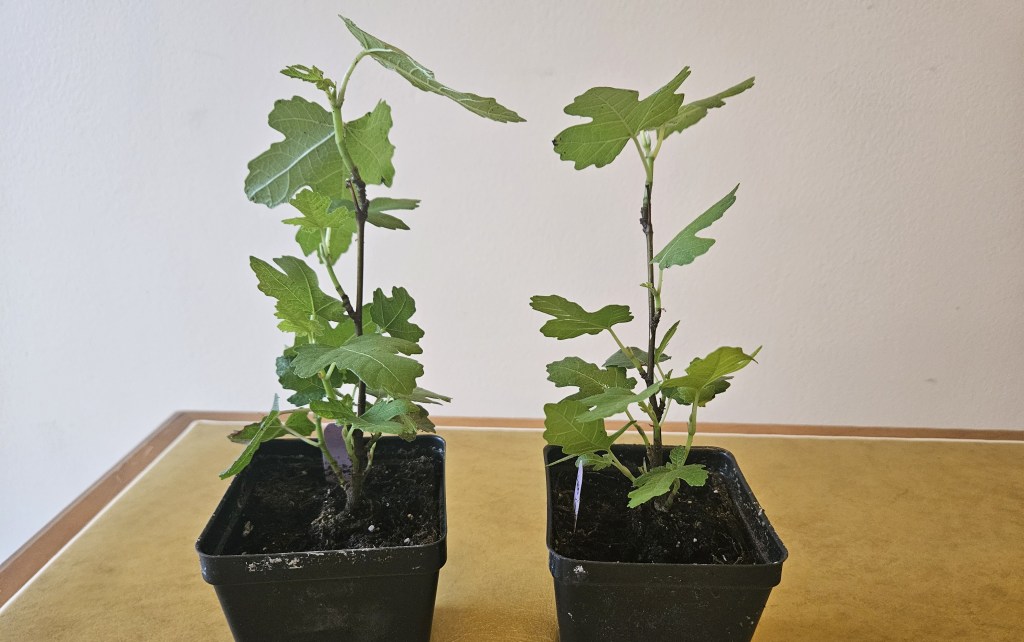
And her uncontained growth is casting a shadow on my fig tree, growing straight and true beside her.

Do nothing from selfish ambition or conceit, but in humility regard others as better than yourselves. Let each of you look not to your own interests, but to the interests of others. Philippians 2:3-4.

There’s a chance I, like my raspberry plant, have focused on the wrong thing – expansion verses fruit. There’s the possibility that my naturally enthusiastic self has spread beyond my boundaries and overshadowed another.

The raspberry bush cannot prune herself. It’s as if her enthusiastic nature can’t be contained. And I don’t want to stifle her; I just want her focused more on fruit than expansion. And that will allow my fig tree to flourish as well.

As for pruning my own enthusiasm, Jesus promises that the Holy Spirit will do this if we let him. He will prune us so that we will bear more fruit.

So, I will learn what I need to know about pruning and try to redirect my raspberry plant’s focus. Find the best way to encourage productive growth. Cut out the excess that her enthusiasm has rendered. I need to let the Holy Spirit do the same with me.

When the Spirit of truth comes, he will guide you into all the truth; for he will not speak on his own, but will speak whatever he hears, and he will declare to you the things that are to come. John 16:13.

The first thing I need to do is learn. The main thing I need to do is listen. The Master Gardener, the creator of all gardens, the creator of all life, knows what I need to do.

Love in Christ, Betsy

Cooler Weather

It’s hot today, but just last week we enjoyed unusual cool weather. The cool morning air called me to set my coffee down and pull some weeds. What a lovely time to be outside.

Recent rains have made my grass green again. The hedgerow has ended its summer siesta and is greeting me with outstretched limbs and upturned leaves. I know the days are getting shorter and soon these plants will tire and fade, but it is still August. My tomatoes may be on their last leg, but the peppers, the basil, the raspberry, and the fig are full of life.

So are the weeds.

During the hot weeks, I stopped pulling them every day. Their growth was stunted by the heat, as was my willingness to exert myself. But the cooler weather revived us all.

The cardboard laid across the ground has done a fair job of keeping the weeds away from the plants, but the fence line is a different story. There, on the edges of the cardboard, where the fence meets exposed ground, the weeds thrive. Crabgrass reaches over the mulch to cover the ground; tall grasses rejoice in their safety from the mower; pilgrims from the hedgerow find new homes. Sometimes the garden plants are hard to see through the weeds.

How did I let this happen? I had been so conscientious earlier in the summer. My attention had waned with the heat and the lack of fruit. Other matters had occupied my thoughts and my hands.

Discipline yourselves, keep alert. Like a roaring lion, your adversary the devil prowls around looking for someone to devour. Resist him, steadfast in your faith, for you know that your brothers and sisters in all the world are undergoing the same kind of suffering. 1 Peter 5:8-9.

I have not been disciplined, alert, steadfast. I have let the weeds grow.

But it is a beautiful cool morning so I will pull some now. I will recommit myself to pulling some weeds every morning.

Therefore, we must pay greater attention to what we have heard, so that we do not drift away from it. Hebrews 2:1.

Drifting away is so easy. New interests draw my eye. Other activities demand my time. Different challenges occupy my mind. Suddenly I am no longer focused on loving God and loving my neighbor. Suddenly there are weeds growing in my garden.

Sometimes I find it hard to focus on loving one another. It’s so nebulous. No clear check list. What does it mean to love one another just as Jesus loved us? (John 13:34)

Fortunately, Paul gives us a description of what a weed-free garden of love looks like.

Love is patient; love is kind; love is not envious or boastful or arrogant or rude. It does not insist on its own way; it’s not irritable or resentful. It does not rejoice in wrongdoing but rejoices in the truth. It bears all things, believes all things, hopes all things, endures all things. 1 Corinthians 13:4-7.

I have some weeds in my garden. They grew when I was busy with other things, when I had drifted away, when I wasn’t paying attention.

But God has granted me the grace to see the weeds and the gift of a cool morning. It’s not too late to pull some weeds. It’s never too late to share God’s love.

Do you know how much God loves you? Each and every one of you, no matter how many weeds are growing in your garden, no matter how little fruit is evident, no matter how far you may have drifted. God loves you.

Won’t you join me today in the cool of the morning? We’ll pick the weeds that hide the beautiful plants growing in our lives.

Love in Christ, Betsy

Information about my new book, Garden Devotions, is available in the menu at the top of this page. Just click on the link titled Garden Devotions! Thanks!

Nothing Remains The Same

Old age and high temperatures have taken their toll on my sugar snaps. I waited to plant some of my seeds until mid-March, so I might have sugar snaps in June, but it is too warm for them now. Their time has passed. Now, all my attention needs to go to the rest of my garden.

My tomato plants are sporting yellow flowers, promising red fruit in the future. Tiny green orbs are dotting my pepper plants. The cucumbers are claiming the space provided. My garden is growing. Even the fig and raspberry bushes are gaining height and sprouting new leaves, perfumed by the basil nearby.

Whenever I hear something that begins with “If things stay this way,” the gardener in me laughs. Things never stay the same. Nothing ever stays the way it is. God created His universe to be in a constant state of change. Even things that seem permanent to us like mountains and oceans are constantly changing incrementally. We know this. We have known this since childhood. And yet we still strive for permanence.

We strive to make things perfect in some delusion that they might stay that way. We build homes and offices to withstand storms, but we know they are not truly permanent. Ruins from civilizations long gone remind us that structures may outlast their inhabitants, but they will not remain the same.

The grass withers, the flower fades; but the word of our God will stand forever. Isaiah 40:8.

We long for that permanence like we long for the tree that produces fruit year-round. Because God has planted that image in our soul, an image of lasting permanence, an image of eternity, an image of Himself.

And He reminds me that I cannot achieve this by my own efforts on this earth. He reminds me of this every day as I walk along the garden and see how it has changed since yesterday.

There is a time for everything. It was true when Solomon said it, and it is true today.

I am not going to fret over the loss of my sugar snaps. They had a glorious season, but it is time for other fruits to shine. I will pull a garlic bulb soon to see how they are doing. Little green tomatoes will ripen into red ones. The cucumbers will continue to indulge their appetite for space.

And while I wait for all these changes, I will water and tend my garden daily. I will treasure this garden for bringing me outside every day. I may even pull the weeds that create a border around my growing plants.

These plants remind me that change is not always a bad thing. I do not want my garden to stay as it is right now, as beautiful as it is to me. I want my plants to age and bear fruit, even if it signals their impending death. That is these plants’ purpose.

I don’t want to stay the same forever either. I want to grow and mature and bear fruit, even as I know I am moving ever closer to my demise. I may live thirty more years; I may die today. God cares for me no matter my life span. He loves me and has put me here for a purpose. He loves you and has put you here for a purpose.

For by grace you have been saved through faith, and this is not your own doing; it is the gift of God – not the result of works, so that no one may boast. For we are what he has made us, created in Christ Jesus for good works, which God has prepared before hand to be our way of life. Ephesians 2:8-10.

And that word of God does remain the same, remains as true today as it was when it was written.

O give thanks to the God of heaven, for his steadfast love endures forever. Psalm 136:26.

Betsy

Growth

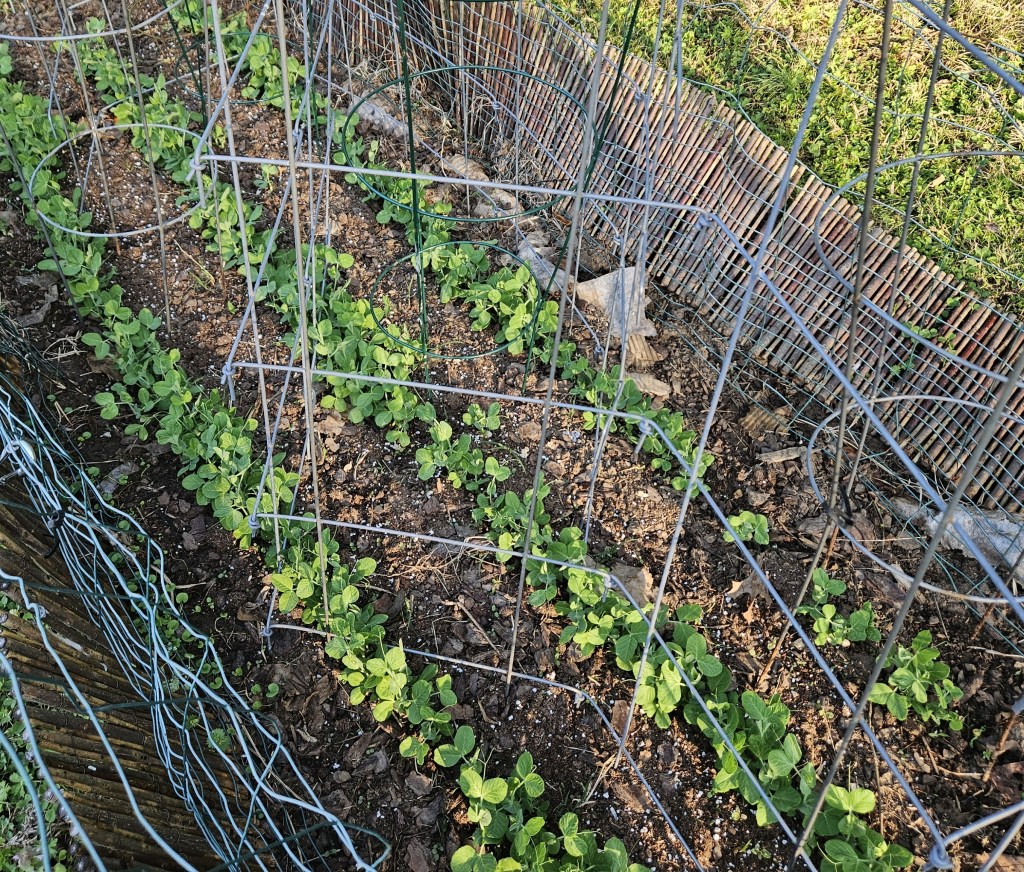
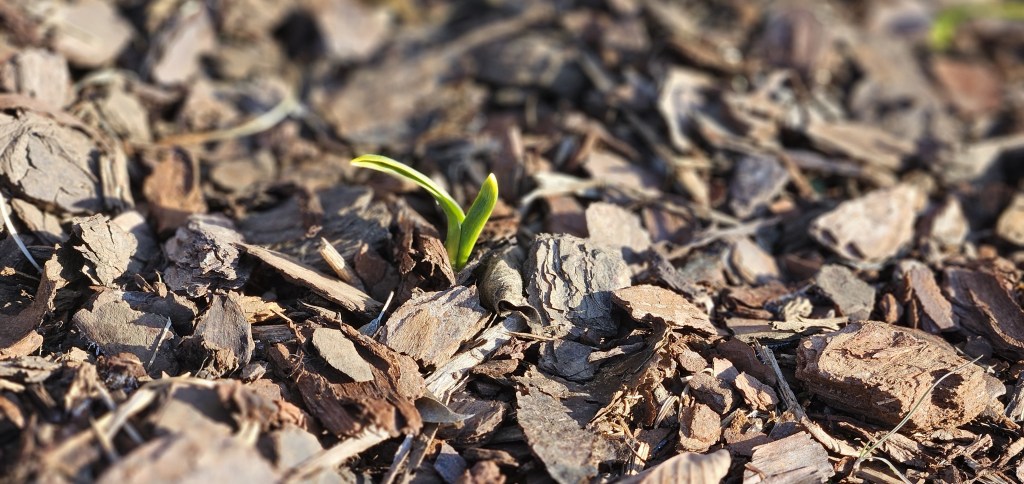
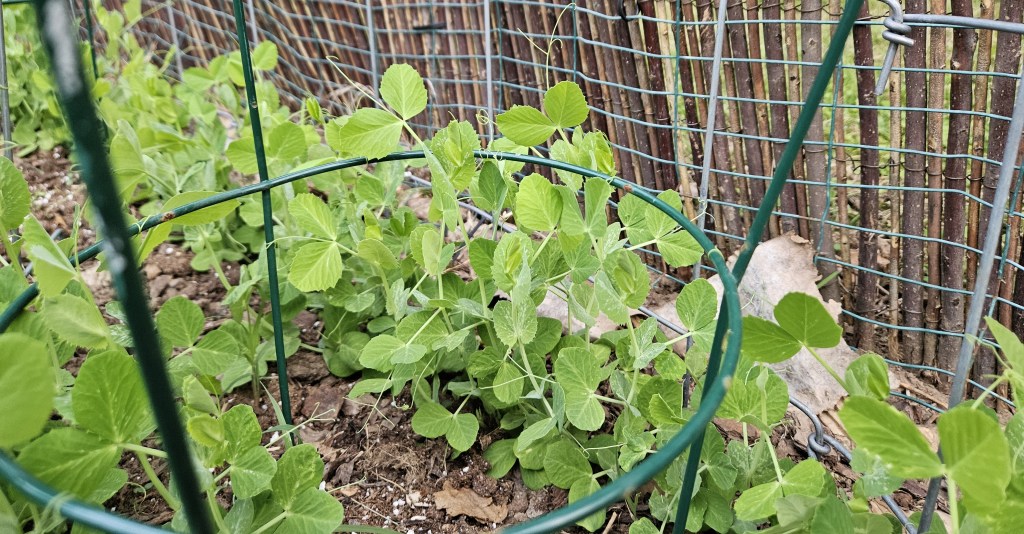
The sugar snaps are growing. The older ones are my height now, the younger ones are chest high. They are reaching out for anything to twirl their tendrils around, constantly pulling themselves upward. They are growing.

God fuels their growth with rain, and I provide water on dry days. They battle the weeds which have sprung up around them, trying to divert their upward growth. Some plants seem to struggle more than others.

I planted these seeds later than usual, so the garden is a few weeks behind my garden last year. The calendar date does not dictate when they blossom; the plants must reach a certain maturity before they produce fruit. My sugar snaps are still growing.

I could be frustrated that I don’t have fruit yet. It is May. But my frustration would not make these plants produce flowers. Seventy days of growth will bring fruit if they get plenty of water and overcome the weeds. Soon, but not today.

Be patient, therefore, beloved, until the coming of the Lord. The farmer waits for the precious crop from the earth… James 5:7.

Are you growing? Am I? Are we impatient to bear fruit when God knows we need this time to grow?

Some of you may be taller than me, further along in your maturity. Some of us may be battling invasive weeds which tie us down and hinder our growth. Some of us may be living in dry days; we may need the living water of communion with God before we can continue to grow.

The growing season can seem to last forever. Fear nibbles at the back of my brain, telling me things will never change, the plant will never flower, the fruit will never come. But that is not true.

Just as my toddler grand-twins will one day tie their shoelaces even though they can’t now, so my plants will one day bear sugar snaps, so we will one day bear the fruit God is growing in us.

The kingdom of God is as if someone would scatter seed on the ground, and would sleep and rise night and day, and the seed would sprout and grow, he does not know how. The earth produces of itself, first the stalk, then the head. But when the grain is ripe, at once he goes in with his sickle, because the harvest has come. Mark 4:26-29.

God is the one growing fruit. As Jesus tells us in John 15, only God can produce His fruit in us; we cannot produce it on our own. We sprout and grow, and we do not even know how. It is not my job to worry about when His fruit will appear. It is my job to stay connected to the vine, stay hydrated with prayer, and overcome the weeds. And to watch for the fruit, to put it to good use once it appears.

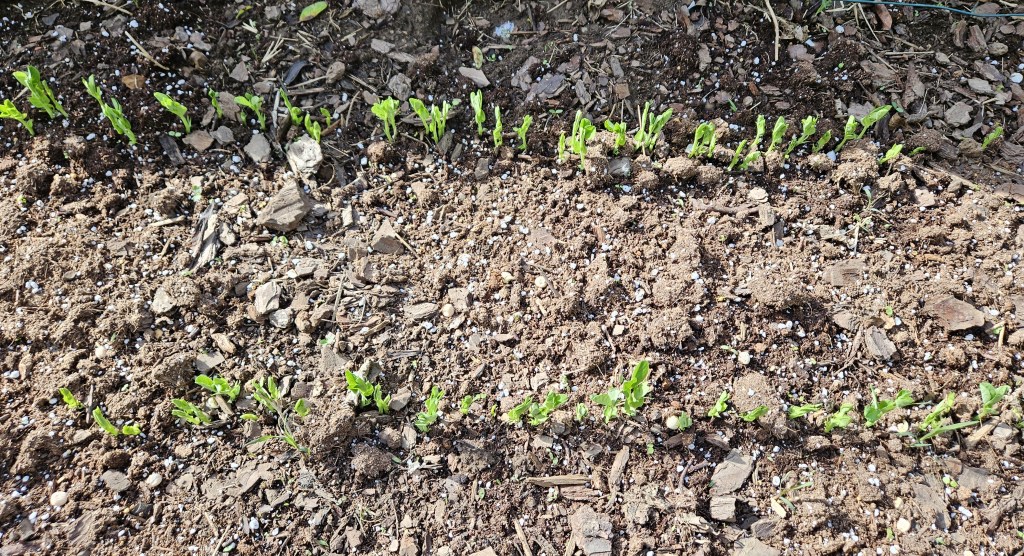
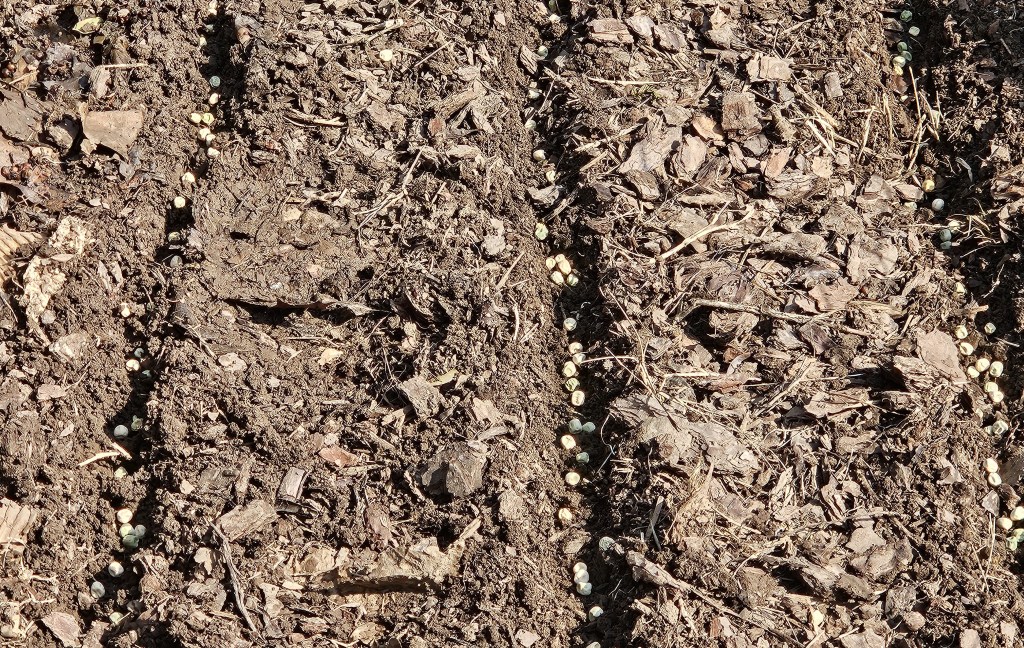
I am proud of my growing sugar snaps. They look beautiful to me, reaching out, reaching up, growing taller every day. To think that the dried pods I put in the ground in March have matured into these plants amazes me. God has completely transformed them. Once lifeless, they are now on the cusp of bearing fruit. Isn’t God amazing?

Too often I am so focused on what has not yet happened that I fail to see all that God has already done. He has brought life where there appeared to be none. He does it every day, everywhere. He has brought growth even when we thought it impossible.

Today, I rejoice and give thanks for growth. Won’t you join me?

Let the heavens be glad and let he earth rejoice, and let them say among the nations, “The Lord is King!” Let the sea roar, and all that fills it; let the field exalt, and everything in it. I Chronicles 16:31-32.