An unwelcome visitor

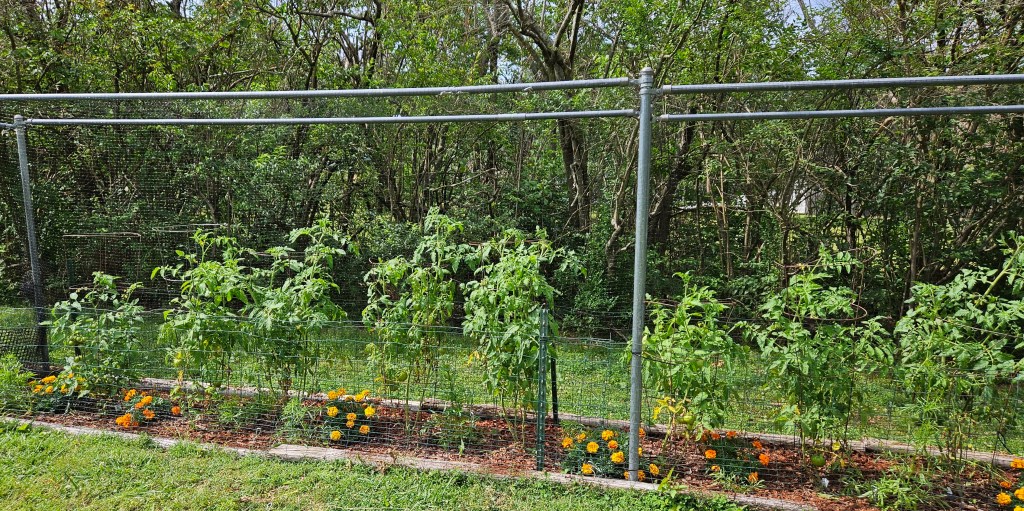
I had an unwelcome visitor in my garden this morning. No bigger than a chipmunk, this baby bunny was more interested in my weeds than my tomatoes. Perhaps he wanted to nibble on the companion flowers, supposedly a repellent for rodents, perhaps not so much for rabbits.

My presence sent him into a panic, racing back and forth along the fence, looking desperately for an exit point. I would not have hurt the bunny, but he didn’t know that. I am much bigger and stronger than he is, so I could have hurt him; I could have killed him. Instead, I stopped to get a picture and let him catch his breath. Then I lifted an edge of the netting and gave him a way out. I wanted him out of my garden. Eventually, he found his exit and fled to the safety of the hedgerow.

 Just then there was in their synagogue a man with an unclean spirit, and he cried out, “What have you to do with us, Jesus of Nazareth? Have you come to destroy us? I know who you are, the Holy One of God.” But Jesus rebuked him saying, “Be silent, and come out of him!” Mark 1:24-25.

Not all predators are satanic evils threatening our existence. Some are cute little bunnies looking for a new place to dine. I thought about letting the bunny stay. If I had, he probably would have died from heart failure by my daily presence. He probably started visiting my garden while I was away. Now that I am back and checking on the garden regularly, my presence alone should make the garden a less enjoyable place for the bunny.

Perhaps the Holy Spirit’s presence in us makes our lives a less enjoyable place for ungodly forces to visit.

Perhaps the appearance of the Holy Spirit sends our ungodly thoughts into a panic, racing back and forth along the fence, looking desperately for an exit point. Maybe if we invited the Holy Spirit into our lives daily, the ungodly forces would either die from heart failure or leave us for friendlier and safer spaces.

Once the bunny was gone from the garden, I examined the fence and netting all around the tomatoes. How had he gained entry? What space had I left unguarded? What gap had he wiggled through?

When I discover unwelcome, ungodly thoughts running rampant in my mind, the Holy Spirit can drive them out, but I need to examine my life. Where did these thoughts come from? How did they get in? Was it that trashy movie I watched? Or that godless and depressing book? Is it my insatiable need for entertainment, or my pride and ego?

I need to find the gap, because if that cute little bunny can get inside, tomato stealing chipmunks and squirrels can as well. If little ungodly thoughts find an easy residence in my mind, larger, more dangerous thoughts can as well.

Be on guard so that your hearts are not weighed down with dissipation and drunkenness and the worries of this life. Luke 21:34.

When I go out tomorrow to check on the garden, I will check carefully for evidence of the bunny’s return. If he has been back, I will recheck the fencing. I have lost too many tomatoes to chipmunks and squirrels in the past.

Have I learned this lesson in my life? How much of my peace and patience and joy and love of others have I lost to unwelcome visitors – worry and insecurity and fear and selfishness?

God is big and scary to these petty concerns, much bigger and stronger than these unwelcome visitors. His presence will send them racing for an exit from your life. His continued presence will keep them out.

 He commands even the unclean spirits, and they obey Him. Mark 1:27.

Betsy

The Traveler

I’ve been out of town, so no new updates on the garden. Instead I thought I’d share this piece of fancy with you. It’s a little long, but I hope you enjoy it.

I had walked to the edge of the field and sat down; just looking at the trees and the abundant undergrowth, trying to catch a few minutes of quiet. Under the mature trees, hundreds of dark green leafy plants covered the ground. They looked so healthy; there were so many, all the same, as far back into the woods as I could see. In my yard, I would consider them weeds and mow them down, but here they had created a community.

Some were taller or shorter, but all seemed to thrive. Are they families with in-laws and grandchildren? Are they neighbors helping each other grow? I felt comfort in this community.

And then I spotted them, the three strangers. At the edge of the woods, at the edge of this community, aliens, immigrants. Their spindly bright green leaves contrasted with the broad dark green growth of their neighbors. Why were there here, I thought, on the edge of the community? Were they not welcomed in? Were they tolerated only here, on the outskirts?

“I’m sorry.” I told them, on behalf of all communities everywhere.

“We are travelers,” the matriarch told me. “We have come from far away and found water and good soil. Here on the edge, away from the established trees, we see the sun throughout the day.”

“Are you lonely?” I asked.

“I have my siblings with me. We have found a place to put down our roots and alter the landscape a little.”

It was then that I noticed all the nibbled-off ends. Some critter had bitten off the flowers, the tops of every stalk that reached for the sun. 

“Oh! Your children! How tragic, to have lost them all!”

“I have not lost them,” the wise woman replied. “I have sent them off to travel. Here at the edge of the woods, I call to those with legs, and they respond. They help my children travel to unknown places, find their own good soil and ample water, put down their own roots. We are travelers, and someday, we will have seen the world and lived everywhere.”

I sat quietly beside these adventurous plants. The breeze lifted my hair and cooled my neck. The smell of the mown grass behind me overwhelmed me. Had we inadvertently mowed some of her sister plants? Had we done it on purpose?

“There is often loss, sweet child.” I heard her say. “Traveling can be dangerous. But I could not imagine my life trapped here like my neighbors, living in the shade under the trees, unable to explore new cultures. I bring the tales of all my traveling ancestors to this place, add my story, and send my children off to add their own.”

I sat and felt the grass under my hands and the sun on my face. What a wise woman this plant was. Could I learn from her?

She has traveled from her home to an unknown world and put down roots. She has sent her children joyfully out into the world to learn from it and teach it, to establish their own roots. I am a native species. Generations ago, my ancestors traveled here, but now we have established ourselves in this spot. I want my children close.

“I have never traveled anywhere,” I admit to her. “I have lived my whole life here, with no desire to live anywhere else. I have surrounded myself with others very similar to myself. I am like the plants under the trees.”

The breeze sways the plants and pushes my hair across my face. A mockingbird is singing other’s songs, joyfully intermixing them as he wishes. In the distance, I can hear shouts of joy from the ballpark. Taking a deep breath, time slows.

“You have traveled here today to speak to me, my child,” my new friend comforts me. “Your parents never even saw me, but your children will hear this story and add their own.”

“Not all travel is physical,” this wise matriarch adds. “Perhaps the hardest travel, the most dangerous travel, is mental, spiritual, and emotional. You have started that journey today.”

I hear my family calling me back and slowly push myself off the ground. Somehow, I am not the same person I was when I sat down. Could I hold on to this expanded world? Could I see the trees and plants, weeds and grasses, as fellow citizens of God’s earth? Could I learn from them? I certainly did today.

Tomorrow, I will go out again. Perhaps I will meet someone new. Maybe I will talk with someone in the community under the trees; maybe not. They may not welcome travelers into their midst or talk with strangers. I understand. Yesterday, I was just like them, but I am learning.

Faith

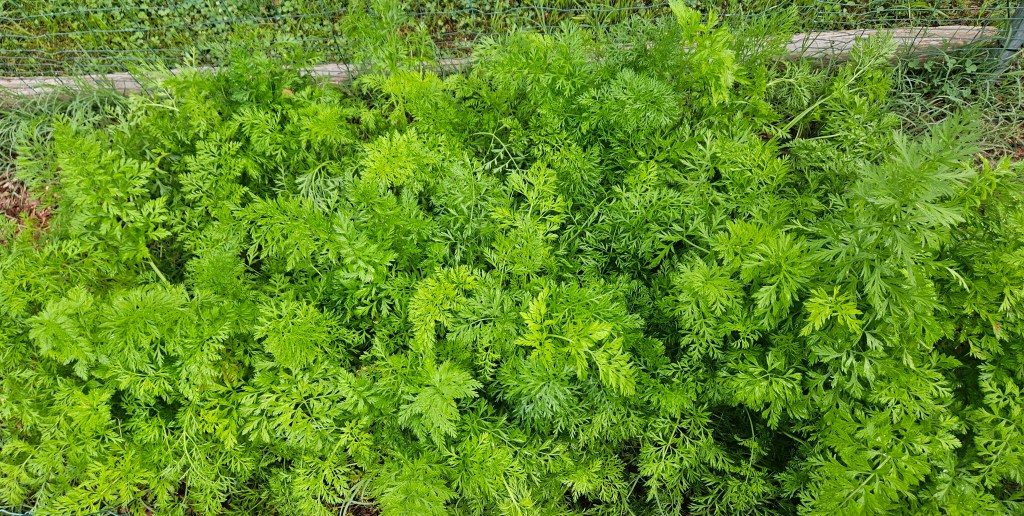
These are carrot plants. I’ve never planted carrots before. I’ve never planted any root vegetable before. I’m not sure I’ll know when they are “done.”

Carrots aren’t like tomatoes that turn red to let me know when to pick them. Supposedly, the tops of the carrots will push out of the ground; that will be my signal to dig them up. I hope that’s true. The plants look healthy to me; I’d hate to mess up a good crop by harvesting them too early or too late. I hope they actually are a good crop; hard to tell since I can’t see them.

A garden is an act of faith. Acts of faith are a little scary; so many unknowns.

Now the Lord said to Abram, “Go from your country and your kindred and your father’s house to the land that I will show you.” Genesis 12:1.

Not even, “Move to that land you’ve been visiting over the years.” Move to that land I will show you. Just pack and go. I’ll let you know when to stop. When the carrot tops push up out of the ground? At least someone told me that the carrot tops would push out of the ground.

It’s a little ridiculous comparing growing carrots to Abram’s journey, but it may be about as adventuresome as I get. Small steps. I do not know how these carrots will turn out. And I can’t monitor their growth or health; it’s all underground.

But there are these visible signs of the growth going on underground. There are these healthy-looking fronds. This greenery encourages me that God is growing healthy carrots where I can’t see them. Maybe Abram has some signposts along the way – “You’re going the right way!”

Peace I leave with you; my peace I give to you. John 14:27. 

Peace. Now that’s some leafy green fronds!

Take a breath and let that sink in.

The tough part of this, for me, is the waiting. I’m used to instant access and “timely” responses. I planted the carrots in late April. I would never have waited that long for an email response!

Wait for the Lord, be strong, and let your heart take courage; wait for the Lord! Psalm 27:14.

A garden takes faith, and a garden takes waiting. A seed planted in February bears fruit in May; a seedling planted in May bears fruit in July. Some things you just can’t rush. For reasons we may not understand, some things just take time.

Be patient, therefore, beloved, until the coming of the Lord. The farmer waits for the precious crop from the earth, being patient with it until it receives the early and the late rains. You also must be patient. James 5:7.

When I hear of evil in the world; when I encounter prejudice and fear-based hatred in my circle of friends; when I let my bias color my view of others, I wonder, with the psalmists of old,

How long, O Lord? Psalm 119:81, Psalm 13:1, Psalm 71:12, Psalm 89:46.

How long before we can see others through God’s eyes? How long before we can give to others without worrying about ourselves? How long before we can react to hate with love? How long before we spend our time building each other up instead of tearing each other down? How long before the Holy Spirit’s fruit is evident in my life and the lives of others?

But then I see a leafy green frond of love and acceptance, of grace and gift, and I thank God for the signs that something good is growing.

Someday, those carrots will rise above the ground. Someday, His kingdom will come on this earth. Have faith, my friend.

“Surely, I am coming soon.” Amen. Come, Lord Jesus! Revelation 22:20.

Betsy

Guarding the Fruit

The robin sits on the framework of my garden and tilts his head. I can almost hear him. “Are those tomatoes ripe enough for me to peck?” A squirrel barks at me from the nearby tree, claiming the tomatoes as his own. I regret to inform you, friend robin and mister squirrel, these tomatoes are not for you!

I have put up a fence to protect my plants from rabbits, pets and errant children, but a fence won’t stop a bird or a squirrel. I need bird netting. Without the bird netting, the robins peck the ripening tomatoes, encouraging bugs to swarm the gooey innards, which the birds devour. Squirrels will take the entire tomato from the vine and horde it away with their nuts.

Bird netting is a thin mesh of material that drapes over the plants. Nick erected the poles around the garden as a support for the netting, so it wouldn’t become entangled in the leaves. (Plus, he liked to build things!) Clipped securely to the fencing, the netting allows access only to insects. To tend to the plants, I have to unclip the netting, but it is worth the effort to protect the fruit. Just in case I have some gaps, I have repellant flowers planted among the tomatoes.

Is this overkill? Do I really need to go to all this effort? Yes! I have gardened for 30 years and lost countless tomatoes to birds and squirrels. What a waste to pour so much time and effort into growing them, only to lose out at the end and not be able to reap the benefits.

Therefore take up the whole armor of God, so that you may be able to withstand on that evil day, and having done everything, to stand firm. Ephesians 6:13.

 Is it overkill to be constantly on guard against forces that would take our fruit from us? I don’t think so. Even if the robins and squirrels aren’t “evil,” I don’t want them to ruin my fruit. I don’t want my peace and kindness destroyed by slanderous political rhetoric from either party. I don’t want my joy and generosity ruined by endless comparisons on social media. I don’t want my self-control challenged by abundant opportunities for self-indulgence.

Putting up the bird netting is not an effortless task. Almost invisible, the netting catches on the fencing, the poles, the plants, the buttons on my shirt. I need to make sure I clip the netting tightly to the fence, but not so much as to limit my access to the tomatoes. There’s a balance there that requires constant reassessment. It takes effort, but if it protects my tomatoes…

Now, discipline always seems painful rather than pleasant at the time, but later it yields the peaceful fruit of righteousness. Hebrews 12:11.

Am I spending this much time and effort, this constant reassessment, protecting my relationship with God, balancing the calls on my time with His call? I can only pray for the strength to do so. Because I am encouraging the growth of His fruit in my life, His fruit for His purposes. My tomatoes are not being grown for the robins and squirrels, and His fruit is not being grown to win accolades from others. Just as I must guard my tomatoes, I must guard my heart, out of which His fruit grows. I do this by spending time in prayer and communion with God, by reading and studying His Word, and by putting on the full armor of God (Ephesians 5:14-17).

And the peace of God, which surpasses all understanding, will guard your hearts and your minds in Christ Jesus. Philippians 4:7.

How sad it would be to lose what fruit God has grown in us because we did not make the effort to protect it. So while social expectation may tilt its head at me, wondering if I’ll play its game, and worldly ways may bark at me, trying to claim my affections, I will boldly inform them to keep out of my garden.

Betsy