Not So Fast!

I thought my garden was over for the year. But just like Lee Corso on Game Day, God is reminding me I don’t have the last say.

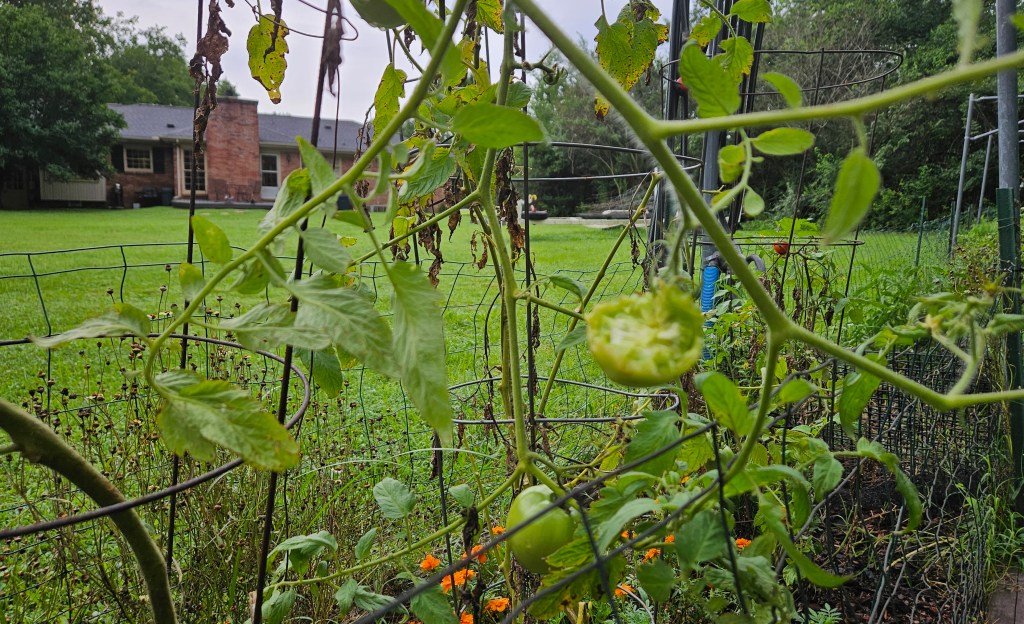
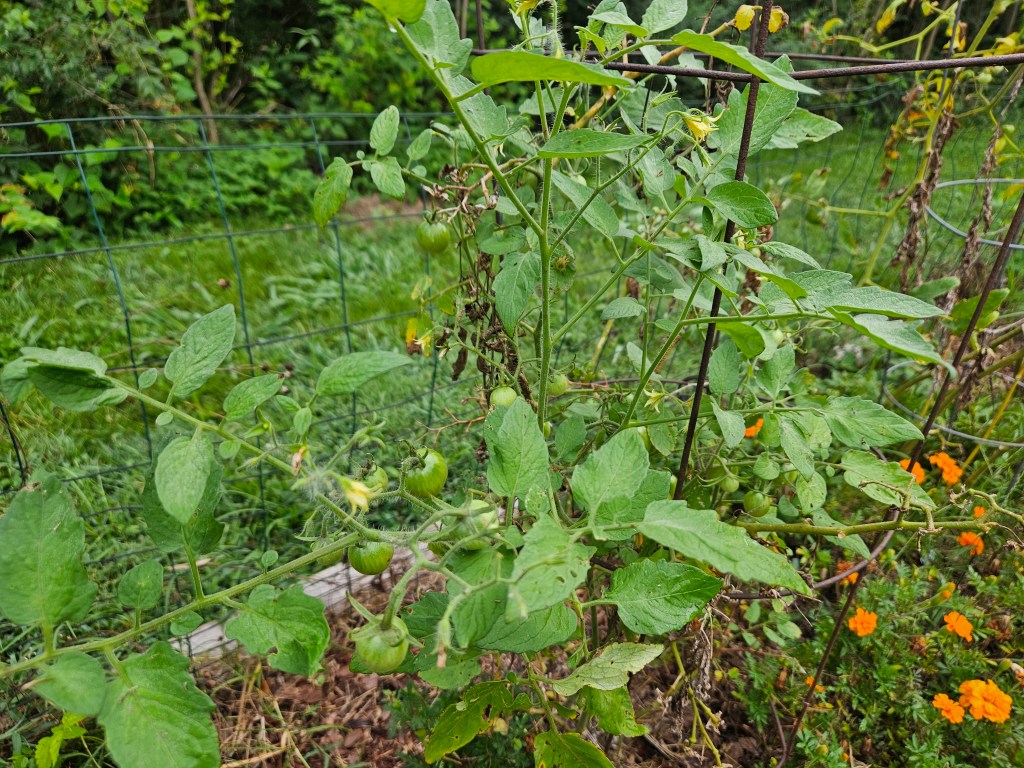
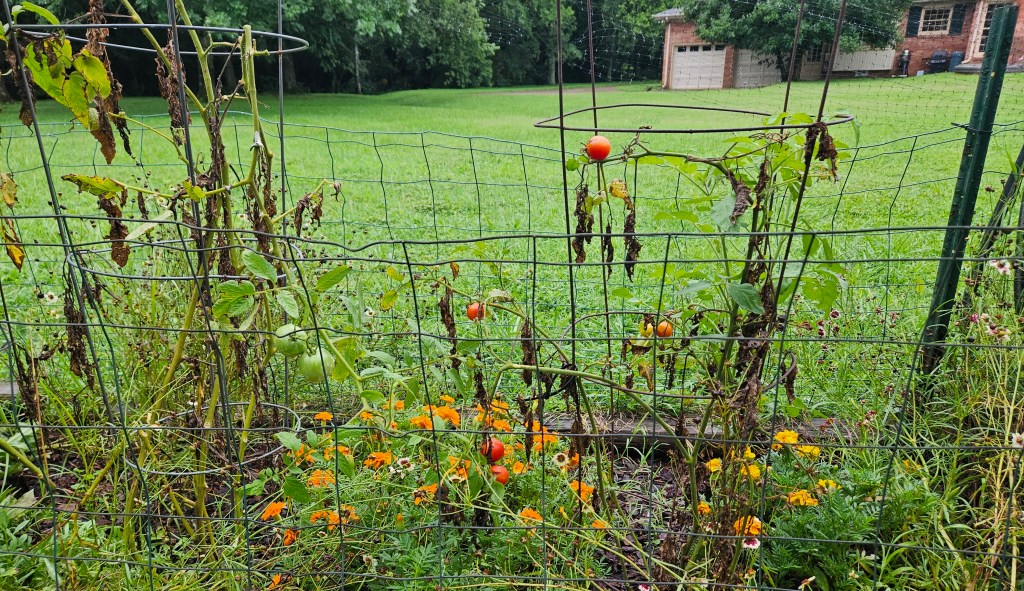
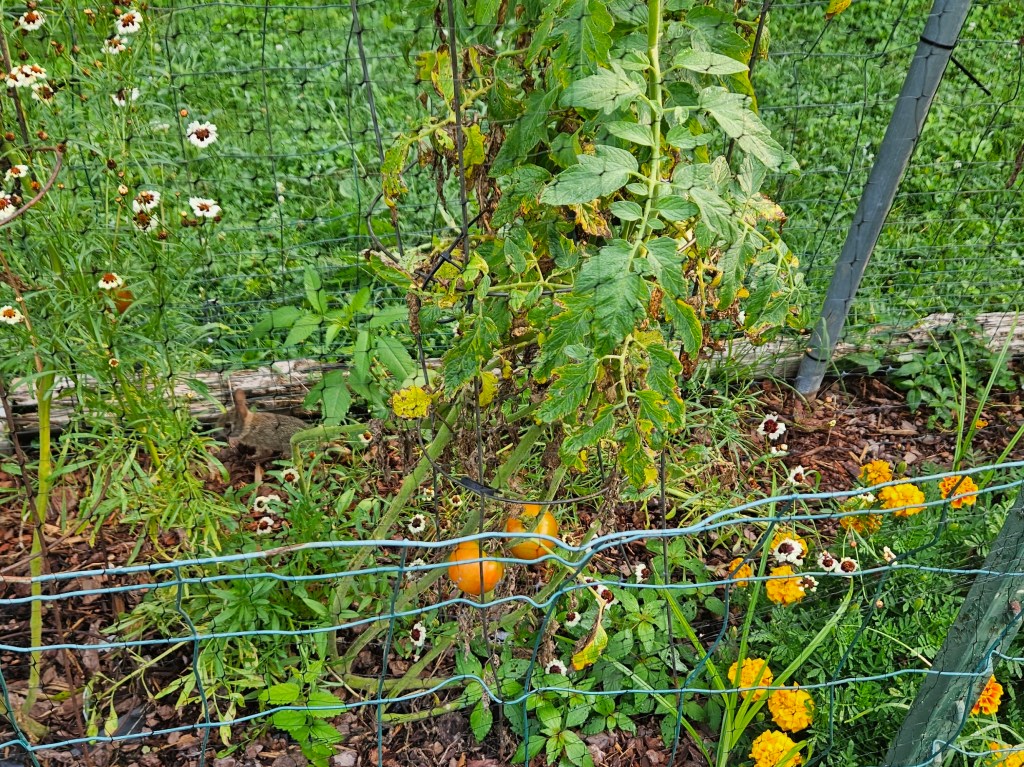
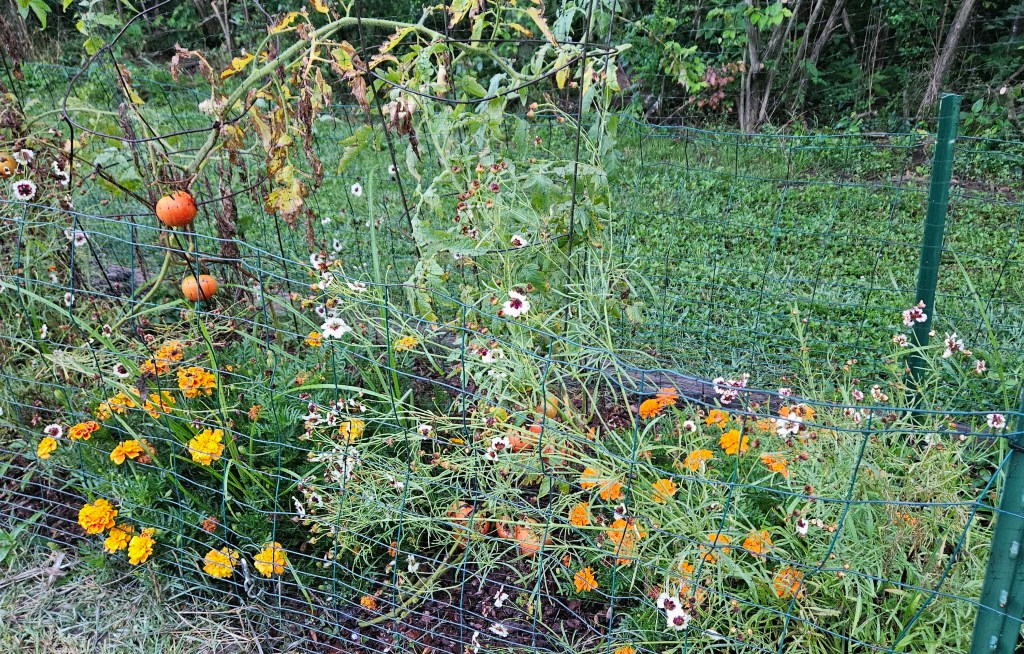
Despite record heat, my once wilted tomatoes are showing signs of life. New green tomatoes are growing on the few surviving stalks. I was ready to pull them all up, but wait! Not so fast, Betsy. There is growth here; there is fruit here.

Isn’t God amazing!?! Just when I thought my garden was all dried up and lifeless, there is life! There is fruit!

Perhaps I should be accustomed to God bringing dead things back to life; He certainly has a history of doing so. Yet it always amazes me! Such joy! Such hope! How can pessimism survive in the face of such evidence?

These new green tomatoes on my dying plant remind me that with God all things are possible. If He can create the cosmos with a word and man with a breath, of course He can create new tomatoes on a dying plant. Of course He can revitalize a lagging congregation. Of course He can reunite disputing factions. Of course He can breathe energy into a seemingly hopeless situation. Of course He can!

Now to him who by the power at work within us is able to accomplish abundantly far more than all we can ask or imagine, to him be glory in the church and in Christ Jesus to all generations, forever and ever. Amen. Ephesians 3:20-21.

I am often ready to give up and move on. Not just with my garden, but with all kinds of things. How many times have I set a deadline and moved on when others did not meet it? Is this efficiency or impatience? Does this tendency indicate practical realism or cynical unbelief?

My parents, German to the bone, managed our family of eight by enforcing strict time frames. If we were to leave at 5, we left at 5, whether you were ready or not. I still get anxious if I know I am running late. I try to be more gracious with others, but I still have to fight the urge to give up and move on when they are not on my schedule.

God is working on this in me. He is not on my schedule. If He has a schedule, He alone sets it. There is a rhythm to life that He has given us based on the rotations of the earth around the sun, but I sense He is not bound by that. Seasons and laws of nature are a gift to us, not a restriction on Him. 

So even though it is late August, I have little green tomatoes on my aging plants. Even though I am a widow in my sixties, I have started a blog and am learning how to write. Even though you may feel used up, tired, and dying, God can produce something new and wonderful in your life.

If the Spirit of him who raised Jesus from the dead dwells in you, he who raised Christ from the dead will give life to your mortal bodies also through his Spirit who dwells in you. Romans 8:11.

And this life is not merely eternal, it is full and vibrant in the here and now. Life with Christ is like new tomatoes on an old plant. His Spirit within gives me the ability to be patient and flexible in my dealings with others, and with myself. He makes me hopeful and expectant rather than cynical and pessimistic. 

I am so glad I didn’t pull the plants up already. I am so grateful that I had not given up on them and moved on yet. God still had life for them to live. God still has life for me to live. God still has life for you to live.

I came that they may have life, and have it abundantly. John 10:10.

Betsy

End Times

There is a sense among many Christians today that we are in the end times. My garden is in the end times. The tomato plants have turned brown and wilted. The cucumber leaves are yellowed and curling. No new fruit is evident. Only the flowers and weeds seem to thrive. The carrots have yet to push above the ground; perhaps they never will.

Yes, this is the end times for my garden. And yet, it is not. This is just the end times for this garden. Next year, God willing, I will have another garden. It won’t be exactly like this one; every year my garden is a little different. Every year, some plants flourish and others struggle. Heat waves, droughts, flooding, sudden cold spells – even if I plant all the same things, each year the garden grows in a unique way.

What looks like the end is actually just change. Change can be scary, but it is certainly nothing new. Change may indicate the end of some patterns that we love, but it has yet to indicate The End.

And you will hear of wars and rumors of wars; see that you are not alarmed; for this must take place, but the end is not yet. Matthew 24:6.

Since Jesus spoke those words, Rome has fallen, the Holy Roman Empire has fallen, the Ottoman Empire has fallen, Russia continues to increase and decrease. Atlas makers cannot keep up with the shifting African nations. Will America fall? History teaches us it is bound to happen at some point or another. But as Christians, we have a dual citizenship. Even if our nation changes radically, even if our nation falls, our status as citizens of God’s Kingdom will not change. His Empire will never fall.

But our citizenship is in heaven, and it is from there that we are expecting a Savior, the Lord Jesus Christ. Philippians 3:20.

Yes, our world is changing; so is my garden. My garden is dying; soon it will be dead. For a season. Since I have a longer concept of time than my plants, I know that this is just a time of rest. The garden will be back next year. It will be different, sure, maybe better, maybe not, but this is not the end of all gardening.

Imagine how much larger God’s concept of time is than ours. Eternity. What is 400 years? What is a thousand? What is four thousand? That’s about how long ago God called Abram. Has it been the blinking of an eye for Him? Treasuring every moment as a parent treasures their moments with their children; time seemingly passing so quickly. 

But do not ignore this one fact, beloved, that with the Lord one day is like a thousand years, and a thousand years are like one day. 2 Peter 3:8.

So, yes, my garden is ending. Soon I will pull up all the dead plants and let the ground rest for the winter. Soon, these plants will stop taking from the earth and return their nutrients to the soil. This change is not a cause for fear or distress. Perhaps it is a time to examine myself and see where I have put my confidence.

Am I trusting my efforts and my garden to feed me? Don’t I know that God alone can make a tomato grow? Am I trusting our government to eradicate evil in our society? Don’t I know that God alone can overcome evil? Don’t I know that Jesus Christ alone is my savior? 

Some take pride in chariots, and some in horses, but our pride is in the name of the Lord our God. They will collapse and fall, but we shall rise and stand upright. Psalm 20:7-8.

If this is the end times, let us take the opportunity today to put our confidence in God and take pride only in His saving grace. If this is just a change of seasons, putting our confidence in God alone will prepare us to embrace God’s gifts in the new season.

May the peace of Christ be with you.

Betsy

True Beauty

I find aging plants fascinating. As the tomato and cucumber plants yield their fruit, their once verdant leaves begin to brown. As the heavy fruit weighs down the branches, the leaves begin to wilt and sag. It seems as if the plant is putting all its energy into producing fruit, no longer as concerned about its appearance.

Of course, it is every bit as beautiful to me as it was as a young plant. As excited as I was to see its growing green leaves, I am more excited to see its ripening fruit.

Do not adorn yourselves outwardly…, rather let your adornment be the inner self with the lasting beauty of a gentle and quiet spirit which is very precious in God’s sight. 1 Peter 3:3-4.

Perhaps this happens to us as we mature as Christians as well. As we focus more on deepening our relationship with God and encouraging the growth of his Spirit’s fruit in our lives, we have fewer resources to give to our outward appearance. Perhaps, at some point, being patient and kind becomes more important than looking younger than we are.

After all, I did not plant those tomato plants to be beautiful plants in my garden. I planted them to bear tomatoes.

I don’t believe God put us in this place and time just to have people admire us. He put us here for a reason: to bear His fruit, to love one another, to further His Kingdom.

For we are what he has made us, created in Christ Jesus for good works, which God has prepared beforehand to be our way of life. Ephesians 2:10.

How beautiful we must be in God’s eyes when we bear His fruit, when we do His will! This is why He created us, planted us in this place, and provided His food and water for us. So what if our leaves brown and wilt? So what if spots appear and our branches droop? The beauty of young things may encourage us to care for them, but true lasting beauty comes in maturity.

And how convenient that this aging out of the garden comes right as everything else is gearing up. Although that is no coincidence. The school year was set when we were a largely agrarian society. Families needed the kids at home during the growing season; their livelihood depended on the summer crops.

Education, football, volunteer work – all that could wait until the crops were in. So, in the summer, I tend to my garden and swim in the lake. In the fall, I go to Bible studies and committee meetings and watch football. This rhythm is still very ingrained in us, even as we move to year-round school in our post-agrarian society.

When my kids were in school, Nick and I battled the push for year-round school. At some deep level, I appreciate that there are seasons for things. Not every day should look the same; not every month should mimic the month before. Maybe because I have a garden, I appreciate the cycle of growth, production, and rest. Non-stop sameness is a product of industrialization; out of sync with the natural flow created by God.

On a bigger scale, this rhythm and flow, this constant change, is part of our spiritual life as well. There are times of growth, times of production, and times of rest. Even as we honor God in everything we do (Col. 3:17), we have seasons of study, seasons of service, and seasons of quiet communion with God.

And there is beauty in all of it. God sees it, even if others may not.

For the Lord does not see as mortals see; they look on the outward appearance, but the Lord looks on the heart. 1 Samuel 16:7

So, when I look at these plants, I do not see the browning leaves but the beautiful fruit. When I look at my older Christian friends, I do not see the lines on their faces but the love in their eyes and the smiles on their lips. I pray we can be beautiful in every season.

Betsy

Trial and Error

I tried something new in my garden this year. Actually, I tried several new things in my garden this year, but right now I am thinking about the Ruby Kisses.

According to the seed catalogue, coreopsis, aka Ruby Kiss, is one of the most squirrel repellent flowers available. After losing most of my tomatoes to squirrels and chipmunks last year, I was in for adding these lovely sounding plants to my garden.

The problems started when the seed packet arrived. For some reason I can’t now recall, I started these flowers in trays on my kitchen table. Surely I did not read that I should start these flowers this way – what a disaster! After purchasing seed trays and potting soil, I dutifully surrendered my kitchen table to the process. Soon, towels also covered my table, to protect it from the excess or errant water and ever-present dirt. Most didn’t come up, but little green sprouts crowded a few of the pots. So I got some larger pots, biodegradable ones that I could put right in the soil when the time came. I only killed about half the plants in the transplanting process.

By the time I was ready to plant my tomatoes, I had about 8 two-inch tall plants to add to my garden. Definitely not worth the effort and mess. I would buy some marigolds when I bought the tomatoes. Although not as effective, according to google, they were pretty and available and mostly grown, so I bought the marigolds.

Just for kicks, I also planted my struggling Ruby Kiss seedlings in among the tomatoes and marigolds. I mean, why not?

Now it’s hard to tell if I am growing tomatoes or wildflowers. No squirrels, but what a mess!

The beauty of a garden is that I now know not to pursue Ruby Kisses in the future.

If we confess our sins, he who is faithful and just will forgive us our sins and cleanse us from all unrighteousness. 1 John 1:9.

Sometimes, I just have to learn things the hard way, by trial and error.

You know what else, besides Ruby Kisses, that is not good for my garden? Resentment. I had to learn that one the hard way, too. I had nurtured it along, feeling it was justified; transplanted it into bigger pots like my family and friends; spilled dirt all over my kitchen table. What a mess. Just have to dig that up and never plant it again.

Condescension is a lot like Ruby Kisses as well. I sense it will protect me, but soon it is overshadowing my fruit. When others look at my garden, is that all they see? Maybe a tomato hidden in there somewhere?

The beauty of the life, and particularly life with Christ, is that we get a new garden every day.

Search me, O God, and know my heart; test me and know my thoughts. See if there is any wicked way in me and lead me in the way everlasting. Psalm 139:23-24.

Perhaps, instead of trying to justify why I am growing Ruby Kisses in my garden, I should be grateful for the lesson learned. Instead of feeling guilty about my errors, I should simply uproot the plant and move forward; see this as a learning moment (a test?). Have I let sin grow in my life just as I have let Ruby Kisses grow in my garden? How much more lovely would my garden be if I could just admit it and move on?

What a gift that God allows us to try and fail. What a gift that God gives us the opportunity to try again, to have a re-do, a make-up test. What a difference it would make if I could look at test results and see not where I failed, but where I could improve.

Create in me a clean heart, O God, and put a new and right spirit within me. Psalm 51:10.

God loves us. We do not need to have a perfect garden for Him to love us; He already does.

We do not need to ace a test; I think we never will this side of heaven. God wants what is best for us. He wants to grow joy and peace and love in our gardens, in our lives. If we mess up occasionally and plant some Ruby Kisses, He forgives us. I’ve learned my lesson. Thank You, Lord.

Betsy

Worth the Effort

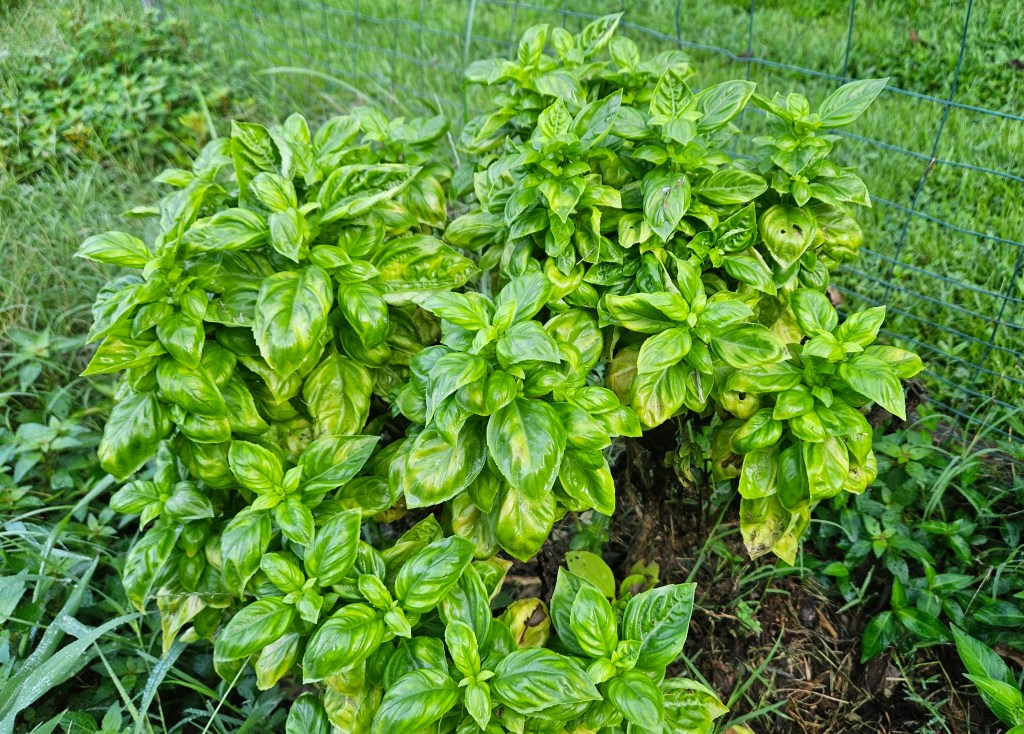
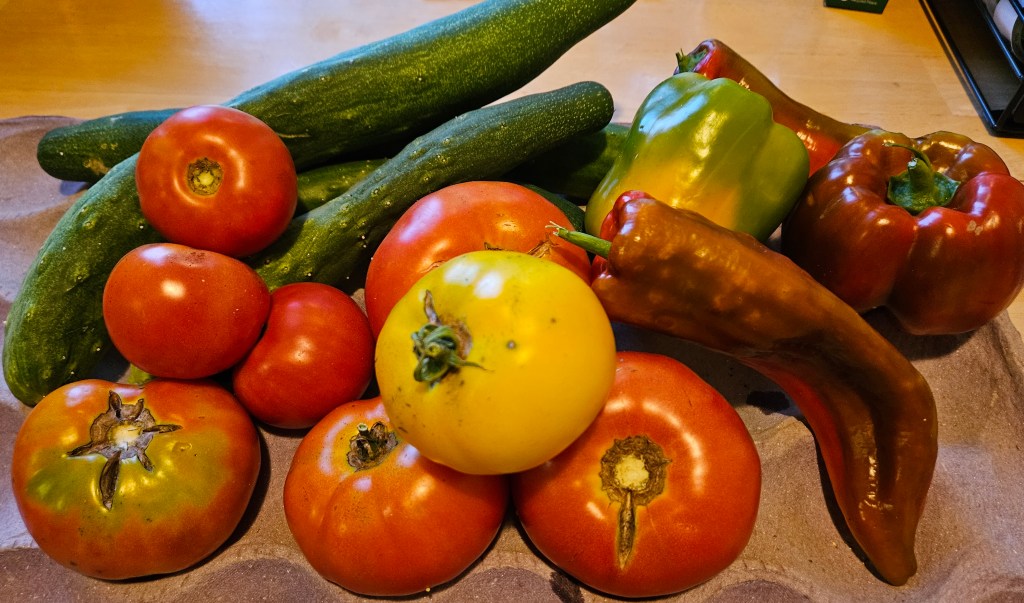
What a decision I have to make today – shall I make a sandwich from the tomato or the cucumber? Maybe both! Few things can compare to the incredible flavor of a homegrown tomato, topped with a little fresh cut basil. But the crisp sweetness of a cucumber just off the vine comes close. I feel wealthy having such delicious options.

The scent of basil on my hands decides for me; tomato it is. I may try the basil on a cucumber if I am still hungry. Such wealth.

I remember how much work it took getting the garden tilled and fenced. I remember sweating in the heat, arms and back aching, as I planted each little seedling. I gaze at the metal poles supporting the bird netting and remember Nick’s labor to erect them.

Was it worth it? Yes!!!

Therefore, my beloved, be steadfast, immovable, always excelling in the work of the Lord, because you know that in the Lord your labor is not in vain. I Corinthians 15:58.

I do not claim to “excel” in gardening, or much of anything else for that matter. But God has granted me the gift of persistence; a willingness to keep at it and see it through. Much of that comes from faith, a conviction that if I am doing what God is calling me to do and listening to His voice, my labor will not be in vain. 

And walking in God’s will can be labor. It can be physical labor, like the garden. It can be emotional labor, like forgiveness and reconciliation. You may be exhausted and sweating. Sometimes it is easier to just sleep in instead of going to church. Sometimes I would rather binge watch stupid TV than make those phone calls or write those letters.

Those who till their land will have plenty of food, but those who follow worthless pursuits have no sense. Proverbs 12:11.

Then I look at these tomatoes and cucumbers. I know that this fruit was worth the effort.

The fruit of the Spirit is worth the effort as well. Knowing that God will grow gentleness and patience in my life is worth making time every morning to read His Word. His peace and joy are worth spending time every day in prayer, presenting my concerns and listening for His response.

If I spend my time in worthless pursuits, His fruit may not be able to grow in my life; I will not have given Him the space and time to grow it. And His fruit, wow! What would my life, your life, our city, our world look if it looked like my table, covered in fruit?

By contrast, the fruit of the Spirit is love, joy, peace, patience, kindness, generosity, faithfulness, gentleness, and self-control. Galatians 5:22.

I want that fruit every bit as much as I want these tomatoes and cucumbers. Even if it takes effort on my part. Even if giving the Spirit space to grow this fruit disrupts my plans or unsettles my easy way of life. I may need to uproot some weeds and plant some good seeds. It may be hard. But the harvest is worth the effort.

When I feel kindness growing where once criticism flourished, I know being in His presence was worth the effort. When I can react in gentleness instead of anger, I am looking at His fruit in my life. When helping someone in need brings me more joy than a rising bank balance, I know God is growing something eternal in my heart.

Do not store up for yourselves treasure on earth …, but store up for yourselves treasures in heaven. Matthew 6:19.

Now that is wealth. If these tomatoes and cucumbers can make me feel wealthy, what do treasures in heaven make me? Wealthy indeed! Such wonderful flavors, such pleasing scents, such delicious abundance. 

O taste and see that the Lord is good. Psalm 34:8.

What wonders of God’s riches will I enjoy today?

Betsy

An unwelcome visitor

I had an unwelcome visitor in my garden this morning. No bigger than a chipmunk, this baby bunny was more interested in my weeds than my tomatoes. Perhaps he wanted to nibble on the companion flowers, supposedly a repellent for rodents, perhaps not so much for rabbits.

My presence sent him into a panic, racing back and forth along the fence, looking desperately for an exit point. I would not have hurt the bunny, but he didn’t know that. I am much bigger and stronger than he is, so I could have hurt him; I could have killed him. Instead, I stopped to get a picture and let him catch his breath. Then I lifted an edge of the netting and gave him a way out. I wanted him out of my garden. Eventually, he found his exit and fled to the safety of the hedgerow.

 Just then there was in their synagogue a man with an unclean spirit, and he cried out, “What have you to do with us, Jesus of Nazareth? Have you come to destroy us? I know who you are, the Holy One of God.” But Jesus rebuked him saying, “Be silent, and come out of him!” Mark 1:24-25.

Not all predators are satanic evils threatening our existence. Some are cute little bunnies looking for a new place to dine. I thought about letting the bunny stay. If I had, he probably would have died from heart failure by my daily presence. He probably started visiting my garden while I was away. Now that I am back and checking on the garden regularly, my presence alone should make the garden a less enjoyable place for the bunny.

Perhaps the Holy Spirit’s presence in us makes our lives a less enjoyable place for ungodly forces to visit.

Perhaps the appearance of the Holy Spirit sends our ungodly thoughts into a panic, racing back and forth along the fence, looking desperately for an exit point. Maybe if we invited the Holy Spirit into our lives daily, the ungodly forces would either die from heart failure or leave us for friendlier and safer spaces.

Once the bunny was gone from the garden, I examined the fence and netting all around the tomatoes. How had he gained entry? What space had I left unguarded? What gap had he wiggled through?

When I discover unwelcome, ungodly thoughts running rampant in my mind, the Holy Spirit can drive them out, but I need to examine my life. Where did these thoughts come from? How did they get in? Was it that trashy movie I watched? Or that godless and depressing book? Is it my insatiable need for entertainment, or my pride and ego?

I need to find the gap, because if that cute little bunny can get inside, tomato stealing chipmunks and squirrels can as well. If little ungodly thoughts find an easy residence in my mind, larger, more dangerous thoughts can as well.

Be on guard so that your hearts are not weighed down with dissipation and drunkenness and the worries of this life. Luke 21:34.

When I go out tomorrow to check on the garden, I will check carefully for evidence of the bunny’s return. If he has been back, I will recheck the fencing. I have lost too many tomatoes to chipmunks and squirrels in the past.

Have I learned this lesson in my life? How much of my peace and patience and joy and love of others have I lost to unwelcome visitors – worry and insecurity and fear and selfishness?

God is big and scary to these petty concerns, much bigger and stronger than these unwelcome visitors. His presence will send them racing for an exit from your life. His continued presence will keep them out.

 He commands even the unclean spirits, and they obey Him. Mark 1:27.

Betsy

The Traveler

I’ve been out of town, so no new updates on the garden. Instead I thought I’d share this piece of fancy with you. It’s a little long, but I hope you enjoy it.

I had walked to the edge of the field and sat down; just looking at the trees and the abundant undergrowth, trying to catch a few minutes of quiet. Under the mature trees, hundreds of dark green leafy plants covered the ground. They looked so healthy; there were so many, all the same, as far back into the woods as I could see. In my yard, I would consider them weeds and mow them down, but here they had created a community.

Some were taller or shorter, but all seemed to thrive. Are they families with in-laws and grandchildren? Are they neighbors helping each other grow? I felt comfort in this community.

And then I spotted them, the three strangers. At the edge of the woods, at the edge of this community, aliens, immigrants. Their spindly bright green leaves contrasted with the broad dark green growth of their neighbors. Why were there here, I thought, on the edge of the community? Were they not welcomed in? Were they tolerated only here, on the outskirts?

“I’m sorry.” I told them, on behalf of all communities everywhere.

“We are travelers,” the matriarch told me. “We have come from far away and found water and good soil. Here on the edge, away from the established trees, we see the sun throughout the day.”

“Are you lonely?” I asked.

“I have my siblings with me. We have found a place to put down our roots and alter the landscape a little.”

It was then that I noticed all the nibbled-off ends. Some critter had bitten off the flowers, the tops of every stalk that reached for the sun. 

“Oh! Your children! How tragic, to have lost them all!”

“I have not lost them,” the wise woman replied. “I have sent them off to travel. Here at the edge of the woods, I call to those with legs, and they respond. They help my children travel to unknown places, find their own good soil and ample water, put down their own roots. We are travelers, and someday, we will have seen the world and lived everywhere.”

I sat quietly beside these adventurous plants. The breeze lifted my hair and cooled my neck. The smell of the mown grass behind me overwhelmed me. Had we inadvertently mowed some of her sister plants? Had we done it on purpose?

“There is often loss, sweet child.” I heard her say. “Traveling can be dangerous. But I could not imagine my life trapped here like my neighbors, living in the shade under the trees, unable to explore new cultures. I bring the tales of all my traveling ancestors to this place, add my story, and send my children off to add their own.”

I sat and felt the grass under my hands and the sun on my face. What a wise woman this plant was. Could I learn from her?

She has traveled from her home to an unknown world and put down roots. She has sent her children joyfully out into the world to learn from it and teach it, to establish their own roots. I am a native species. Generations ago, my ancestors traveled here, but now we have established ourselves in this spot. I want my children close.

“I have never traveled anywhere,” I admit to her. “I have lived my whole life here, with no desire to live anywhere else. I have surrounded myself with others very similar to myself. I am like the plants under the trees.”

The breeze sways the plants and pushes my hair across my face. A mockingbird is singing other’s songs, joyfully intermixing them as he wishes. In the distance, I can hear shouts of joy from the ballpark. Taking a deep breath, time slows.

“You have traveled here today to speak to me, my child,” my new friend comforts me. “Your parents never even saw me, but your children will hear this story and add their own.”

“Not all travel is physical,” this wise matriarch adds. “Perhaps the hardest travel, the most dangerous travel, is mental, spiritual, and emotional. You have started that journey today.”

I hear my family calling me back and slowly push myself off the ground. Somehow, I am not the same person I was when I sat down. Could I hold on to this expanded world? Could I see the trees and plants, weeds and grasses, as fellow citizens of God’s earth? Could I learn from them? I certainly did today.

Tomorrow, I will go out again. Perhaps I will meet someone new. Maybe I will talk with someone in the community under the trees; maybe not. They may not welcome travelers into their midst or talk with strangers. I understand. Yesterday, I was just like them, but I am learning.

Faith

These are carrot plants. I’ve never planted carrots before. I’ve never planted any root vegetable before. I’m not sure I’ll know when they are “done.”

Carrots aren’t like tomatoes that turn red to let me know when to pick them. Supposedly, the tops of the carrots will push out of the ground; that will be my signal to dig them up. I hope that’s true. The plants look healthy to me; I’d hate to mess up a good crop by harvesting them too early or too late. I hope they actually are a good crop; hard to tell since I can’t see them.

A garden is an act of faith. Acts of faith are a little scary; so many unknowns.

Now the Lord said to Abram, “Go from your country and your kindred and your father’s house to the land that I will show you.” Genesis 12:1.

Not even, “Move to that land you’ve been visiting over the years.” Move to that land I will show you. Just pack and go. I’ll let you know when to stop. When the carrot tops push up out of the ground? At least someone told me that the carrot tops would push out of the ground.

It’s a little ridiculous comparing growing carrots to Abram’s journey, but it may be about as adventuresome as I get. Small steps. I do not know how these carrots will turn out. And I can’t monitor their growth or health; it’s all underground.

But there are these visible signs of the growth going on underground. There are these healthy-looking fronds. This greenery encourages me that God is growing healthy carrots where I can’t see them. Maybe Abram has some signposts along the way – “You’re going the right way!”

Peace I leave with you; my peace I give to you. John 14:27. 

Peace. Now that’s some leafy green fronds!

Take a breath and let that sink in.

The tough part of this, for me, is the waiting. I’m used to instant access and “timely” responses. I planted the carrots in late April. I would never have waited that long for an email response!

Wait for the Lord, be strong, and let your heart take courage; wait for the Lord! Psalm 27:14.

A garden takes faith, and a garden takes waiting. A seed planted in February bears fruit in May; a seedling planted in May bears fruit in July. Some things you just can’t rush. For reasons we may not understand, some things just take time.

Be patient, therefore, beloved, until the coming of the Lord. The farmer waits for the precious crop from the earth, being patient with it until it receives the early and the late rains. You also must be patient. James 5:7.

When I hear of evil in the world; when I encounter prejudice and fear-based hatred in my circle of friends; when I let my bias color my view of others, I wonder, with the psalmists of old,

How long, O Lord? Psalm 119:81, Psalm 13:1, Psalm 71:12, Psalm 89:46.

How long before we can see others through God’s eyes? How long before we can give to others without worrying about ourselves? How long before we can react to hate with love? How long before we spend our time building each other up instead of tearing each other down? How long before the Holy Spirit’s fruit is evident in my life and the lives of others?

But then I see a leafy green frond of love and acceptance, of grace and gift, and I thank God for the signs that something good is growing.

Someday, those carrots will rise above the ground. Someday, His kingdom will come on this earth. Have faith, my friend.

“Surely, I am coming soon.” Amen. Come, Lord Jesus! Revelation 22:20.

Betsy

Guarding the Fruit

The robin sits on the framework of my garden and tilts his head. I can almost hear him. “Are those tomatoes ripe enough for me to peck?” A squirrel barks at me from the nearby tree, claiming the tomatoes as his own. I regret to inform you, friend robin and mister squirrel, these tomatoes are not for you!

I have put up a fence to protect my plants from rabbits, pets and errant children, but a fence won’t stop a bird or a squirrel. I need bird netting. Without the bird netting, the robins peck the ripening tomatoes, encouraging bugs to swarm the gooey innards, which the birds devour. Squirrels will take the entire tomato from the vine and horde it away with their nuts.

Bird netting is a thin mesh of material that drapes over the plants. Nick erected the poles around the garden as a support for the netting, so it wouldn’t become entangled in the leaves. (Plus, he liked to build things!) Clipped securely to the fencing, the netting allows access only to insects. To tend to the plants, I have to unclip the netting, but it is worth the effort to protect the fruit. Just in case I have some gaps, I have repellant flowers planted among the tomatoes.

Is this overkill? Do I really need to go to all this effort? Yes! I have gardened for 30 years and lost countless tomatoes to birds and squirrels. What a waste to pour so much time and effort into growing them, only to lose out at the end and not be able to reap the benefits.

Therefore take up the whole armor of God, so that you may be able to withstand on that evil day, and having done everything, to stand firm. Ephesians 6:13.

 Is it overkill to be constantly on guard against forces that would take our fruit from us? I don’t think so. Even if the robins and squirrels aren’t “evil,” I don’t want them to ruin my fruit. I don’t want my peace and kindness destroyed by slanderous political rhetoric from either party. I don’t want my joy and generosity ruined by endless comparisons on social media. I don’t want my self-control challenged by abundant opportunities for self-indulgence.

Putting up the bird netting is not an effortless task. Almost invisible, the netting catches on the fencing, the poles, the plants, the buttons on my shirt. I need to make sure I clip the netting tightly to the fence, but not so much as to limit my access to the tomatoes. There’s a balance there that requires constant reassessment. It takes effort, but if it protects my tomatoes…

Now, discipline always seems painful rather than pleasant at the time, but later it yields the peaceful fruit of righteousness. Hebrews 12:11.

Am I spending this much time and effort, this constant reassessment, protecting my relationship with God, balancing the calls on my time with His call? I can only pray for the strength to do so. Because I am encouraging the growth of His fruit in my life, His fruit for His purposes. My tomatoes are not being grown for the robins and squirrels, and His fruit is not being grown to win accolades from others. Just as I must guard my tomatoes, I must guard my heart, out of which His fruit grows. I do this by spending time in prayer and communion with God, by reading and studying His Word, and by putting on the full armor of God (Ephesians 5:14-17).

And the peace of God, which surpasses all understanding, will guard your hearts and your minds in Christ Jesus. Philippians 4:7.

How sad it would be to lose what fruit God has grown in us because we did not make the effort to protect it. So while social expectation may tilt its head at me, wondering if I’ll play its game, and worldly ways may bark at me, trying to claim my affections, I will boldly inform them to keep out of my garden.

Betsy

Weeds

Despite having tilled my garden space and put down weed barrier cloth, there are still weeds in my garden. Ugh, I wish there weren’t.

Weeds can sap water and nutrients away from my vegetable plants. Weeds can entangle my young plants and pull them to the ground.

Weeds are unavoidable. The garden is in the yard, so, of course, the yard creeps into the garden space. Weeding is without a doubt my least favorite part of gardening, but I need to do it, because the weeds will hinder my plant’s growth.

Jesus compared the cares and pleasures of life to weeds.

As for what fell among the thorns, these are the ones who hear, but as they go on their way, they are choked by the cares and riches and pleasures of life, and their fruit does not mature. Luke 8:14.

I live in the world, so, of course, the cares and pleasures of the world creep into my relationship with God. I need to weed them out before they sap my resources, hinder my growth, choke out the Spirit, and pull me to the ground.

Therefore, since we are surrounded by so great a cloud of witnesses, let us also lay aside every weight and the sin that clings so closely. Hebrews 12:1.

The cares and pleasures of the world are not bad things, as weeds are not bad things. In fact, by definition, weeds are just plants growing where you don’t want them to grow. Dandelions provide many benefits for the soil and for humans, but I don’t want them in my garden.

The best advice is to weed daily. Every time I go out to the garden, I look for weeds and pull a few. Normally, these are the weeds that are encroaching on the plants, or are big and visible. I try to pull these before they become too well established and cause problems. Ideally, this would keep my garden weed-free, but it doesn’t. To really rid my garden of weeds, I have to set aside more time than my morning walk- though allows. To really examine those things that are hindering my spiritual growth and weed them out of my life may take more time than my morning devotional time allows. I may need to set aside a time for just this purpose and ask God to show me the weeds.

Search me, O God, and know my heart; test me and know my thoughts. See if there is any wicked way in me, and lead me in the way everlasting. Psalm 139:23-24.

Perhaps I don’t like to weed because I rather like weeds. I love to see an abandoned field covered in wildflowers. I love the dainty white and purple and yellow blossoms throughout my yard before the movers cut them down. That dandelion pushing through the concrete inspires me. God has brought beauty to the world in the most unlikely places; what an amazing gift! Just so, God has given us earthly pleasures like good food and wine and fellowship. They all have their place. Weeding our spiritual garden does not mean we are to become puritanical in our elimination of earthly joys, but we are to keep them in their proper place, keep them from becoming our focus.

Therefore do not worry, saying, “What will we eat?” or “What will we drink?” or “What will we wear?” For it is the gentiles who strive for all these things; and indeed your Father knows that you need all these things. But strive first for the kingdom of God and his righteousness, and all these things will be given to you as well. Matthew 6:31-32.

And you know what? There is beauty in a weed-free garden. With help, I cleared my tomatoes, peppers and carrots of weeds and added mulch to help prevent further growth. My cucumbers, pictured above, are next. I know the weeds will creep back, mandating my continued vigilance, but there is a weightlessness, a sense of relief, an optimism that forces a smile upon my face as I look at my weed free garden space. Joy – a fruit of the Spirit.

Betsy