An unwelcome visitor

I had an unwelcome visitor in my garden this morning. No bigger than a chipmunk, this baby bunny was more interested in my weeds than my tomatoes. Perhaps he wanted to nibble on the companion flowers, supposedly a repellent for rodents, perhaps not so much for rabbits.

My presence sent him into a panic, racing back and forth along the fence, looking desperately for an exit point. I would not have hurt the bunny, but he didn’t know that. I am much bigger and stronger than he is, so I could have hurt him; I could have killed him. Instead, I stopped to get a picture and let him catch his breath. Then I lifted an edge of the netting and gave him a way out. I wanted him out of my garden. Eventually, he found his exit and fled to the safety of the hedgerow.

 Just then there was in their synagogue a man with an unclean spirit, and he cried out, “What have you to do with us, Jesus of Nazareth? Have you come to destroy us? I know who you are, the Holy One of God.” But Jesus rebuked him saying, “Be silent, and come out of him!” Mark 1:24-25.

Not all predators are satanic evils threatening our existence. Some are cute little bunnies looking for a new place to dine. I thought about letting the bunny stay. If I had, he probably would have died from heart failure by my daily presence. He probably started visiting my garden while I was away. Now that I am back and checking on the garden regularly, my presence alone should make the garden a less enjoyable place for the bunny.

Perhaps the Holy Spirit’s presence in us makes our lives a less enjoyable place for ungodly forces to visit.

Perhaps the appearance of the Holy Spirit sends our ungodly thoughts into a panic, racing back and forth along the fence, looking desperately for an exit point. Maybe if we invited the Holy Spirit into our lives daily, the ungodly forces would either die from heart failure or leave us for friendlier and safer spaces.

Once the bunny was gone from the garden, I examined the fence and netting all around the tomatoes. How had he gained entry? What space had I left unguarded? What gap had he wiggled through?

When I discover unwelcome, ungodly thoughts running rampant in my mind, the Holy Spirit can drive them out, but I need to examine my life. Where did these thoughts come from? How did they get in? Was it that trashy movie I watched? Or that godless and depressing book? Is it my insatiable need for entertainment, or my pride and ego?

I need to find the gap, because if that cute little bunny can get inside, tomato stealing chipmunks and squirrels can as well. If little ungodly thoughts find an easy residence in my mind, larger, more dangerous thoughts can as well.

Be on guard so that your hearts are not weighed down with dissipation and drunkenness and the worries of this life. Luke 21:34.

When I go out tomorrow to check on the garden, I will check carefully for evidence of the bunny’s return. If he has been back, I will recheck the fencing. I have lost too many tomatoes to chipmunks and squirrels in the past.

Have I learned this lesson in my life? How much of my peace and patience and joy and love of others have I lost to unwelcome visitors – worry and insecurity and fear and selfishness?

God is big and scary to these petty concerns, much bigger and stronger than these unwelcome visitors. His presence will send them racing for an exit from your life. His continued presence will keep them out.

 He commands even the unclean spirits, and they obey Him. Mark 1:27.

Betsy

The Traveler

I’ve been out of town, so no new updates on the garden. Instead I thought I’d share this piece of fancy with you. It’s a little long, but I hope you enjoy it.

I had walked to the edge of the field and sat down; just looking at the trees and the abundant undergrowth, trying to catch a few minutes of quiet. Under the mature trees, hundreds of dark green leafy plants covered the ground. They looked so healthy; there were so many, all the same, as far back into the woods as I could see. In my yard, I would consider them weeds and mow them down, but here they had created a community.

Some were taller or shorter, but all seemed to thrive. Are they families with in-laws and grandchildren? Are they neighbors helping each other grow? I felt comfort in this community.

And then I spotted them, the three strangers. At the edge of the woods, at the edge of this community, aliens, immigrants. Their spindly bright green leaves contrasted with the broad dark green growth of their neighbors. Why were there here, I thought, on the edge of the community? Were they not welcomed in? Were they tolerated only here, on the outskirts?

“I’m sorry.” I told them, on behalf of all communities everywhere.

“We are travelers,” the matriarch told me. “We have come from far away and found water and good soil. Here on the edge, away from the established trees, we see the sun throughout the day.”

“Are you lonely?” I asked.

“I have my siblings with me. We have found a place to put down our roots and alter the landscape a little.”

It was then that I noticed all the nibbled-off ends. Some critter had bitten off the flowers, the tops of every stalk that reached for the sun. 

“Oh! Your children! How tragic, to have lost them all!”

“I have not lost them,” the wise woman replied. “I have sent them off to travel. Here at the edge of the woods, I call to those with legs, and they respond. They help my children travel to unknown places, find their own good soil and ample water, put down their own roots. We are travelers, and someday, we will have seen the world and lived everywhere.”

I sat quietly beside these adventurous plants. The breeze lifted my hair and cooled my neck. The smell of the mown grass behind me overwhelmed me. Had we inadvertently mowed some of her sister plants? Had we done it on purpose?

“There is often loss, sweet child.” I heard her say. “Traveling can be dangerous. But I could not imagine my life trapped here like my neighbors, living in the shade under the trees, unable to explore new cultures. I bring the tales of all my traveling ancestors to this place, add my story, and send my children off to add their own.”

I sat and felt the grass under my hands and the sun on my face. What a wise woman this plant was. Could I learn from her?

She has traveled from her home to an unknown world and put down roots. She has sent her children joyfully out into the world to learn from it and teach it, to establish their own roots. I am a native species. Generations ago, my ancestors traveled here, but now we have established ourselves in this spot. I want my children close.

“I have never traveled anywhere,” I admit to her. “I have lived my whole life here, with no desire to live anywhere else. I have surrounded myself with others very similar to myself. I am like the plants under the trees.”

The breeze sways the plants and pushes my hair across my face. A mockingbird is singing other’s songs, joyfully intermixing them as he wishes. In the distance, I can hear shouts of joy from the ballpark. Taking a deep breath, time slows.

“You have traveled here today to speak to me, my child,” my new friend comforts me. “Your parents never even saw me, but your children will hear this story and add their own.”

“Not all travel is physical,” this wise matriarch adds. “Perhaps the hardest travel, the most dangerous travel, is mental, spiritual, and emotional. You have started that journey today.”

I hear my family calling me back and slowly push myself off the ground. Somehow, I am not the same person I was when I sat down. Could I hold on to this expanded world? Could I see the trees and plants, weeds and grasses, as fellow citizens of God’s earth? Could I learn from them? I certainly did today.

Tomorrow, I will go out again. Perhaps I will meet someone new. Maybe I will talk with someone in the community under the trees; maybe not. They may not welcome travelers into their midst or talk with strangers. I understand. Yesterday, I was just like them, but I am learning.

Faith

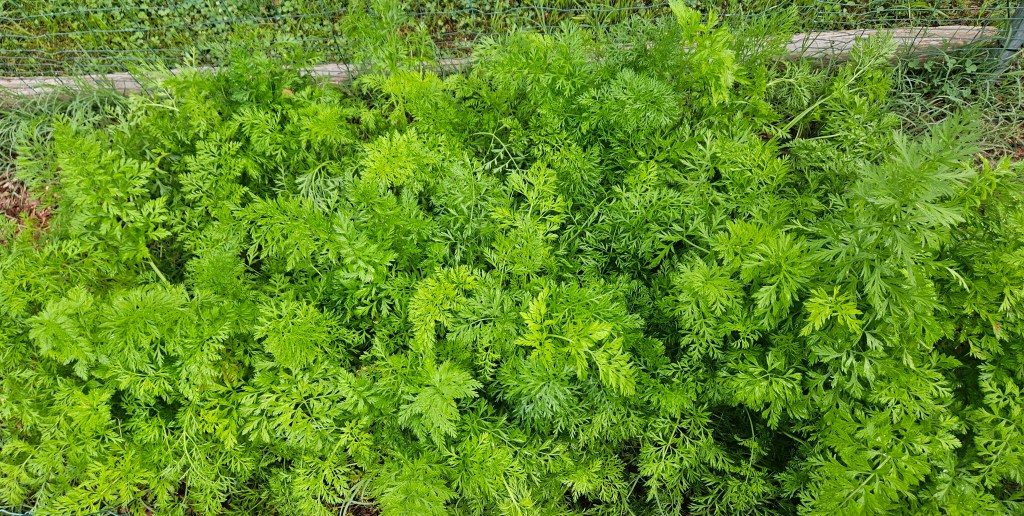
These are carrot plants. I’ve never planted carrots before. I’ve never planted any root vegetable before. I’m not sure I’ll know when they are “done.”

Carrots aren’t like tomatoes that turn red to let me know when to pick them. Supposedly, the tops of the carrots will push out of the ground; that will be my signal to dig them up. I hope that’s true. The plants look healthy to me; I’d hate to mess up a good crop by harvesting them too early or too late. I hope they actually are a good crop; hard to tell since I can’t see them.

A garden is an act of faith. Acts of faith are a little scary; so many unknowns.

Now the Lord said to Abram, “Go from your country and your kindred and your father’s house to the land that I will show you.” Genesis 12:1.

Not even, “Move to that land you’ve been visiting over the years.” Move to that land I will show you. Just pack and go. I’ll let you know when to stop. When the carrot tops push up out of the ground? At least someone told me that the carrot tops would push out of the ground.

It’s a little ridiculous comparing growing carrots to Abram’s journey, but it may be about as adventuresome as I get. Small steps. I do not know how these carrots will turn out. And I can’t monitor their growth or health; it’s all underground.

But there are these visible signs of the growth going on underground. There are these healthy-looking fronds. This greenery encourages me that God is growing healthy carrots where I can’t see them. Maybe Abram has some signposts along the way – “You’re going the right way!”

Peace I leave with you; my peace I give to you. John 14:27. 

Peace. Now that’s some leafy green fronds!

Take a breath and let that sink in.

The tough part of this, for me, is the waiting. I’m used to instant access and “timely” responses. I planted the carrots in late April. I would never have waited that long for an email response!

Wait for the Lord, be strong, and let your heart take courage; wait for the Lord! Psalm 27:14.

A garden takes faith, and a garden takes waiting. A seed planted in February bears fruit in May; a seedling planted in May bears fruit in July. Some things you just can’t rush. For reasons we may not understand, some things just take time.

Be patient, therefore, beloved, until the coming of the Lord. The farmer waits for the precious crop from the earth, being patient with it until it receives the early and the late rains. You also must be patient. James 5:7.

When I hear of evil in the world; when I encounter prejudice and fear-based hatred in my circle of friends; when I let my bias color my view of others, I wonder, with the psalmists of old,

How long, O Lord? Psalm 119:81, Psalm 13:1, Psalm 71:12, Psalm 89:46.

How long before we can see others through God’s eyes? How long before we can give to others without worrying about ourselves? How long before we can react to hate with love? How long before we spend our time building each other up instead of tearing each other down? How long before the Holy Spirit’s fruit is evident in my life and the lives of others?

But then I see a leafy green frond of love and acceptance, of grace and gift, and I thank God for the signs that something good is growing.

Someday, those carrots will rise above the ground. Someday, His kingdom will come on this earth. Have faith, my friend.

“Surely, I am coming soon.” Amen. Come, Lord Jesus! Revelation 22:20.

Betsy

Guarding the Fruit

The robin sits on the framework of my garden and tilts his head. I can almost hear him. “Are those tomatoes ripe enough for me to peck?” A squirrel barks at me from the nearby tree, claiming the tomatoes as his own. I regret to inform you, friend robin and mister squirrel, these tomatoes are not for you!

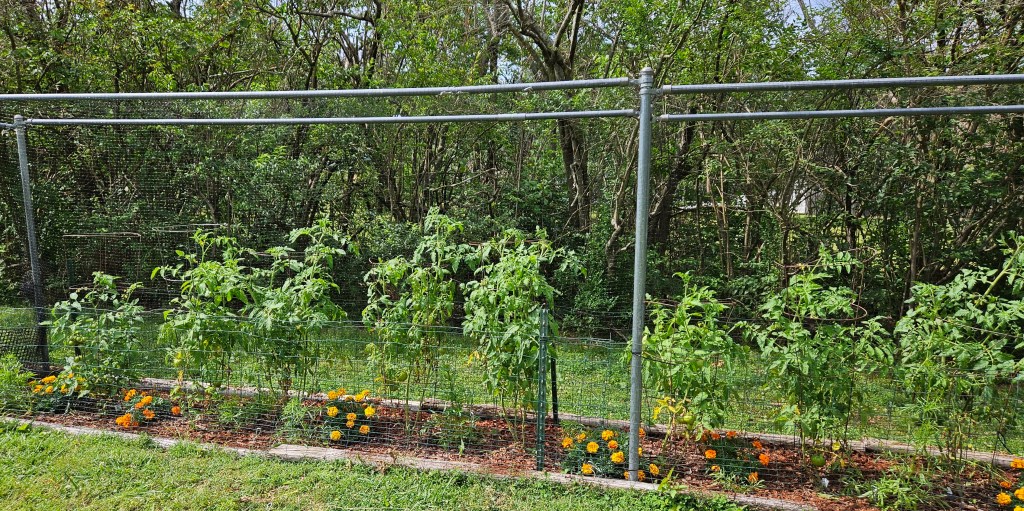
I have put up a fence to protect my plants from rabbits, pets and errant children, but a fence won’t stop a bird or a squirrel. I need bird netting. Without the bird netting, the robins peck the ripening tomatoes, encouraging bugs to swarm the gooey innards, which the birds devour. Squirrels will take the entire tomato from the vine and horde it away with their nuts.

Bird netting is a thin mesh of material that drapes over the plants. Nick erected the poles around the garden as a support for the netting, so it wouldn’t become entangled in the leaves. (Plus, he liked to build things!) Clipped securely to the fencing, the netting allows access only to insects. To tend to the plants, I have to unclip the netting, but it is worth the effort to protect the fruit. Just in case I have some gaps, I have repellant flowers planted among the tomatoes.

Is this overkill? Do I really need to go to all this effort? Yes! I have gardened for 30 years and lost countless tomatoes to birds and squirrels. What a waste to pour so much time and effort into growing them, only to lose out at the end and not be able to reap the benefits.

Therefore take up the whole armor of God, so that you may be able to withstand on that evil day, and having done everything, to stand firm. Ephesians 6:13.

 Is it overkill to be constantly on guard against forces that would take our fruit from us? I don’t think so. Even if the robins and squirrels aren’t “evil,” I don’t want them to ruin my fruit. I don’t want my peace and kindness destroyed by slanderous political rhetoric from either party. I don’t want my joy and generosity ruined by endless comparisons on social media. I don’t want my self-control challenged by abundant opportunities for self-indulgence.

Putting up the bird netting is not an effortless task. Almost invisible, the netting catches on the fencing, the poles, the plants, the buttons on my shirt. I need to make sure I clip the netting tightly to the fence, but not so much as to limit my access to the tomatoes. There’s a balance there that requires constant reassessment. It takes effort, but if it protects my tomatoes…

Now, discipline always seems painful rather than pleasant at the time, but later it yields the peaceful fruit of righteousness. Hebrews 12:11.

Am I spending this much time and effort, this constant reassessment, protecting my relationship with God, balancing the calls on my time with His call? I can only pray for the strength to do so. Because I am encouraging the growth of His fruit in my life, His fruit for His purposes. My tomatoes are not being grown for the robins and squirrels, and His fruit is not being grown to win accolades from others. Just as I must guard my tomatoes, I must guard my heart, out of which His fruit grows. I do this by spending time in prayer and communion with God, by reading and studying His Word, and by putting on the full armor of God (Ephesians 5:14-17).

And the peace of God, which surpasses all understanding, will guard your hearts and your minds in Christ Jesus. Philippians 4:7.

How sad it would be to lose what fruit God has grown in us because we did not make the effort to protect it. So while social expectation may tilt its head at me, wondering if I’ll play its game, and worldly ways may bark at me, trying to claim my affections, I will boldly inform them to keep out of my garden.

Betsy

Weeds

Despite having tilled my garden space and put down weed barrier cloth, there are still weeds in my garden. Ugh, I wish there weren’t.

Weeds can sap water and nutrients away from my vegetable plants. Weeds can entangle my young plants and pull them to the ground.

Weeds are unavoidable. The garden is in the yard, so, of course, the yard creeps into the garden space. Weeding is without a doubt my least favorite part of gardening, but I need to do it, because the weeds will hinder my plant’s growth.

Jesus compared the cares and pleasures of life to weeds.

As for what fell among the thorns, these are the ones who hear, but as they go on their way, they are choked by the cares and riches and pleasures of life, and their fruit does not mature. Luke 8:14.

I live in the world, so, of course, the cares and pleasures of the world creep into my relationship with God. I need to weed them out before they sap my resources, hinder my growth, choke out the Spirit, and pull me to the ground.

Therefore, since we are surrounded by so great a cloud of witnesses, let us also lay aside every weight and the sin that clings so closely. Hebrews 12:1.

The cares and pleasures of the world are not bad things, as weeds are not bad things. In fact, by definition, weeds are just plants growing where you don’t want them to grow. Dandelions provide many benefits for the soil and for humans, but I don’t want them in my garden.

The best advice is to weed daily. Every time I go out to the garden, I look for weeds and pull a few. Normally, these are the weeds that are encroaching on the plants, or are big and visible. I try to pull these before they become too well established and cause problems. Ideally, this would keep my garden weed-free, but it doesn’t. To really rid my garden of weeds, I have to set aside more time than my morning walk- though allows. To really examine those things that are hindering my spiritual growth and weed them out of my life may take more time than my morning devotional time allows. I may need to set aside a time for just this purpose and ask God to show me the weeds.

Search me, O God, and know my heart; test me and know my thoughts. See if there is any wicked way in me, and lead me in the way everlasting. Psalm 139:23-24.

Perhaps I don’t like to weed because I rather like weeds. I love to see an abandoned field covered in wildflowers. I love the dainty white and purple and yellow blossoms throughout my yard before the movers cut them down. That dandelion pushing through the concrete inspires me. God has brought beauty to the world in the most unlikely places; what an amazing gift! Just so, God has given us earthly pleasures like good food and wine and fellowship. They all have their place. Weeding our spiritual garden does not mean we are to become puritanical in our elimination of earthly joys, but we are to keep them in their proper place, keep them from becoming our focus.

Therefore do not worry, saying, “What will we eat?” or “What will we drink?” or “What will we wear?” For it is the gentiles who strive for all these things; and indeed your Father knows that you need all these things. But strive first for the kingdom of God and his righteousness, and all these things will be given to you as well. Matthew 6:31-32.

And you know what? There is beauty in a weed-free garden. With help, I cleared my tomatoes, peppers and carrots of weeds and added mulch to help prevent further growth. My cucumbers, pictured above, are next. I know the weeds will creep back, mandating my continued vigilance, but there is a weightlessness, a sense of relief, an optimism that forces a smile upon my face as I look at my weed free garden space. Joy – a fruit of the Spirit.

Betsy

Support

As I walk along the garden in the mornings, the new growth amazes me. How proud I am of these little plants who are growing bigger and stronger every day! They stretch out their arms and reach for the sun; little yellow blossoms and tiny green tomatoes emerge unannounced. I know I had very little to do with this. God is growing these plants, and it is marvelous in my sight!

I do have a role to play as they grow, however. I need to keep the branches resting on the supports. Since they are growing so quickly, I need to check on them often. Ever so gently, I lift the growing branch and rest it in the provided structure, the tomato cage. Metal uprights, braced by layers of rings and firmly planted in the soil, these structures allows the plant to bear the weight of the emerging fruit. Without the structure, the limb would fall to the ground; the fruit would sit in the soil; the tomato would rot.

Some fruit, like winter squash, pumpkins, and watermelon, have thick rinds that protect the yummy goodness from their surroundings, but tomatoes do not. Their thinner skins would be pierced by the mulch and bruised by the ground.  They need structure to lean on, structure to support them.

Therefore, encourage one another and build up each other, as indeed you are doing. 1 Thessalonians 4:11.

My circle of Christian friends, my church, my Bible study groups, my family, these are the structures in my life that support my growth. Without them, I have no doubt that I would be lying on the ground, rotting. Most of us do not have thick enough skins to go through life without support, without structure. We need solid, sturdy support that can bear our weight. Our support needs to come from upright people, braced by layers of faith, and firmly planted in God’s Word.

And we need to be that support for others as well. All of us, at one time or another, need each other. Even Moses needed the help of others to fulfill God’s will.

Whenever Moses held up his hand, Israel prevailed; and whenever he lowered his hand, Amelek prevailed. But Moses’ arms grew weary, so they took a stone and put it under him, and he sat on it. Aaron and Hur held up his hands, one on one side and the other on the other side, so his hands were steady. Exodus 17:11-12.

And do you know why these fine fellows knew Moses needed help? Because they were there with him. If I do not go out and check on my tomato plants daily, the branches can become too big to be lifted and placed on the support. Trying to tuck them back inside the cage could break off the limb, losing the fruit. If we are not available to our friends, then we may never know they need support. If we do not alert our friends to our need for help, we may be risking losing our own fruit. We must support each other, and allow others to support us.

It will not be so among you; but whoever wishes to be great among you must be your servant, and whoever wishes to be first among you must be your slave; just as the Son of Man came not to be served, but to serve, and to give his life as a ransom for many. Matthew 20:26-28.

Sometimes it can be humbling to ask for help; sometimes it can be demanding to provide it. But God calls us to humble ourselves (Luke14:11), and look to the interests of others (Philippians 2:4).

All in the name of bearing fruit for the Kingdom. If we keep that as our first goal, then whatever it takes to help that fruit grow, to keep that fruit from rotting on the ground, is not humiliating or a burden.

Then we will share in the joy of seeing those yellow blossoms and little green tomatoes ripen into wonderful, delicious fruit.

This is the Lord’s doing; it is marvelous in our eyes. Psalm 118:23.

Betsy

June

June is a special time in the garden. It is not time to plant or time to harvest. The summer plants have established themselves; the fence is secure; the sweet peas are past their prime. I go out to the garden without tools and return without ripe fruit. But I do not return empty-handed. There is a magic in the slowness of June in the garden.

I am watching my plants grow. Daily I tuck the growing tomato branches inside the cage, pick a few weeds that have burst through the barrier cloth, check the moisture of the soil, and water if needed. Mostly, I talk to the plants. Yes, I am that crazy old lady that talks to her plants.

Science has confirmed that talking to your plants actually encourages them to grow. I used to think that was just because we were expelling carbon dioxide, which the plants like to take in, but then I learned plants like harmonic music as well. Who knew plants could hear. It turns out that trees, and probably most plants, make thousands of decisions throughout their lives, the complexities of which rival human decision making. There is even a movement to declare trees as sentient beings. It is difficult for me to see my pepper plants are sentient beings, but they are certainly living things.

And all living things thrive on encouragement, praise, and support. “Look at those new leaves, cucumber! Good job!” “Let me lift your branch up for you, sweet tomato. That fruit will get heavy!” “That little pepper is getting so big! Way to go!”

Therefore encourage one another, and build up each other, as indeed you are doing… And we urge you, beloved, to admonish the idlers, encourage the fainthearted, help the weak, be patient with all of them. I Thessalonians 5:11,14.

That is really all I can do right now – encourage my plants. These plants will bear fruit when it is their time to bear fruit; that fruit will ripen when it ripens. Since I have no control over those things, I choose to enjoy, savor even, this time of tranquility.

I can feel the morning sun on my face and feel the breeze cooling my neck. When I lift the tomato branches, their aroma fills my nose to the point I can taste it. When I pull a weed, soft soil brings up the scents of the earth; an earthworm scoots for cover. As I stand and face the sky, I take a deep breath and feel connected to all of God’s creation.

The earth is the Lord’s and all that is in it, the world and those that live in it. Psalm 24:1.

With the industrial revolution, the move to cities, electricity and cars, we have become an increasing indoor people. Unless we go to a farmer’s market, we are several steps removed from the source of our food. We no longer walk to work; few of us work outside or play outside. Culturally, we have lost our connection to the earth, but there is grass-roots effort to rectify that (pun intended).

For me, the garden, and specifically, the garden in June, helps me reestablish that connection.

In June, I can just go out and be in the garden. While I talk to my plants, they sometimes seem to talk to me, telling me about God and His creation, teaching me what they have learned over millennia. Often I just stand or sit with them.

Be still and know that I am God! I am exalted among the nations; I am exalted in the earth. Psalm 46:10.

I encourage you to go outside today. Look for a flower in bloom or a weed overcoming its concrete prison. Sit under a tree or admire its leaves. Breath in the scent of earth or cut grass or roses. Feel the sun and the breeze and the blades of some petal nearby. The earth exalts God. Let’s take a moment today to join in that exultation.

Betsy

Abundant Fruit

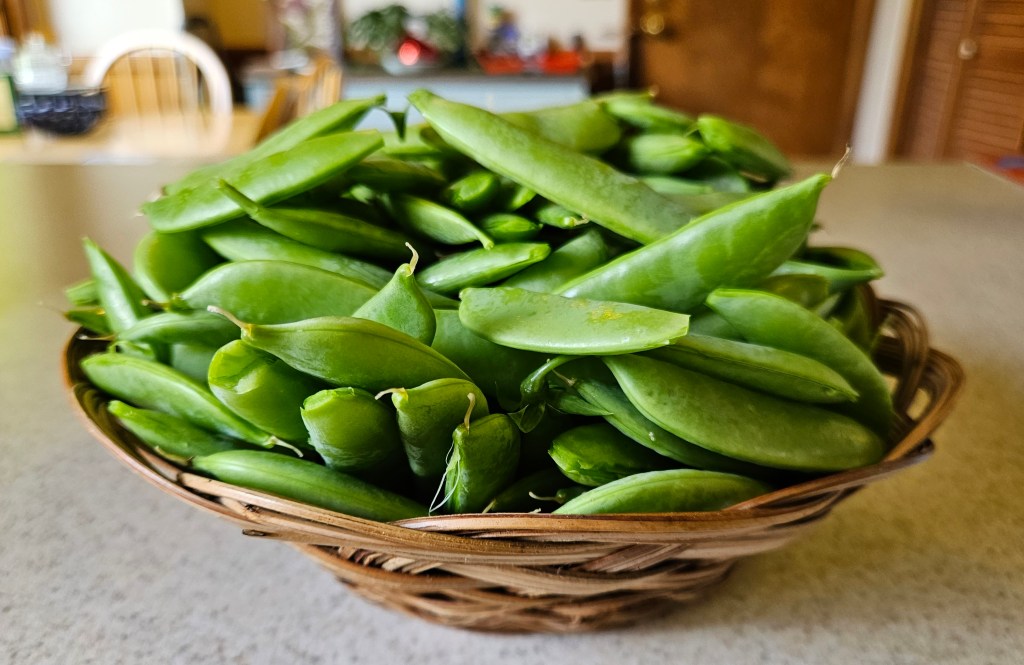
The sweet peas were awesome this year! They were such a source of joy after last year’s dismal crop. For a while I was picking 50-60 sweet peas every day. The plants are at the end of their growing season now, but what a fantastic harvest. They are so delicious and such a treat to share them with family and friends! There are certainly too many for me to eat by myself.

Friends have asked why this crop has been so good when last year’s was so bad. Of course, there is no single answer to that question, but “right time, right place” seems to sum it up.

Last year, spring was hot and dry. This spring has been cool and rainy, ideal for the peas.

This year, I planted my seeds in their happy place, perhaps because the soil contains the right nutrients, perhaps because the hedge row blocks the afternoon sun. Maybe there was a lesson I needed to learn from the failed crop last year. Whatever the reason, I am overwhelmed with gratitude for the abundant harvest this year.

Sometimes, there is a “right time, right place” for what God calls us to do as well. We may not understand why we need to do whatever it is God is calling us to do today and not tomorrow, but if God calls us to do it today, then today is when we should do it.

In Deuteronomy 1, God tells his people to enter the promised land. Afraid, they delay their obedience. When Moses chastises them, they decide to obey the earlier command, but do not ask if they should. The result is a rout, followed by 40 years of wandering.

Although I told you, you would not listen. You rebelled against the command of the Lord and presumptuously went up into the hill country. Deuteronomy 1:43.

Compare this failure to the battle of Jericho, where the people follow God’s unusual and illogical commands exactly, resulting in a tremendous victory (Joshua 6). I love the image of the walls just falling down without human effort. It gives me hope when I look at some of the supposedly insurmountable problems facing us today.

This year’s thriving sweet peas, after last year’s failure, also gives me hope. What happened last year does not dictate what can happen this year. Our past need not determine our future; if we obey God, anything can happen. Four years ago, my life was falling apart as I walked my husband through his last month on earth. Who could have predicted that this year I would rejoice over an abundant sweet pea harvest?

In fact, the abundant fruit caused a problem. The plants grew taller than expected, taller than my support cages. Laden with the relatively heavy ripe fruit, the tops of the plants fell over. Such abundant fruit needs better supports. Gently, I encouraged the plants to stay upright and not become entangled. Next year I will provide taller supports, but for this year I could only try to lessen the stress on the plant.

One of the best way to do this is to pick the peas. As I break off the ripe fruit, the branch lifts, its burden removed.

Can the fruit God’s Spirit produces in us become a burden for us as well? If we retain our grasp on it and do not share it with others, will it weigh us down, hinder our growth and entangle us? Is love really love if we do not give it to others? What about gentleness and patience? Doesn’t God give us gifts precisely so that we will share them with others?

I will bless you and make your name great, so that you will be a blessing. Genesis 12:2.

Like good stewards of the manifold grace of God, serve one another with whatever gift each of you has received. 1 Peter 4:10.

God can produce an abundant harvest in you, in the right place, at the right time. If He is, take the time today to share your abundance with others.

Betsy

Hidden Fruit

See all my sweet peas? No? I don’t see them either. But they are there. Right after I took this picture, I picked 40 and left 27 to grow. They are there.

A few are right there on the end of the little branch, proudly declaring themselves, but most of them hide behind stems and leaves, worried about the bright sun and marauding birds, too timid and embarrassed to expose themselves.

But there is a trick to get this fruit to show. Gently shake the plant. The sweet peas react differently to the shaking than the leaves and stems do. They sway differently. Your eye, if you are looking, sees the difference at once.

The Holy Spirit, bearing His fruit in our lives, allows us to react differently as well. When God gently shakes our world, our reactions differ from those of the non-believers around us.  

Blessed are you when people revile you and persecute you and utter all kinds of evil against you falsely on my account. Rejoice and be glad, for your reward is great in heaven, for in the same way they persecuted the prophets who were before you. Matthew 5:11-12.

Perhaps our world just needs a little shaking for our fruit to show up.

I must admit I would rather the shaking not be necessary. I would rather the fruit be obvious. Oddly enough, even then, it is sometimes hard to see.

Sometimes I don’t see the fruit that is right in front of my eyes. Sometimes I don’t see my keys sitting on the table, or the mayo in the fridge. What is it that makes me not see the thing right in front of my eyes? Is my mind preoccupied with other thoughts? Am I so stressed about looking for it that I’m temporarily blinded? Am I running some visual tape from the past instead of actually looking at the present view? Do I do this with issues far more important than mayo or keys or peas?

You will indeed listen, but never understand, and you will indeed look, but never perceive. For this people’s heart has grown dull, and their ears hard of hearing, and they have shut their eyes; so that they might not look with their eyes, and listen with their ears, and understand with their heart and turn – and I would heal them. Matthew 13:14-15, Also Acts 28:26, Isaiah 6:10, Jeremiah 5:21, Ezekiel 12:2.

Somehow, we can tell when we are looking and actually seeing. We can tell when others are actually seeing us; we can sense it when we are talking to them. I can only imagine what it must have felt like to have Jesus concentrate his gaze on you. Whether you were a rich young ruler (Mark 10:21), a tax collector (Luke 19:5), a fisherman (Matthew 4:18), or a denying disciple (Luke 22:61), when Jesus looked at you, when Jesus saw you, he saw what was really there. Not blinded by outward appearances, societal norms, or preconceived notions, Jesus looked and saw.

Jesus can see the fruit that the Holy Spirit is growing in our lives. God can give us this type of sight as well. We can see God around us; we can see the fruit in others; we can see the fruit in ourselves.

So have no fear; for nothing is covered up that will not be uncovered, and nothing secret that will not become known. What I have said to you in the dark, tell in the light; and what you hear whispered proclaim from the rooftops. Matthew 10:26-27.

These verses aren’t talking about the shameful things we try to hide; these verses are talking about the fruit that God is bearing in our lives, the tender moments when He heals our pain and takes our hand. When God is bearing fruit in your life, some of it will be obvious, but some may hide, camouflaged by our daily lives. So don’t worry when God shakes your life a little; He’s just making His fruit obvious to the world.

Betsy

Why?

Cleaning out my garage has reminded me of a time in my life when I really wanted a bigger house. Every time I prayed about it, I could hear the Spirit asking me, “Why?”

Like an insistent toddler, every answer I gave was followed by, “Why?”

I wanted a bigger house because there wasn’t enough room in this one. Why? We had so much stuff. Why? Because we needed all these things. Why? But everyone I know has a bigger house! Why does that matter?

Why? The question kept probing until I had to come to terms with some deeply held and formerly unchallenged attitudes. It forced me to face some very uncomfortable truths about myself. Who was I trying to impress – God or my friends?

Before long, God seemed to pose this question before every endeavor I undertook. Why? I want to join this club. Why? I want to go to this party. Why? I want to volunteer here. Why?

I want my kids to do (fill in the blank!). Why?  

Beware of practicing your piety before others in order to be seen by them; for then you have no reward from your Father in heaven. So whenever you give alms, do not sound a trumpet before you, as the hypocrites do in the synagogues and in the streets, so that they may be praised by others. Truly I tell you, they have received their reward. Matthew 6:1-2

Does this mean I shouldn’t have my name in the event program as a donor? Does this mean I shouldn’t decide to donate more just to be at the “gold level”? Why am I giving to this or that charity? Am I really committed to their work, or do I want to be a part of that crowd of people?

Why. It is the important question. Not why does God act the way He does, but why do I act the way I do? Self-examination can be scary. It forces me to identify what and who I really deem important.

For the word of God is living and active, sharper than any two-edged sword, piercing to the division of soul and of spirit, of joints and of marrow, and discerning the thoughts and intentions of the heart. Hebrews  4:12

Years ago I was in a bible study on idols and false gods. We talked about what idols look like in today’s world. Although I don’t worship the statue of Athena, I may worship knowledge. Many of us value what we have accomplished in this world, what we have made with our own hands. Have you seen Julie’s new home? It is spectacular! And the new stadium for our football team? Wow!! Very impressive.

Their land is filled with silver and gold, and there is no end to their treasures; their land is filled with horses, and there is no end to their chariots. Their land is filled with idols; they bow down to the work of their own hands, to what their own fingers have made. Isaiah 2:7-8

There is nothing wrong with beautiful homes and state-of-the-art stadiums. There is nothing wrong, and many things that are right, with donating to worthy causes. There is nothing wrong, and many things that are right, about treasuring your family and friends.

The question becomes, do you value these things more than God? Are you honoring God with these things, or honoring yourself? The question becomes, why are you doing what you are doing? Why am I doing what I do?

That is something only you and God can determine. Only you can answer those whys for yourself, as only I can answer them for myself. God and His Spirit will help you. He loves you so intensely. He desires your love in return.

No one can serve two masters; for a slave will either hate the one and love the other, or be devoted to the one and despise the other. You cannot serve God and wealth. Matthew 6:24

So ask yourself, why?

Betsy