Garden Shoes

I first posted this in 2023. Couldn’t get it off my mind, so I am starting October with a first-ever repeat!

They sit by the back door expectantly, waiting for me to slip them on. Worn out, worn in, scuffed and muddy and comfortable, these are my garden shoes.

I slip them on before I head to the garden. The yard, covered in dew, strewn with grass clippings, muddy from the recent rains, and riddled with thorny plants and industrious bees, can be a messy place. Inside my shoes, my feet are dry and clean and safe.

Without these shoes, dedicated to this less than glamorous role in life, either my feet would be in peril, or my fancier shoes would be.

Their appearance in no way diminishes their importance, quite the opposite. It is their worn out, worn in, scruffy, muddy, comfortable countenance that gives them value, makes them perfect for the role of garden shoe.

But God has so arranged the body, giving the greater honor to the inferior member, that there may be no dissension within the body, but the members may have the same care for one another. 2 Corinthians 12:24-25.

Has God assigned you a less than glamorous role in life? Are you worn out, scruffy, and covered in yard debris? Do you feel like an “inferior member?” Haven’t we all felt that way at some point?

Maybe your infant has just thrown up on your one clean shirt, or your mom has wandered down the street in her pajamas looking for the dog that died three years ago. Maybe the dishes have piled up in the sink and toilet backed up in the bathroom. Maybe your boss has trashed your work and told you to start again, again. Maybe your body has failed you, leaving only wishes with no option of action.

You have a very crucial role in the kingdom of God. You are every bit as much a part of God’s garden as the ministers and the missionaries.

In a large house, there are utensils not only of gold and silver, but also of wood and clay, some for special use, some for ordinary. 2 Timothy 2:20.

And all are valuable. Could you imagine using your silver goblet to measure flour? The silver goblet may be shiny and precious and placed where all can see, but the plastic measuring cup far more useful, more functional, more necessary, and more important to daily life.

I wouldn’t wear my garden shoes to a ladies’ luncheon, but I depend on them.

And Jesus tells us that God values the less glamorous servants highly.

Whoever wants to be first must be last of all and servant of all. Mark 9:35. (Also Matthew 20:26, Luke 22:26.)

Maybe in the tables-turned, topsy-turvy Kingdom of Heaven, God will give my garden shoes the place of honor.

Maybe in the tables-turned, topsy-turvy kingdom of Heaven, God will give the parent, the caregiver, the housekeeper, the worker, and the invalid seats of honor.

So the last will be first, and the first will be last. Matthew 20:16. (Also Matthew 19:30.)

So, if you are feeling like a worn-out pair of garden shoes today, take heart. If we are following Jesus, He will give us the work He needs us to do, glamorous or not. His Spirit within us will make us “dedicated and useful to the owner of the house, ready for every good work.” (2 Timothy 2:21.)

My garden shoes wait patiently for me to slip them on. Just a little walk out to the garden, around and through it, then back inside. Job done; they rest. How happy these shoes make me, doing their little job so well. I do not see their age, their misshapen body, their dirty exterior covered in yard debris; I see their faithful, useful, service.

Well done, good and faithful servant, You have been faithful over a little; I will set you over much. Enter into the joy of your master. Matthew 25:21.

 Love in Christ, Betsy

A Little Change

I made a little change in my garden to solve a nagging problem.

Change can be hard, but what if God is calling us to do just that, change?

I’ve had a problem with my lawn service this summer. They come when I am not home. And their mower sprays grass clipping all over my garden plants.

If I were home when they were mowing, I would ask them not to do this. I’m not sure why this is even so much of a problem this year since it hasn’t been in the past. Perhaps they have a new mower, but the problem may be mine. Since I did not pull up all my landscape timbers last year, they have sunk lower into the ground. Several of them are rotting away. The accumulation of grass clipping has hastened this process.

I could text my mower about the problem. I considered replacing all the landscape timbers. But I decided instead to edge the garden with a taller “clipping barrier.” Of course, the stores don’t carry foot-tall edging, so I had to order a trial sample to see if it would work. I like the look.

This edging may help with critter control as well. It’s different. Time alone will tell if it’s better.

My daughter, who works with ministry innovators, often writes about how change often happens slowly, develops through necessity, and occurs when we are focusing on something else. I look at my garden as the sixth summer without my husband draws to a close and I see change.

The bones of my garden are the same. Same poles, same fence posts, same location. But I no longer dismantle it; I no longer let the garden return to grass every year. I have perennial fruit trees and herbs. I pay helpers to assist me. And now I have foot high edging. I am adapting, slowly, by necessity, to gardening without him.

All in an effort to bear fruit.

There’s a lot of discussion about change in the church. When is change necessary to bear fruit for God and when is it conforming to the world? Jesus was an agent of change. He ate with simmers, broke sabbath laws, and overturned the tables in the temple.

The pharisees and their scribes were complaining to his disciples, saying, “Why do you eat and drink with tax collectors and sinners?” Jesus answered, “Those who are well have no need of a physician, but those who are sick. I have come to call not the righteous, but sinners to repentance.” Luke 5:30-32.

The established church leaders didn’t like the change. And Jesus didn’t stop at changing the status quo. He sent the Spirit to live within us and change our focus, our attitudes, our actions, and our lives. He takes our established garden and slowly transforms it into a more gracious, more loving, more fruitful place.

Several hundred years ago, women who used herbs to cure ailments were considered witches. Now it’s a multi-million-dollar business. Most Christians have no qualms putting aloe on a burn, drinking chamomile tea to relax, or taking garlic to reduce cholesterol. Some Christians even advocate turning away from established medicine to more homeopathic remedies. They should be grateful the church no longer labels them witches for this.

Is God calling you to make some changes this fall?

Perhaps minor changes like a better edging around your garden space, a more sacred quiet time alone with the Lord, a more intentional effort to keep the litter at bay.

Maybe He is calling you to make a radical change, eat with sinners and social outcasts, try an herbal remedy, go against established church tradition.

I pray that God will always keep me open to the changes He calls me to make. I pray that He will continue to call me, sinner that I am. And I pray that He will bear His fruit in my life and in yours.

Love in Christ, Betsy

Still Growing!

The heat has decimated my tomato plants. They brought me plenty of tomatoes in July, but they are spent now, brown, sagging, and lifeless.

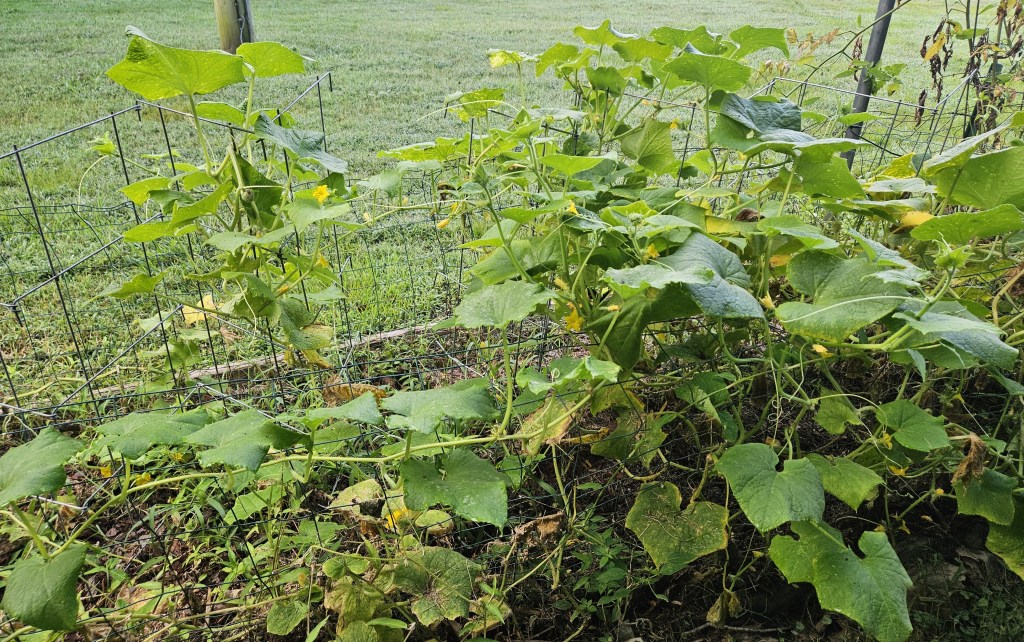
My cucumber plants, however, are still growing, still sprouting flowers, still bearing fruit.

Usually they too are brown, sagging, and lifeless by mid-August. But not this year. Although I can’t know for sure, I think the difference is that this year my creek has flooded – twice in the past six weeks.

Sudden downpours of heavy rain have overrun my little creek’s capacity and sent it across the yard dousing my cucumber plants in fresh water and leaving behind new dirt and nutrients. Far enough away for the current, the flood water in my yard accumulates but flows gently. As much as six inches of water may have flowed across my plants, but they were able to withstand its push.

And now they are bearing flowers, thriving in the warmth, revitalized by the water the storms brought.

Perhaps there is a lesson here.

Flooding can be devastating. We’ve been reminded of that brutally this year. We are reminded of that dramatically every few years. We were all stunned by the photos of farm houses floating down the Missouri and Mississippi rivers in 1993. Nashville saw catastrophic flooding in 2010. More people die from flooding than any other weather-related cause except heat. Flooding is a serious issue; one we should not take lightly.

But not all flooding brings devastation and death. Most floods are less dramatic. Often, we have warnings that heavy rain is coming. We can usually mitigate the damage, get ourselves and our loved ones to safe places, prepare for the storm.

Everyone who hears these words of mine and acts on them will be like the wise man who built his house on rock. The rain fell, the floods came. And the winds blew and beat on that house, but it did not fall, because it had been founded on rock. Matthew 7:24-25.

My landscape timbers are tied to the garden fence to keep them from floating away. Everything electrical in my garage is elevated above the “normal” flood line. Even my recycling is elevated, which would not be hurt, but it is a mess to clean up if water tips the cans over. And the water has gotten in my garage twice in the past six weeks.

Of course, flooding like what happened in Texas this summer, in North Carolina, what happened in 2010, and what happened in 1993 is beyond what anyone could prepare for. But they are not beyond what we can recover from. The Midwest has recovered. Nashville has recovered. North Carolina is recovering. Texas will recover.

My cucumbers recovered quickly. Thrived even. Healthier after the storm than before it. I find hope in this. When the storms come, and they will come, when the water rises, and it will rise, we can withstand, survive, recover, perhaps even thrive. It may be hard to believe when all you see is devastation. It may even feel insensitive to hope in the face of loss and destruction. But that is when we need hope the most, when we can’t see the reason for it.

Now faith is the assurance of things hoped for, the conviction of things not seen. Hebrews 11:1.

I don’t know what storm you are facing, or what floodwater threatens you today. God knows. He and His Spirit can help you prepare for the onslaught. He can help you withstand, survive, and recover. Perhaps He can even cause you to thrive in the aftermath.

Build on the rock and stand firm.

Love in Christ, Betsy

Rethinking No-Till

Weeds are taking over my garden. Sigh. For years I, well, someone (for years that someone was my husband), tilled the garden ground every year to prepare it for seeds and plants. For the past two years I have been trying the no-till method. Just cover the ground with cardboard to suppress the weeds. No arduous tilling required.

Guess what? It doesn’t work.

I had hoped that I could find one action that would keep the weeds from invading my garden. But tilling doesn’t prevent weeds from returning and covering them with cardboard doesn’t prevent them from surfacing. Weeds are only kept at bay by constant, consistent, and diligent weeding. Sigh.

The daily attention to keeping undesirable plants out of my garden is tiresome. The temptation to just let a few remain is strong. The problem is, soon the few become many and spread throughout the garden. Soon the weeds are growing among my tomato plants, stealing their water and nutrients.

Hiding the weeds does not make them go away. Even the one-time upheaval of tilling will not keep them at bay forever. These weeds, which are prevalent and pervasive in my yard, want my garden as well. But my garden is set aside for a special purpose, and weeds are not welcome there.

And others are those sown among thorns; these are the ones who hear the word but the cares of the world, and the lure of wealth, and the desire for other things come in and choke the word, and it yields nothing. Mark 4:18-19.

I did not sow my tomatoes among weeds, among thorns, but weeds have entered my garden and are choking my plants. Am I letting the cares of the world choke the effects of the word in me as well?

Weeds are not bad things. They are, by definition, just plants growing where we don’t want them to grow. Cares of the world, the lure of wealth, and the desire for things are not bad. But my relationship with God is more important. And if I want that relationship to bear Godly fruit to share with the world, I need to weed those cares and desires from my life.

Covering them up doesn’t work. Even the one-time mass upheaval of repentance and revival doesn’t work. The weeds will return without constant, consistent, and diligent attention on my part.

Search me, O God, and know my heart; test me and know my thoughts. See if there is any wicked way in me and lead me in the way everlasting. Psalm 139:23-24.

I don’t enjoy this process any more than I enjoy weeding. My ego would like me to believe that I don’t have any wicked ways in me. But who am I kidding? Those weeds are hiding just under the cardboard, seeking a weak spot where they can break through and spread across my life.

Sure, I can let a few remain. That would be the easy thing to do. The problem is, soon the few become many and spread throughout the garden. Soon the weeds are growing among my tomato plants, stealing their water and nutrients. Soon, I will be bearing the weeds of the world, wealth, and other things instead of bearing the fruit of the Holy Spirit.

Just as I water daily, I need to pull weeds daily. Just as I water the Spirit with prayer daily, I need to pull the weeds of worldly concerns daily. Because I am God’s garden, set apart from the yard to bear His fruit.

But you are a chosen race, a royal priesthood, a holy nation, God’s own people, in order that you may proclaim the might acts of him who called you out of darkness into his marvelous light. 1 Peter 2:9.

I don’t want the weeds to choke that out.

Love in Christ, Betsy

Summer Harvest

Tomatoes! It feels like years since I have had a successful tomato garden. Oh, I have picked a few tomatoes and enjoyed them, but it’s been a while since I picked more than I could eat.

My daughter, Kat Bair, writes a blog as part of her job as a ministry consultant. She has written about me not giving up on having a garden just because I have had years of less-than-success with it. I’d never really thought about it that way.

Tomatoes will grow in my yard. I remember years of taking tomatoes with me everywhere I went to pass them along to others. My less-than-success has been due to learning how to do the things my husband used to do, trial and error, new methods, discovering the details that impact success. And the weather, which is beyond any of our control.

This year’s rain has really helped. The squirrels get their water elsewhere. The tomato and cucumber plants have ample water to refresh them on these hot days. Not the steady soaking showers of Spring, but the sudden claps of thunder and downpours brought on by heat and clouds.

If my soaker hose is analogous to reading the Bible and praying every day, these storms are like inspiration and direction from the Holy Spirit, sudden, unpredictable, powerful, restoring.

And the results are exhilarating. Tomatoes! Large Better Boys, Romas and Cherries, smaller Early Girls. Plenty for me and plenty to share!

The point is this: the one who sows sparingly will also reap sparingly, and the one who sows bountifully will also reap bountifully. 2 Corinthians 9:6.

It would have been easy to give up gardening over the past years. At times, the only thing that kept me planting and tending and watering was my commitment to you, readers, to write about it.

So, thank you. Your encouragement, your readership, has filled my tomato tray with fruit once more.

You, and of course, God, who sends the rains and the makes the sun to shine and enables the plants to bear flowers and produce tomatoes and cucumbers.

This fruit won’t last. It is here and good for eating for a limited time. I could preserve it somehow, and if food were scarce, I would, but I prefer to share my excess.

I pick out my best tomatoes and cucumbers and bag them up for the people with whom I will share them. A single tomato for those living in retirement homes, more for those at home with children.

I share because that is why God gives us excess – to share with those who need it and don’t have it, whatever “it” may be.

And if we preserve, continue working, continue praying, continue to be open to the soaking of prayer and the sudden storms of the Spirit, God will produce an abundant harvest in each of our lives.

So let us not grow weary in doing what is right, for we will reap at harvest time, if we do not give up. Galatians 6:9.

So here, in the middle of summer, persevere. Rest, rehydrate, and carry on. A harvest awaits.

Love in Christ, Betsy

Summer Love

You may know it’s summer because the kids are out of school or the Fourth of July is mere days away, but I know it is summer when I have my first tomato sandwich.

Few things compare to the call of a red tomato dangling from its plant. It calls to something deep inside us – Take, eat. For the past few years, the squirrels have been taking and eating, sensing that same call. This year, it’s my turn.

I usually prefer my sandwiches on rye bread, probably Germanic genes expressing themselves, but not for a tomato sandwich. Only white bread will do, a soft and unassuming base to highlight the tang and tart and sweet of the tomato.

Later in the summer when the newness of having tomatoes wear off, I will add basil and fresh mozzarella to my sandwich, but I savor the first tomato sandwich without distractions.

I take a bit and let my taste buds absorb every drop of the tomato’s tang and its salty juices. The tender meat of the tomato fills my mouth and makes my eyes light up. Wow. That is good!

I have been looking forward to this sandwich since I put that little plant in the ground months ago. This sandwich is why I put that plant in the ground. Why I watered it and weeded it and fenced it and draped bird netting over it. All for this sensation.

My brothers and sister, whenever you face trials of any kind, consider it nothing but joy, because you know that the testing of your faith produces endurance; and let endurance have its full effect, so that you may be mature and complete, lacking in nothing. James 1:2-4.

At the risk of being sacrilegious, my friends, enduring the struggle of establishing a garden, tending it, and protecting it from predators has produced joy, this first tomato sandwich, lacking in nothing.

The garden isn’t a perfect metaphor for my walk of faith, but it’s a good one. Too often I focus on the grind of gardening, the daily attention it requires, the myriads of things that can go wrong, the nagging doubt that I am doing it wrong, the constant comparisons to other gardens.

But God calls us to tend our own garden. He promises it will be worth it. He encourages us to stick with it because the tomato sandwich it will generate is priceless.

In fact, the fruit that God promises to produce is so wonderful that any effort we may exert to encourage its growth will be washed away in the sheer joy of tasting the fruit. Every effort is worthwhile; nothing else compares.

Again, the kingdom of heaven is like a merchant in search of fine pearls; on finding one pearl of great value, he went and sold all that he had and bought it. Mattthew 13:45.

This tomato sandwich will soon be gone, and I will want another. A self at peace, a content and restful spirit, an open and generous heart, the joy of loving another, these fruits are eternal. These fruits only God can produce in us.

This tomato, like all my tomatoes, is a summer love. Wonderful, exciting, fulfilling, and short-lived.

God wants to grow eternal fruit in me, fruit that I can share with a hungry world, fruit that enlivens our senses and delights our souls.

By contrast, the fruit of the Spirit is love, joy, peace, patience, kindness, generosity, faithfulness, gentleness, and self-control. There is no law against such things. Galatians 5:22.

He wants to grow that fruit in you as well. It may take a little effort on your part, a commitment to continue when it feels difficult or pointless. But one day that tomato will ripen and you will get to savor His love, and Wow. That is good!

Love in Christ, Betsy

Enthusiasm

I thought my cucumbers were enthusiastic plants, climbing their supports and stretching outside the fence, but they are mild in comparison to this raspberry plant!

In her second year, my raspberry plant has already birthed three new plants in the cracks in the cardboard covering. She is almost six feet tall. I sense I need to cut her back, hem her in, trim off the excess.

I have seen articles and studies on pruning, but I skim right past them. Tomato plants and cucumbers don’t require pruning. Although it’s possible they could be better if I did prune them…

Pruning is an important part of growing perennial plants, but I am new to perennials and have much to learn. Seeing this raspberry bush take over my garden and reach into the yard makes me want to learn. This can’t be best for the plant, best for the berry harvest, or best for me.

And yet, her growth is thrilling. Her enthusiasm for growth is contagious. I want to grow with enthusiasm and burst out all over the place!

My mother used to tamp down my enthusiasm on a regular basis, to the point where I felt like a wild pony trapped in a corral. But she understood. She had been a cheerleader in her youth; enthusiasm runs in my genes. Perhaps she was trying to prune me.

He removes every branch in me that bears no fruit. Every branch that bears fruit, he prunes to make it bear more fruit. John 15:2.

I am tempted to use this as my guide for how to prune. I am sure Jesus’ listeners at the time knew how to prune; they were grape and olive growers. They were being asked to apply their gardening knowledge to spiritual growth. Perhaps that is what the Holy Spirit would like me to do – learn how to prune this raspberry bush, when and how and to what extent, and apply that knowledge to my spiritual life.

Perhaps the goal should not be excessive growth that spreads out everywhere, but a contained healthy plant that produces much fruit. My smaller tomato plants are covered in green tomatoes, while this huge raspberry produces few berries.

And her uncontained growth is casting a shadow on my fig tree, growing straight and true beside her.

Do nothing from selfish ambition or conceit, but in humility regard others as better than yourselves. Let each of you look not to your own interests, but to the interests of others. Philippians 2:3-4.

There’s a chance I, like my raspberry plant, have focused on the wrong thing – expansion verses fruit. There’s the possibility that my naturally enthusiastic self has spread beyond my boundaries and overshadowed another.

The raspberry bush cannot prune herself. It’s as if her enthusiastic nature can’t be contained. And I don’t want to stifle her; I just want her focused more on fruit than expansion. And that will allow my fig tree to flourish as well.

As for pruning my own enthusiasm, Jesus promises that the Holy Spirit will do this if we let him. He will prune us so that we will bear more fruit.

So, I will learn what I need to know about pruning and try to redirect my raspberry plant’s focus. Find the best way to encourage productive growth. Cut out the excess that her enthusiasm has rendered. I need to let the Holy Spirit do the same with me.

When the Spirit of truth comes, he will guide you into all the truth; for he will not speak on his own, but will speak whatever he hears, and he will declare to you the things that are to come. John 16:13.

The first thing I need to do is learn. The main thing I need to do is listen. The Master Gardener, the creator of all gardens, the creator of all life, knows what I need to do.

Love in Christ, Betsy

First Tomatoes

I went out of town for a week and came home to red tomatoes! What a joy to see them there, peeking out from the green leaves. The squirrels didn’t steal them, the birds didn’t peck them, too much water didn’t split their sides. Ripe tomatoes!

The normal garden routine is to walk along the garden and watch the green tomatoes get bigger and bigger, then lighter and lighter, then see hints of pink and tints of orange arise. I put up the bird netting and seal off entry points for the squirrels and pray the tomatoes ripen before they are destroyed.

But sometimes the garden surprises me.

My little prodigy tomato plant brought me beautiful red cherry tomatoes while I wasn’t even looking.

Isn’t God amazing!

Should I be surprised they appeared the week of Pentecost, when God reminds us that He is the giver of gifts, the giver of power, and the source of all growth? God produced fruit on my tomato plant just as His Spirit produces fruit in our lives. Sometimes we work and struggle to help the fruit grow, and sometimes it suddenly appears like flames of fire or red tomatoes.

But there’s another reason these little tomatoes fill me with joy. For the past few years, my tomato plants have struggled. They may yet struggle this year, but these little red jewels fill me with hope and encouragement. Perhaps the effort I extend may actually result in the desired end – ripe tomatoes.

They are days when I love gardening for the activity itself – scooping up dirt in my hand and inhaling the soil’s scent. I sense a connection with the earth, the minerals in the dirt that are essential for life, the energy and life the soil brings. I sense the awakening of a long dormant part of my brain left by ancient ancestors who relied on the earth for daily survival.

Few things can compare to the scent of the basil and garlic plants, or the tart tang of tomato plant leaves. Sometimes just the joy of being outside makes gardening worthwhile. The bunnies and birds, the honeysuckle and fireflies, the tinkle of the creek and the swaying tree branches remind me of how good God is to us.

But I don’t garden for these sensations. I garden for the fruit. I want sugar snaps, cucumbers, peppers, and especially, I want tomatoes.

After walking in the creek for a while, I led my grandkids to the garden, and we picked those little red tomatoes. Two for each of them, which they ate walking beside the garden.

What a perfect gift.

Sometimes, I get tired of gardening and the effort it takes. Sometimes, the lack of visible results is discouraging. The same is true in my walk of faith. Sometimes, I get tired of extending the effort and discouraged by my lack of progress. Will reading my Bible today really make any difference? Do I really need to go to church today? I know I committed to this group, but they won’t miss me if I skip.

But then, God surprises me with a gift. Some word leaps off the page and I sense God speaking to my heart. I sit beside an old friend in the pew and reconnect. A woman in the group provides just the piece of information I need to finish my project. Ripe tomatoes on the vine.

His divine power has given us everything needed for life and godliness, through the knowledge of him who called us by his own glory and goodness. 2 Peter 1:3.

Put in the work. The tomatoes are worth it!

Love in Christ, Betsy

First Fruits

I have sugar snaps! Small green pods emerged from the white blossoms. The pods grew long and fat in the cool, wet weather until finally they are ready for harvest. What a gift!

I walk along the vines, shorter than I would like them to be, and pinch off the larger peas. The peas hide behind the leaves and blend in with the stalks, hiding themselves from my eager hands. These are the first fruits of the sugar snaps, the first fruits of my garden.

I take a bite, sweet and crunchy, and another as I savor the freshness of the peas, and the moisture from the morning dew. I eat a few more before I remember I need to take a picture of my harvest!

That a delicious fruit would emerge from the seed I planted is February is a small miracle, a common one, but miraculous all the same. The plant grew, reached out, drew itself higher. It took nutrients and water from the ground and used the sun’s warmth to transform these elements into a living, growing thing. Flowers appeared from nowhere and produced fruit. Somehow, the knowledge, ability, and desire to do these things was contained in miniscule DNA of the seed I planted. And people say there is no God!

Ask the plants of the earth and they will teach you; and the fish of the sea will declare to you. Who among you does not know that the hand of the Lord has done this? Job 12:8-9.

This has been a chaotic spring for me. I dedicated myself to polishing my first novel, attending writers’ conferences, and submitting my work for review and critique. I have not given my garden the attention it has received in the past, but God has rewarded the effort I did extend to it by producing these incredible peas.

He has rewarded my efforts in other ways as well – speaking engagements, continued book sales, a growing readership, and recognition from the Association of Christian Fiction Writers. It’s been a busy and productive spring for me, and this harvest is the perfect transition to the coming summer.

The temptation is to think that my dedication and my efforts made any of this happen. But I did not make the seed grow. I merely planted the seed and tended the garden. I set aside my desires to binge-watch mindless television and allowed God to produce fruit in my life. And what joy and affirmation that fruit brings!

Will I let Him grow gentleness in me? Patience? He has produced joy when I thought I would never feel it again. He is producing self-discipline, a fruit I never thought I would bear. Did He plant miniscule DNA in me that contained the knowledge, ability, and desire to bear these fruits? Are the in the DNA of the Holy Spirit which He sent to live in me?

And I will ask the Father, and he will give you another Advocate to be with you forever. This is the Spirit of truth, whom the world cannot receive, because it neither sees him nor knows him. You know him, because he abides with you, and he will be in you. John 14:16-17.

The appearance of fruit continues to amaze me. Whether it’s a sugar snap or the word not spoken, God blesses me with fruit. Sometimes, I feel the fruit will never arrive, but it always appears at the perfect time. As if God knows, because He does.

Whether you are waiting to blossom, watching your fruit grow, or enjoying a bountiful harvest, know that God wants to produce delicious fruit through you – fruit that will refresh and nourish the world.

Love in Christ, Betsy

Holy Week

Holy Week finds me mired in mundane tasks. We are about to celebrate God’s greatest act since creation, and I am wondering what I will wear.

Perhaps I should be focusing on what Jesus endured on our, on my, behalf. His willingness to endure such brutality so that I would not have to, so that I would not be marked for destruction because of my sins.

Perhaps I should be immersed in His humanity, his willingness and ability to walk among us as a human, to learn our language, feel our grief, and struggle beside us. His frustration with those who closed their ears and found fault was evident. Am I the pharisee in the story? Confident that I know how God will manifest Himself, quick to criticize anything new or uncomfortable?

Perhaps I should be rejoicing in His miraculous saving power, His coming resurrection, the gift of His Spirit. He is making me a new creation (2 Cor. 5:17). He has given me the ability to become a child of God (John 1:12), an heir to His kingdom (Romans 8:16).

Shouldn’t I be weeping at the foot of the cross or rejoicing at the empty tomb?

My raspberry has returned for her second year. This is my first perennial, possible only because I am no longer tilling my garden every spring. I was worried it might not survive the winter, but it is bright and green and sending new plants up in the cracks of the cardboard.

Soon it will be time to plant the summer garden. Perhaps this weekend if I get the plants bought and the weather cooperates.

Easter is late this year, and it has compressed too many activities into the following week. The lake beckons, writing deadlines loom, travel preparations need attention. Holy Week finds me mired in mundane tasks.

But are these mundane tasks? Lunches with friends, a chance to connect and support and love each other? Tending to the garden, growing food, interacting with nature? Appreciating the beauty in the world, the lakes, the creeks, the flowers, and the trees, is this not a form of worship of the One who created it all?

And in addition, I have the privilege of sharing with you the joy that my raspberry bush is alive. She survived the winter. She is growing and cheerful. Perhaps she will bear fruit this year, although I have been told to wait until the third year.

Perhaps it is in the mundane tasks of life that we are to see and remember God. Yes, there are the moments of extreme passion and tremendous theological impact like what we celebrate this week. Four days that really did change the world. But most of our time is ‘ordinary time.’ Time spent with family or friends, at the lake, in the yard, or at the kitchen sink.

Perhaps these are exactly the times when I am called to display Christ’s presence in my life. Am I willing to suffer a little to ease someone else’s burden? Am I willing to share the daily struggles of those around me? Am I open to God acting in unpredictable ways? Am I becoming a new creation through the power of God’s Spirit?

Am I, like my raspberry bush, bursting with new life and sending sprouts into bare spaces? If so, why am I wondering what I will wear?

And why do you worry about clothing? Consider the lilies of the field, how they grow; they neither toil nor spin, yet I tell you that Solomon in all his glory was not clothed like one of these. Matthew 6:28-29.

I pray you have a blessed Holy Week, dear friends. I pray you acknowledge God in all the mundane tasks of life. I pray you have moments of weeping and moments of rejoicing and moments of quiet reflection. And don’t worry about what you wear; God sees your heart.

Love in Christ, Betsy